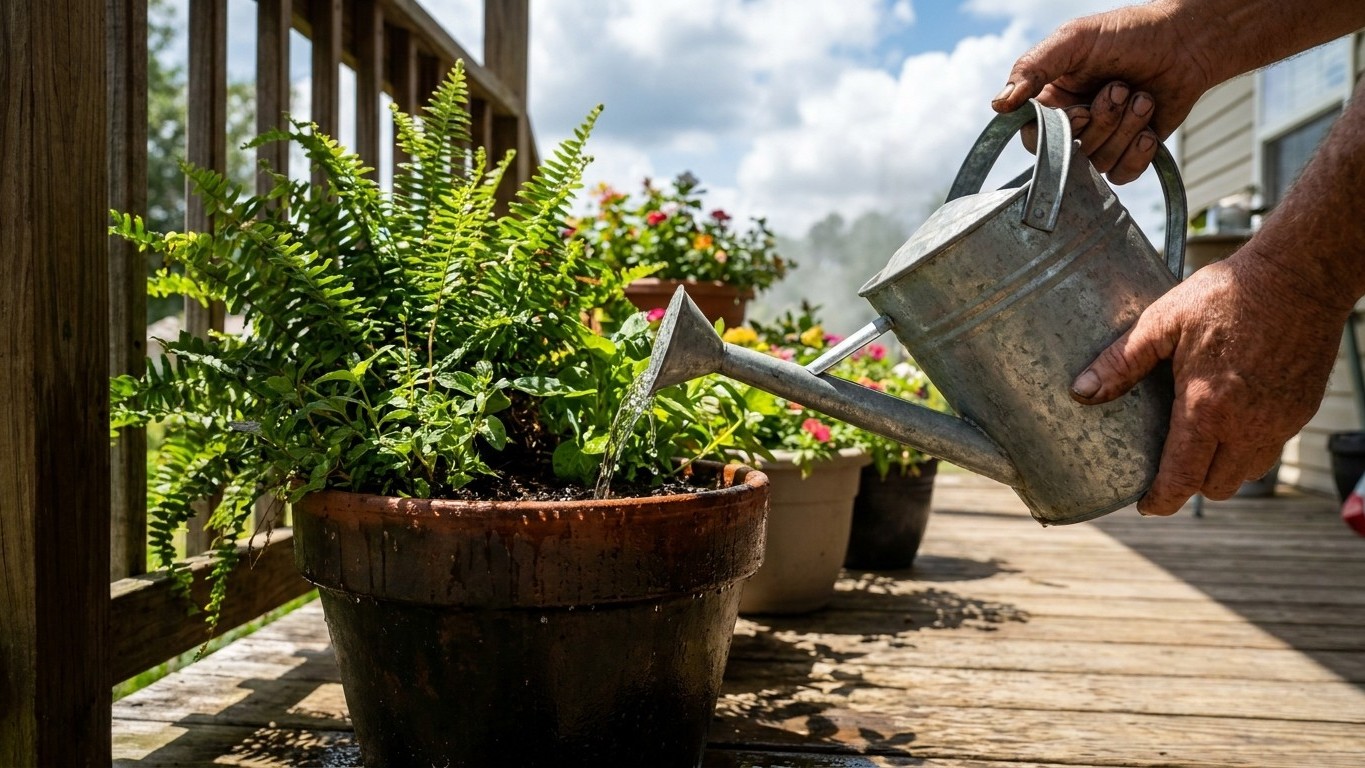

Container gardens in Louisiana live and die by two things: how hot it gets and how the water that falls from the sky actually behaves once it hits a pot instead of open ground. Get the rhythm wrong here and a plant can wilt within a single afternoon or rot within a week. Here’s what the local numbers mean for watering cans and hoses.
What changes here

July, the driest summer month on record for this reference station, still averages 6.79 inches of rain. At the same time, the region logs 70.7 days a year at or above 90F. Put those two together and the takeaway for anyone watering pots is this: the sky delivers plenty of water in raw volume, but the heat burns through it fast, and a container never gets to keep what a garden bed would.
Do the arithmetic on July alone. Spread across roughly 4.4 weeks, 6.79 inches works out to about 1.5 inches of rain a week, comfortably above the old rule of thumb that a bed wants an inch a week. On paper, that sounds like Louisiana’s driest month should barely require a watering can at all. But that number describes rainfall over open ground measured in a rain gauge, not what lands in a 12-inch pot of potting mix sitting on a sunny porch.
Containers don’t behave like garden soil, and this is where the sand-versus-clay logic that applies to in-ground beds doesn’t carry over cleanly. Potting mix is built to drain fast, closer to sand than to clay no matter what’s in the ground underneath it. A hard summer thunderstorm can dump half an inch in twenty minutes, and most of it will run straight out the drainage holes before the roots ever see it. Meanwhile, with 70.7 days a year pushing past 90F, the same small volume of mix that would hold moisture for days in cooler weather can dry out in one afternoon of direct sun. The rainfall total looks generous. The reality in a pot is that July’s heat cancels out a good chunk of July’s rain before it does the plant any good.
How to water when it matters
The goal with any container is to get water deep into the root ball rather than wetting just the surface, and to do it at a time of day when the plant can actually use it. Morning watering lets the plant take up moisture before the day’s heat pushes evaporation into high gear, and it gives any water that splashes onto leaves time to dry before nightfall. That matters more in Louisiana than in a dry climate, because the humidity here already gives fungal disease a head start.
Checking the mix before watering beats watering on a schedule. Push a finger up to the second knuckle near the edge of the pot. If it comes out dry, the plant needs water. If it’s still damp, wait. A trowel works the same way for larger planters where a finger won’t reach root depth.
Because potting mix drains fast regardless of what’s happening in the ground beneath the deck or patio, container watering in Louisiana leans toward more frequent, thorough soakings rather than the deep-and-rare approach that works for an in-ground bed on clay. A raised bed on heavy clay can go a week between waterings and still have moisture at the roots. A pot in full sun during a stretch of 90-plus-degree days often can’t.
- Check the mix by pressing a finger in near the pot’s edge; if it’s dry to the second knuckle, water now.
- Water at the base of the plant, directly onto the mix, not over the foliage.
- Water in the early morning, before the day’s heat and sun peak.
- Keep pouring until water runs freely from the drainage holes, then stop.
- As a starting point, check full-sun containers daily on stretches of 90F-plus weather, and back that off if the mix is still damp; every pot size and mix drains at its own rate.
What goes wrong
A little water every day keeps the plant happy
Light, frequent splashes wet only the top inch of mix, so roots stay shallow, close to the pot’s hot outer wall instead of reaching down toward cooler, steadier moisture. On a day that hits 90F or above, and Louisiana logs 70.7 of those a year, that shallow root mass bakes fast and the plant shows stress by afternoon. This is the mistake that costs the most here, precisely because the heat load is so high.
I water the leaves after work
Evening watering onto foliage leaves leaves wet all night, and Louisiana’s humidity already gives fungal spores everything they need to spread. Water the base of the plant instead, and do it early enough that any accidental splash on the leaves has hours of daylight to dry.
The rain already took care of it
A pot’s small surface catches far less of a passing shower than the eye suggests, and a hard summer downpour often runs off a full container before it soaks in. This is the opposite failure from the one above: assuming a wet season means no watering at all, when in fact a pot without good drainage can sit waterlogged after a heavy stretch of Louisiana’s summer rain and start rotting roots within days. Check the mix with a finger before deciding either way.
No mulch on top
Leaving the surface of the mix bare hands the sun back everything a watering can just delivered. A one-inch layer of mulch, bark, or even gravel on top of the mix slows evaporation and buys the roots extra hours between waterings, especially during Louisiana’s longest hot stretches.
Local help
The LSU AgCenter offers Louisiana-specific guidance on container gardening, soil, and seasonal planting calendars. Watering restrictions can appear during dry spells and vary by parish and by water provider, so check current rules directly with the local utility before setting an automatic watering schedule.
Common questions
How often should I water container plants in Louisiana during summer?
Check daily during stretches of 90F-plus heat and water whenever the mix is dry two knuckles down; back off if a recent rain has left it damp.
Does Louisiana’s rainfall mean I can skip watering pots?
No. Even in July, the driest summer month, at 6.79 inches of rain, most of what falls during a heavy shower runs off a container’s small surface rather than soaking into the mix.
What’s the biggest watering mistake for containers in Louisiana?
Light daily sprinkling that never reaches the root ball, leaving roots shallow and exposed on the region’s 70.7 annual days of 90F-plus heat.
Can a container get too much water here?
Yes, especially during heavy summer rain if the pot lacks good drainage; standing water around the roots leads to rot even in a state known for heat and sun.