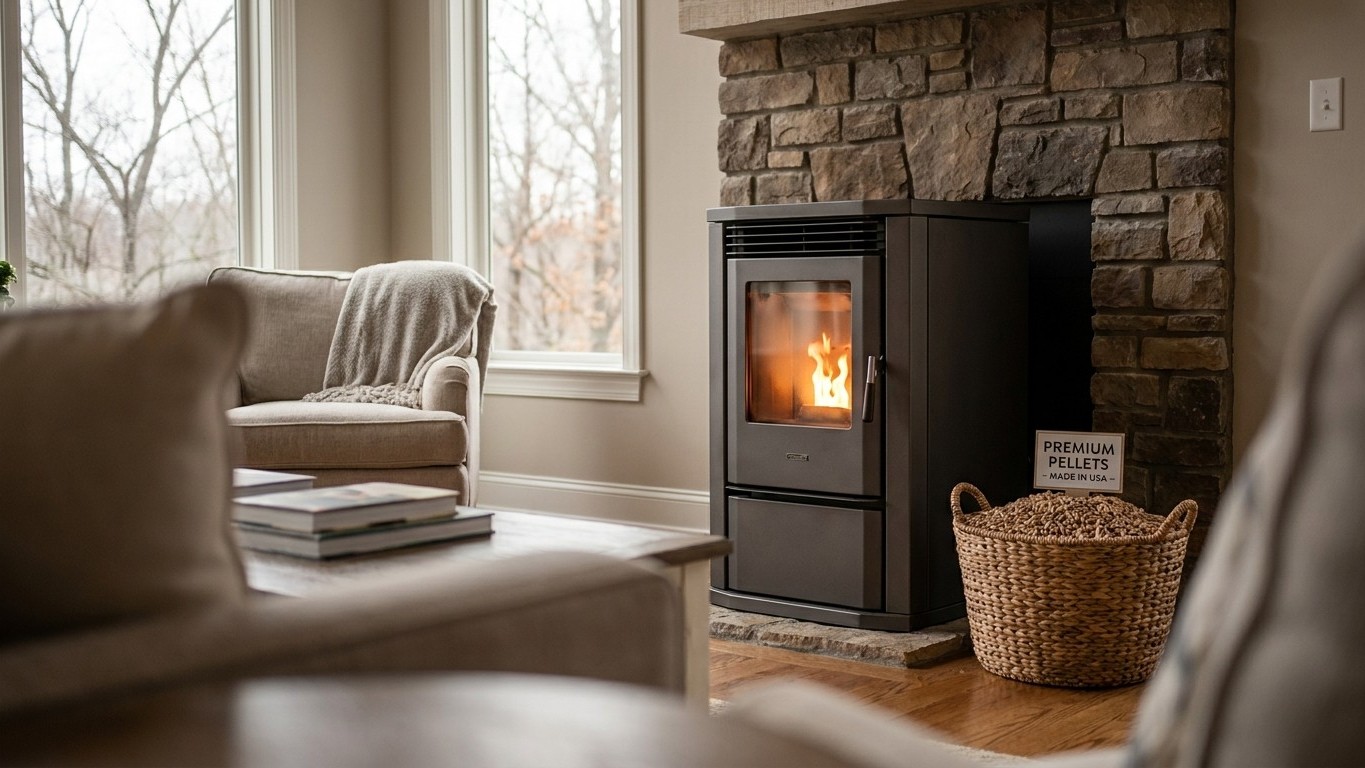

A Missouri winter asks a lot of a pellet stove: about 5,071 heating degree days a year at the Kansas City reference station, spread across roughly eight months of demand. That’s enough cold, for long enough, that most households here treat the stove as a real heat source rather than a mood accessory. What that means in tons, in storage headaches, and in what happens when the power drops is where the numbers actually matter.
How hard the winter works here

Kansas City Intl AP racks up about 5,071 heating degree days a year, base 65 F, according to NOAA’s 1991-2020 Climate Normals. That figure is the whole story in one number: it’s the sum, for every day of the year, of how far the average temperature fell below 65 F. Double the degree days, roughly double the fuel burned to keep a given house comfortable. At just over 5,000, Kansas City sits in a mid-to-upper range nationally, well past the point where a pellet stove can be called decorative. This is a load a stove has to carry, not just brighten.
Depth and length are two different questions
Degree days measure depth. The calendar measures length, and Missouri’s heating season runs long. Heating demand starts in October, the first month whose normal mean temperature (56.4 F) drops under the 65 F threshold NOAA uses to define a heating degree day. It climbs through the fall, peaks hard in January at 1,117 degree days for that month alone, and doesn’t fully let go until June, when the mean finally climbs back above 65 F. That’s about eight months where the stove could reasonably be lit. A furnace or a stove doesn’t just fight a few brutal weeks here; it works a long shoulder season on either side of a genuinely cold core.
That combination, a hard peak plus a long tail, is worth sitting with. A place with the same annual total but concentrated into four punishing months would need a different sizing strategy than one where the load is spread across eight. Missouri leans toward the second pattern: not the coldest winter on the map, but one that lingers.
One station doesn’t speak for the whole state
Every number above comes from a single weather station, Kansas City Intl AP. Missouri stretches from the Iowa line to the Arkansas bootheel, and a household in the northern counties or up in the hillier parts of the state should expect a colder, longer season than this figure suggests. Someone farther south, closer to the Bootheel’s milder winters, should expect less. Treat 5,071 as the reference point for the Kansas City area specifically, and check a station closer to home before betting a season’s wood budget on it.
How many tons a winter takes here
Nobody can hand you a tons-per-winter number that fits your house, and any source that claims to publish one for “Missouri” is guessing. What you can do is work the math yourself, because the units are fixed and simple. A standard bag of pellets weighs 40 pounds. Fifty bags make a ton. From there, consumption tracks the heat your house actually needs to lose to the outside, which is exactly what those heating degree days above are measuring. More degree days moving through your walls means more bags feeding the hopper to replace that lost heat.
What changes the number from house to house, sometimes by a factor of two even on the same street, comes down to three things:
- How well the house holds heat — insulation, air sealing, window quality, and even how open the floor plan is around the stove.
- Whether the stove is the only heat source or a supplement — a stove backing up a furnace burns far fewer bags than one carrying the whole load through a Missouri January.
- The setting it runs at — most stoves have a range of burn settings, and running one notch higher for comfort adds up over eight months, not eight days.
The only estimate worth trusting is the one you measure
Given that spread, the honest approach isn’t a formula. It’s counting the bags you actually burn through your first winter and using that as your baseline going forward. Track bags by month if you can; with October and January both carrying real degree-day loads here, you’ll likely see the difference between shoulder-season burning and the January peak show up directly in your count. One measured season on your own thermostat beats any published estimate, because it’s the only number that already includes your house, your insulation, and your habits. For the broader mechanics of the bag-to-ton math and typical ranges nationally, the national guide on how many pellets a winter takes walks through it in more detail.
Buying and storing them in this climate
Timing purchases around Missouri’s own calendar matters more than chasing a sale price. Heating demand here starts climbing in October, so the window to buy ahead is late summer, before that ramp-up begins. Wait until the first hard cold snap and you’re competing with everyone else who waited too, right as retailers see the same regional pull on stock. Pellets are also typically cheapest in the off-season, when demand is lowest and suppliers are moving inventory before the next delivery cycle. Buying in July or August, rather than November, tends to be both easier and cheaper.
What Missouri’s air does to a bag of sawdust
Pellets are compressed sawdust held together by nothing but pressure and their own natural lignin, no glue involved. That makes them efficient to burn and vulnerable to moisture. Missouri summers run humid, and a garage or shed that isn’t well sealed can trap enough ambient moisture to swell and crumble pellets sitting in bags on a concrete floor, especially if that floor sweats during a muggy stretch. Winters bring their own version of the problem: a covered but unheated porch or barn can still see condensation cycles as temperatures swing above and below freezing.
The practical fix is keeping bags off bare concrete (a pallet or shelving works), under a roof, and away from anything that traps humidity against the plastic. When comparing sources, compare price per ton rather than per bag or per pallet, since that’s the only unit that lines up cleanly across sellers. For the full rundown on stacking, humidity control, and how to tell degraded pellets from good ones, the national storage and quality guide covers it without needing to repeat it here.
What a winter outage means here
A wood stove burns with nothing but a match and a draft. A pellet stove needs electricity to run the auger that feeds pellets into the fire and the fan that moves heat into the room. Cut the power, and the stove goes cold no matter how full the hopper is. That single fact separates pellet heat from wood heat in a way that matters more as the climate gets colder, and Missouri’s 5,071 heating degree days put it firmly in the range where that distinction has teeth.
The stakes shift with the season
An outage in October or April, at the edges of the heating season, is an inconvenience: a cold evening, maybe a blanket and a backup space heater. An outage in January, when the degree-day load is at its yearly peak (1,117 for that month alone), is a different problem entirely, especially for a household leaning on the stove as a primary heat source rather than a supplement.
What most Missouri homes fall back on during a stove outage lines up with how the state actually heats. Per EIA’s Residential Energy Consumption Survey, 76% of Missouri households use a furnace as their main heating equipment, and natural gas serves as the fuel behind 59% of homes, with electricity powering another 31%. A central heat pump covers about 10% of households. Propane shows up in about 7% of homes, while the survey doesn’t publish a reliable figure for boiler heating or for fuel oil and kerosene in the state, meaning too few households reported those to generate a solid estimate, not that nobody uses them.
| Heating equipment or fuel | Share of Missouri households |
|---|---|
| Furnace (main equipment) | 76% |
| Natural gas (main fuel) | 59% |
| Electricity (main fuel) | 31% |
| Central heat pump (main equipment) | 10% |
| Propane (main fuel) | 7% |
| Steam or hot-water boiler | not reported (estimate suppressed) |
| Fuel oil or kerosene | none reported |
For most Missouri households, that means a furnace running on gas or electricity is doing the primary work, with the pellet stove as a supplement whose outage risk is real but not the whole heating picture. Sizing a generator or a battery backup for the stove itself is a job for the appliance’s own electrical rating, printed on its label, not a guess based on state averages. The national guide on pellet stoves and power outages covers how to plan around that gap.