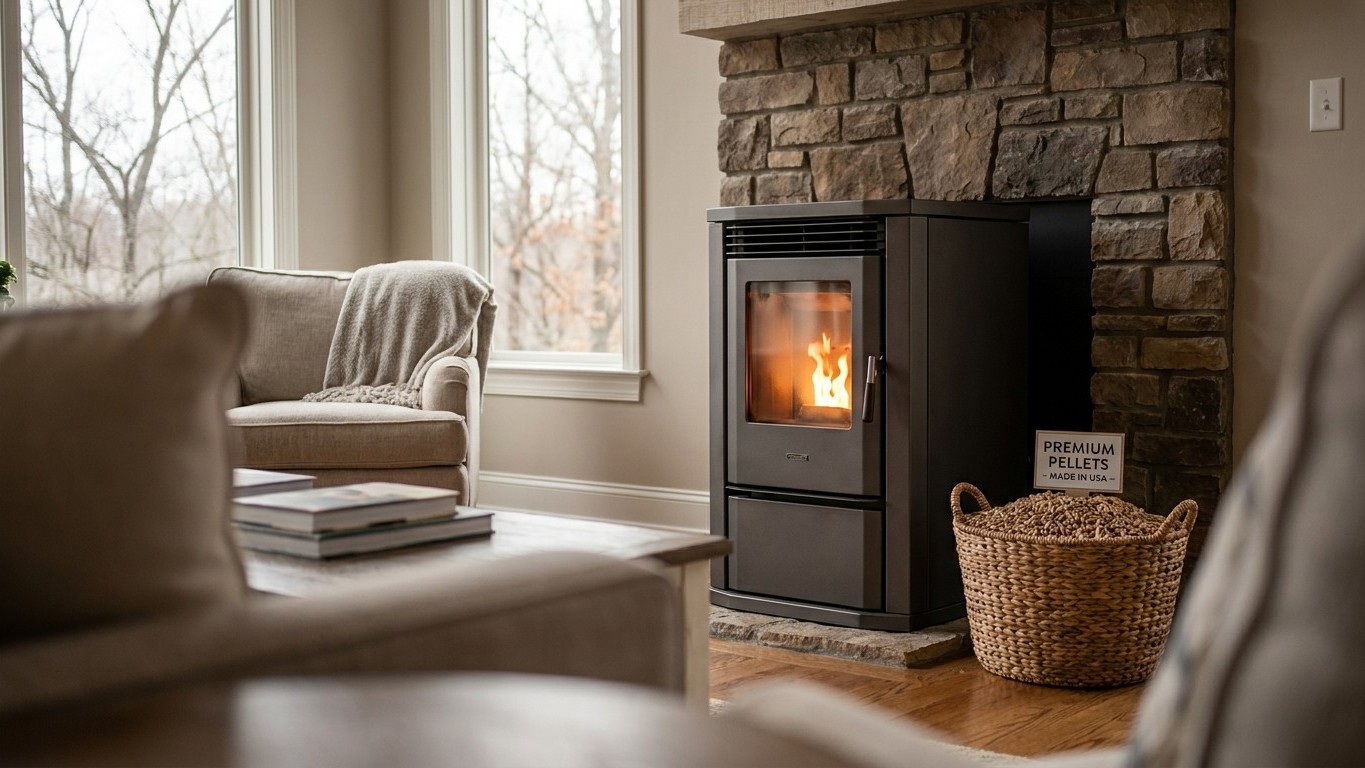

A winter in western Washington runs long before it runs brutal. Around Seattle, heating degree days land near 4,376 a year, a moderate load stretched across nearly ten months of demand. That combination, mild but persistent, shapes everything about running a pellet stove here: how many bags you’ll burn, when to buy them, and what happens the day the power goes out.
How hard the winter works here

Seattle-Tacoma International Airport, the reference station NOAA uses for this region, logs about 4,376 heating degree days a year under the standard 65 F base, plus roughly 265 cooling degree days. That heating number sits close to the national average, not the coldest reading on the map and not the mildest either. It’s the figure that turns climate into fuel: every degree the daily mean falls below 65 F gets added up across the year, so a house here needs roughly the same total heat input as a house in a lot of the Midwest, just delivered more gently and for longer.
That’s the part easy to miss. Depth and length are different measurements, and Seattle’s winter is long rather than deep. The monthly data makes that plain: heating demand starts in September, when the normal mean temperature (62.6 F) first drops below the 65 F threshold, and it doesn’t fully let go until July. December carries the peak load at 711 degree days, but January (687) and February (588) aren’t far behind, and even October (349) and November (555) are already asking for real heat. Ten months of some heating demand is a very different burn pattern than a three-month cold snap followed by a mild spring.
What this means for a stove
A pellet stove in a house near Sea-Tac isn’t decoration. The degree-day total is high enough that it can genuinely offset a meaningful share of a heating bill, especially in a well-sealed house, though it’s rarely the sole heat source in this region (more on that below). The load is spread thin over a long calendar rather than concentrated into a few brutal weeks, which means the stove runs more often at moderate settings than it runs flat-out for short bursts.
One more thing worth saying plainly: this figure comes from one station, at sea level near Puget Sound. A house up in the Cascades foothills, or east of the mountains in a colder interior climate, faces a noticeably different number. If you’re not within easy driving distance of Seattle-Tacoma, treat this as a starting point and check your own county’s climate data before you plan a winter’s worth of fuel.
How many tons a winter takes here
Nobody can hand you a tons-per-winter figure that fits your house, and any territorial page claiming otherwise is guessing. What you can do is work the math yourself, using the same degree-day logic above as the starting point. A standard pellet bag weighs 40 pounds. Fifty bags make a ton. From there, consumption tracks how much heat your house actually needs to lose to the outside air, which is exactly what the degree-day total measures: more degree days, more fuel burned to hold the same indoor temperature, roughly in proportion.
But the proportion isn’t fixed, because three things move it independently of climate:
- How well the house holds heat. A tightly insulated, well-sealed home burns a fraction of what a drafty older one burns under the identical degree-day load.
- Whether the stove is the only heat or a supplement. A stove backing up a furnace runs on a different schedule and a different total than one carrying the whole house through a ten-month season.
- The setting it runs at. A stove left on a low, steady burn to take the edge off a room uses far less fuel over a season than one dialed up to heat an entire floor plan.
Two houses on the same Seattle-area street, built to different standards and run at different settings, can land a full ton apart over a season. That’s why the only number worth trusting is the one you generate yourself. Buy a modest supply to start, track every bag you actually burn from the first cool week in September through the last one in spring, and use that count as your baseline for next year. One measured winter beats every calculator, because it’s the only figure that already accounts for your house, your habits, and your thermostat setting. For the national framework behind this math, including how climate zones typically compare, see our guide on how many pellets a winter takes.
Buying and storing them in this climate
Timing matters here because the heating season starts in September and doesn’t really let go until July. That’s a wide window, and it means demand for pellets builds early and stays elevated for most of the year rather than spiking for a few weeks. Buying ahead of that stretch, ideally before September, avoids the scramble that hits every region when an early cold snap or a hard freeze sends everyone to the same shelves at once. Pellets are also generally cheaper when bought outside the coldest months, since demand (and price) tends to climb once the season is underway.
Storage against a wet climate
Pellets are compressed sawdust held together by nothing but pressure and their own natural lignin, no glue involved. That construction is exactly why moisture is the enemy: a pellet that absorbs damp swells, loses its shape, and crumbles into sawdust again, losing most of its heat value in the process. Western Washington’s winters are wet more than they are humid in the summer sense, but the effect on stored fuel is the same problem in a different form. A garage floor that sweats during a cold snap, a basement with persistent dampness, or bags stacked directly against a concrete slab can all ruin fuel before it ever reaches the hopper.
The practical fix is straightforward: keep bags off the floor, keep them under cover, and don’t buy more than you can store dry through the full ten-month season. When comparing supply options, compare price per ton, the only figure that lets you measure one purchase against another fairly. Our national pages cover the full storage method and the quality markers (ash content, moisture percentage, PFI or ENplus certification) worth checking before you buy; see our guides on pellet storage and pellet quality standards for the details that apply everywhere, not just here.
What a winter outage means here
A pellet stove depends on electricity in a way a wood stove doesn’t. The auger that feeds pellets into the firebox, the fan that pushes combustion air through, and the blower that circulates warm air into the room all run on household power. Cut the power, and the stove stops working within minutes, regardless of how many tons of fuel sit in the hopper.
Given how long Seattle’s heating season runs, an outage lands differently depending on when it hits. In the depth of a December cold snap, with 711 degree days of demand pressing on the house, losing the stove during a power outage is a real problem, especially in a home that leans on it as a primary heat source. In a milder shoulder month like October or April, the same outage is more of an inconvenience, an evening without the stove rather than a heating emergency.
What most households fall back on matters here too. Federal survey data for Washington shows furnaces as the dominant primary heating equipment, used in 47% of homes, with central heat pumps at 9%. On the fuel side, electricity supplies 55% of homes and natural gas 37%, while state-level figures for boilers, fuel oil, and propane weren’t reliable enough to publish separately. That means a lot of Washington homes already lean on electric-powered heating equipment (furnace blowers, heat pumps, or electric resistance) as their main source, which is worth remembering: a power outage in this state doesn’t just knock out the pellet stove, it very often knocks out the primary furnace or heat pump at the same time, since both typically need electricity to run. That’s a meaningfully different situation than a home heated by a gravity-fed oil furnace or a wood-burning system that keeps working without power.
Sizing a generator or a battery backup for your specific stove isn’t something to guess at from a state-level article. Check the wattage rating printed on your stove’s data plate, and compare it against what your backup power source can actually deliver, including the surge load when the auger motor starts. For the full breakdown of backup options and what they realistically cover, see our national guide on pellet stoves during a power outage.