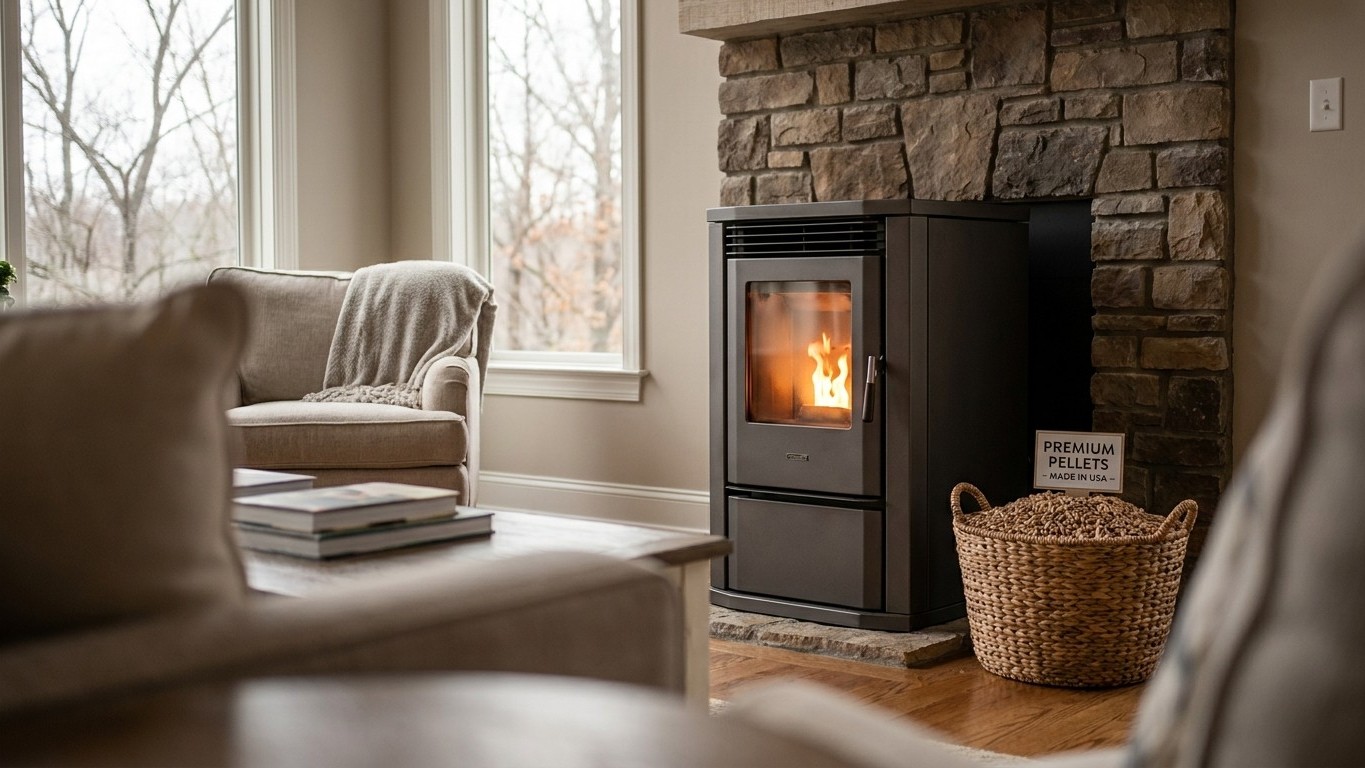

A Maryland winter runs long before it runs brutal: heating demand stretches from October through May, but the real question for a pellet stove is how much wood the house burns to stay warm. Around Baltimore, that works out to roughly 4,484 heating degree days a year, enough to make a stove a genuine heating source in most homes here, not just a fireplace substitute. The tonnage varies by house, but the season itself is knowable.
How hard the winter works here

The number that matters is 4,484 heating degree days a year, measured at Baltimore Washington International Airport under NOAA’s 1991-2020 Climate Normals. That figure counts, for every day of the year, how far the average temperature fell below 65 F, then adds it all up. Twice the degree days means roughly twice the fuel burned to hold a house at the same temperature. At 4,484, Maryland sits in the middle of the pack nationally: colder than the Carolinas, milder than New England, but far from the low-demand territory where a stove is mostly ambiance.
That same station also logs about 1,322 cooling degree days, a reminder that Maryland summers run humid and warm enough to matter for storage later in this guide. But the heating side is the one that decides what a stove needs to do all winter.
Length matters as much as depth. The heating season around Baltimore opens in October, the first month where the normal mean temperature (57.4 F) drops under the 65 F baseline NOAA uses for these counts, and it doesn’t close until June. That’s roughly eight months of some heating demand, even if most of it is light at the edges. The middle of that stretch is where the work happens: January averages 951 degree days on its own, more than double October’s 260 and nearly triple April’s 318. December (820) and February (794) aren’t far behind. A stove sized for January is doing something very different in October or May, and a homeowner watching the hopper burn faster in the dead of winter isn’t imagining it.
One caution worth repeating: this is a single-station figure, tied to Baltimore. Western Maryland, up toward Garrett and Allegany counties, runs measurably colder in winter, while the Eastern Shore and southern counties near the Chesapeake trend a bit milder. Anyone outside the Baltimore-Washington corridor should treat 4,484 as a starting reference, not their own backyard number, and check a station closer to home if one is available.
How many tons a winter takes here
Nobody can hand a Maryland homeowner a tons-per-winter figure and have it mean anything, because no source publishes one by state or county, and two houses on the same street can burn twice as much as each other depending on how they’re built. What can be worked out is the arithmetic behind it. A standard bag of pellets weighs 40 pounds, and fifty of those bags make a ton. From there, consumption tracks the heat the house actually needs to replace, which is exactly what the degree-day figure above measures. A house that needs to fight 951 degree days in January is going to eat through bags at a different pace than the same house in a 260-degree-day October.
Three things move that number more than anything else:
- How well the house holds heat — insulation, air sealing, window quality, and even how many stories the home has all change how much fuel it takes to hold a temperature.
- Whether the stove is the only heat source or a supplement — a stove carrying the whole load through a Baltimore-area January burns far more than one backing up a furnace on the coldest nights only.
- The setting it runs at — a stove left on a low or medium feed rate for comfort burns noticeably less than one pushed to high to actually heat a space.
Given how much those three variables swing the answer, no published number for “a winter in Maryland” would be honest. The one method that actually works is counting bags through a single real season and using that as a personal baseline. Track how many bags go through the hopper from the first cool night in October through the last one in spring, and that number becomes far more useful than any estimate, because it reflects this house, this stove, and this winter’s actual weather. For the general math behind bag-to-ton conversions and how other climates compare, the national guide on how many pellets a winter takes walks through the full calculation.
Buying and storing them in this climate
Timing the purchase matters more than most people think. With heating demand starting in October around Baltimore, the smart window to buy is before that month, while supply is steady and demand hasn’t spiked. Once a cold snap hits anywhere in the region, whether it’s an early frost or a hard January stretch, pellets can sell out fast at local dealers and big-box stores alike, and prices tend to firm up right when demand peaks. Buying in late summer or early fall, when the shelves are full and nobody’s in a hurry, is the closest thing to a guaranteed discount in this business.
Storage is the other half of the equation, and Maryland’s climate makes it a real consideration rather than an afterthought. Pellets are compressed sawdust held together by nothing but pressure and natural lignin, no glue involved, which means moisture is their one real enemy. Maryland summers run humid, especially near the Chesapeake Bay and along the I-95 corridor, and that humidity gets into anything stored in an unsealed garage or an uninsulated shed. Damp pellets swell, then crumble, and crumbled pellets clog auger-fed stoves or simply burn poorly. A garage floor that sweats in July and August, which is common in this region, is not a safe place to stack bags directly on the concrete; a pallet or shelving to keep bags off the slab makes a real difference.
On pricing, there’s no dealer name or price worth repeating here, because it shifts by season and by supplier. The only number worth comparing across options is the price per ton, since bag sizes and bundle deals make per-bag pricing misleading. For the full rundown on stacking, humidity control, and pellet quality grading, the national storage guide and the pellet quality and grading page cover the details that apply everywhere, Maryland included.
What a winter outage means here
A pellet stove is not a wood stove, and the difference shows up the moment the power goes out. Every pellet stove depends on electricity to run the auger that feeds fuel into the burn pot and the fan that moves warm air into the room. Cut the power, and the stove stops working, full stop, no matter how full the hopper is. That’s a meaningful limitation in a state where storms, from summer thunderstorms to the occasional winter ice event, do knock out power in parts of Maryland every year.
How much that matters depends on when it happens. An outage in October, with the season sitting at a mild 260 degree days, is an inconvenience: a cold evening, maybe a blanket and a sweater. An outage during a January cold snap, when the state is running through 951 degree days that month, is a different situation entirely, especially for a household where the stove carries a meaningful share of the heating load.
What most Maryland households actually fall back on tells the story: 64% of homes here report a furnace as their main heating equipment, 49% run on natural gas and 41% on electricity as primary fuels, 19% use a central heat pump, and smaller shares run steam or hot-water boilers (7%) or fuel oil and kerosene (7%), according to the U.S. Energy Information Administration’s 2020 Residential Energy Consumption Survey. Propane wasn’t reported with a reliable estimate for the state, which means the data doesn’t rule it out, it simply couldn’t be measured accurately in the survey. In practice, a furnace running on gas or electricity is the backup most Maryland homes already have, whether the pellet stove is a supplement to it or the other way around.
Sizing a generator or a battery to bridge that gap isn’t something to guess at from a state-level article. That number comes from the stove’s own electrical draw, printed on its appliance label, and from how long a household actually expects to ride out an outage. The national guide on pellet stoves and power outages walks through how to read that label and match it to a backup plan.