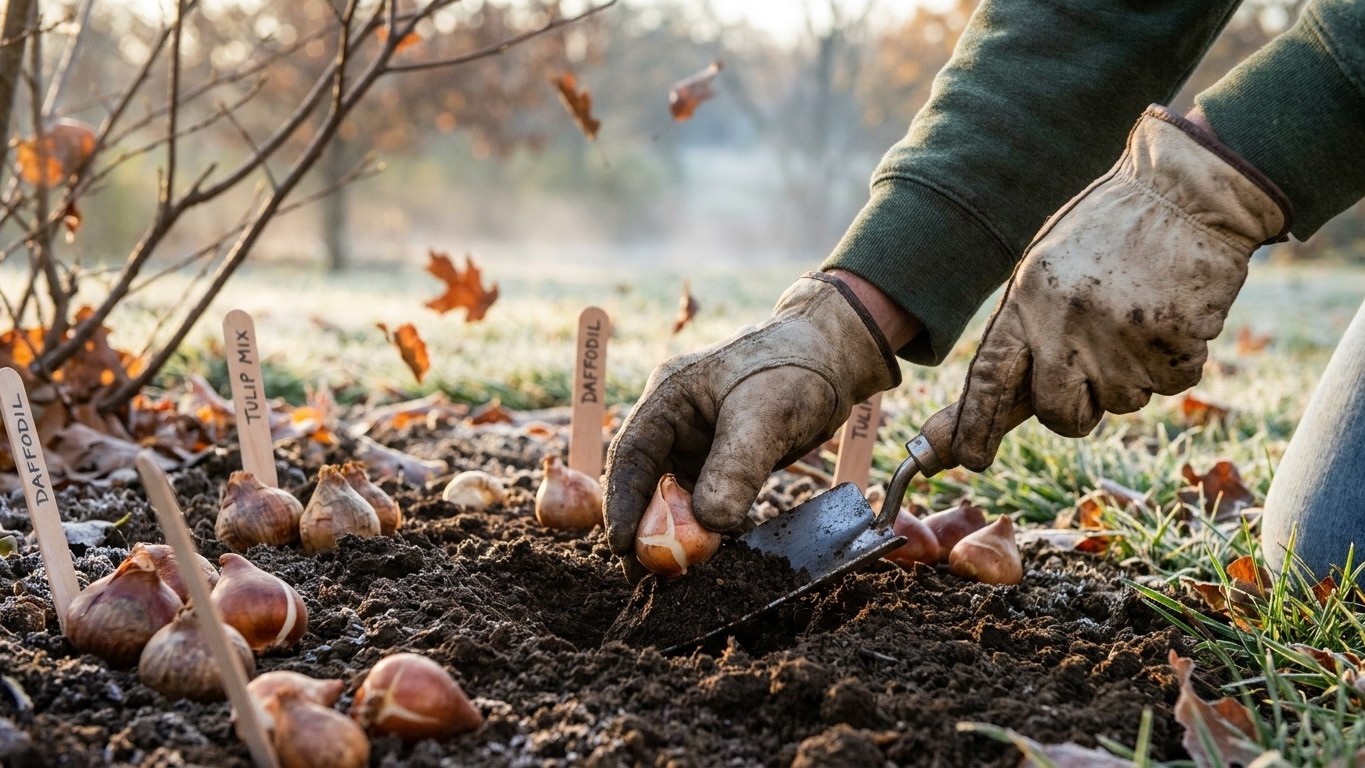

Spring bulbs planted in Missouri need a six-week head start before the ground freezes, and they need a long, genuinely cold winter to bloom at all. The good news: most of the state clears that cold requirement by a wide margin. The bad news: a handful of popular bulbs still fail here, and knowing which ones matters more than knowing when to dig the hole. For gardeners who’d rather sidestep soil issues altogether, Growing Spring Bulbs in Containers in Missouri offers a reliable alternative to in-ground planting.
When to plant bulbs in Missouri

The planting window opens once the soil has cooled from summer but closes before it locks up hard for winter. In practice that means working backward from the average first fall frost, which for the Kansas City reference station runs from October 18 to October 29, according to NOAA’s 1991-2020 Climate Normals. Count back roughly six weeks from that date and you land on the sweet spot for putting bulbs in the ground.
Six weeks is not an arbitrary cushion. It is the minimum time a bulb needs to grow roots into the surrounding soil before that soil turns cold enough to stop root growth. A bulb planted too early, while the ground is still warm from September sun, often pushes green top growth above the surface. That growth has no chance against a hard freeze and dies back, wasting the energy the bulb needed to store for spring.
What happens at the other end
Wait too long and the opposite problem shows up. Bulbs planted into cold, near-frozen soil in December don’t root at all before winter locks in. They sit dormant and unanchored, and come spring they emerge weak, lopsided, or not at all. Missouri’s clay-heavy soils make this worse than sandy ground would, because clay holds moisture that then freezes solid around an unrooted bulb.
One caution worth repeating: that October 18-29 window is an average. By definition, roughly half of all years bring frost earlier than October 18, and half bring it later than October 29. A gardener working off a single date rather than a range is gambling on the wrong half of that split. The safer approach is to treat late September through mid-October as the planting season across most of the state, checking local soil temperature rather than the calendar alone.
Whether your winter is cold enough
This is the question that actually decides whether spring bulbs bloom, and it has nothing to do with planting depth or fertilizer. A spring bulb needs a sustained cold period, typically twelve to fourteen weeks with soil temperatures below about 45°F, to complete the internal chemistry. Gardeners who want to skip the wait for outdoor winter chill altogether, or who simply want blooms ahead of the season, can replicate that same cold requirement indoors; see Forcing Spring Bulbs Indoors in Missouri for how it’s done that turns a bud into a flower. Skip that cold exposure and the bulb still grows leaves the following spring. It just doesn’t flower, or it sends up a bloom on a stem too stunted to notice. This figure matters no matter where you garden, because it’s the yardstick against which every bulb variety gets measured.
Missouri clears that threshold comfortably. The coldest-month mean minimum temperature at the Kansas City reference station is 19.5°F, which sits far below the 45°F chilling line. That gap is not a close call. It means the ground stays cold enough for chilling from roughly mid-November through into March, well past the twelve-to-fourteen-week minimum most spring bulbs require. Southern counties run milder, but even there, winters typically deliver enough sustained cold for the standard bulb list.
What that margin buys the Missouri gardener is simple: no pre-chilling, no refrigerator drawer, no workaround. Bulbs go straight into the ground and the winter does the rest. Compare that to gardeners in USDA zones 8 and warmer, where the ground never gets cold enough on its own, and tulip growers there resort to twelve weeks of refrigeration before planting, kept away from ripening fruit because the ethylene gas fruit releases kills the flower bud forming inside the bulb. Missouri gardeners don’t need that step for the bulbs on the recommended list below.
Cold required versus cold delivered
| Bulb | Weeks of chilling needed (below 45°F) | What Missouri delivers | Verdict |
|---|---|---|---|
| Tulips | 14-16 weeks | ~16-18 weeks, mid-Nov to March | Meets requirement, no pre-chill needed |
| Daffodils | 12-15 weeks | ~16-18 weeks | Comfortable margin |
| Hyacinths | 12-14 weeks | ~16-18 weeks | Comfortable margin |
| Crocus | 8-15 weeks (varies by species) | ~16-18 weeks | Meets requirement across the state |
| Alliums | 8-10 weeks | ~16-18 weeks | Wide margin, easiest of the group |
A gardener offered any bulb not on this list should ask one question first: does it need that much cold, and does this territory supply it? Where the answer is no on either side, the bulb is a one-season display at best.
Which bulbs suit Missouri
Missouri’s hardiness range, 5b to 7b under the USDA system, covers the needs of the standard spring bulb catalog without much argument. These are the bulbs that both survive the winter cold and get the chilling they need to rebloom year after year:
- Daffodils (hardiness zones 3-8)
- Crocus (zones 3-8)
- Hyacinths (zones 4-8)
- Alliums (zones 3-8)
- Snowdrops (zones 3-7)
- Muscari (grape hyacinth, zones 4-8)
- Species and Darwin hybrid tulips (zones 3-7)
Hardiness ranges are not a hard line, though. A daffodil rated to zone 7b can still struggle in an exposed, wind-scoured spot in the coldest reaches of the state, while a marginal bulb often survives longer than its rating suggests when tucked against a south-facing foundation. Local exposure moves the outcome more than the map does.
The disappointments are worth naming plainly, because the gardener who has already lost a bed of them remembers exactly how it went. Standard hybrid tulips, the tall, single-color bedding types sold in mixed bags, often put on a strong show the first spring and then fade fast in Missouri’s clay soils, which hold winter moisture and rot the bulb before the next bloom cycle. Amaryllis, ranunculus, and paperwhites, all rated to zone 8 or warmer, don’t survive outdoors here at all. They freeze solid over winter and simply don’t come back, regardless of how deep they’re planted or how much mulch covers them.
What digs them up here
Squirrels and voles don’t raid bulb beds at random. Chemistry decides which bulbs get eaten and which get ignored. Daffodils and alliums contain compounds that are toxic or simply foul-tasting to rodents, which is why they survive squirrel-heavy yards where other bulbs vanish by December. Tulips and crocus have no such defense. They’re starchy and palatable, which makes them a preferred target the moment the ground softens enough to dig.
- Bulbs squirrels and voles take: tulips, crocus, lilies
- Bulbs they generally leave alone: daffodils, alliums, snowdrops, muscari, hyacinths
The one measure that consistently works is physical, not chemical: lay galvanized wire mesh flat over the planting bed, pin it down, and leave it in place until the ground freezes hard enough that digging isn’t worth the effort for a rodent anymore. Repellent sprays, whether pepper-based or predator-scent, wash off with the first rain and need reapplying constantly to do anything at all. If tulips or crocus are going in a yard with a known squirrel population, the wire mesh step isn’t optional.
Where to check for your own county
Everything above is anchored to the Kansas City reference station, and Missouri stretches across enough latitude and terrain that a single station can’t speak for the whole state. The northern counties near the Iowa line run colder and see frost land earlier than the October 18-29 window suggests, while the Bootheel in the southeast often stays workable weeks longer into fall. A planting date built around the state’s center can be off by close to three weeks at either edge of the map.
The most reliable adjustment for a specific address is the University of Missouri Extension, the state’s land-grant extension service. County extension offices track local frost data and soil conditions and can confirm whether a given fall is running early or late compared to the historical average, which matters more than the average itself when the calendar says it’s time to plant.