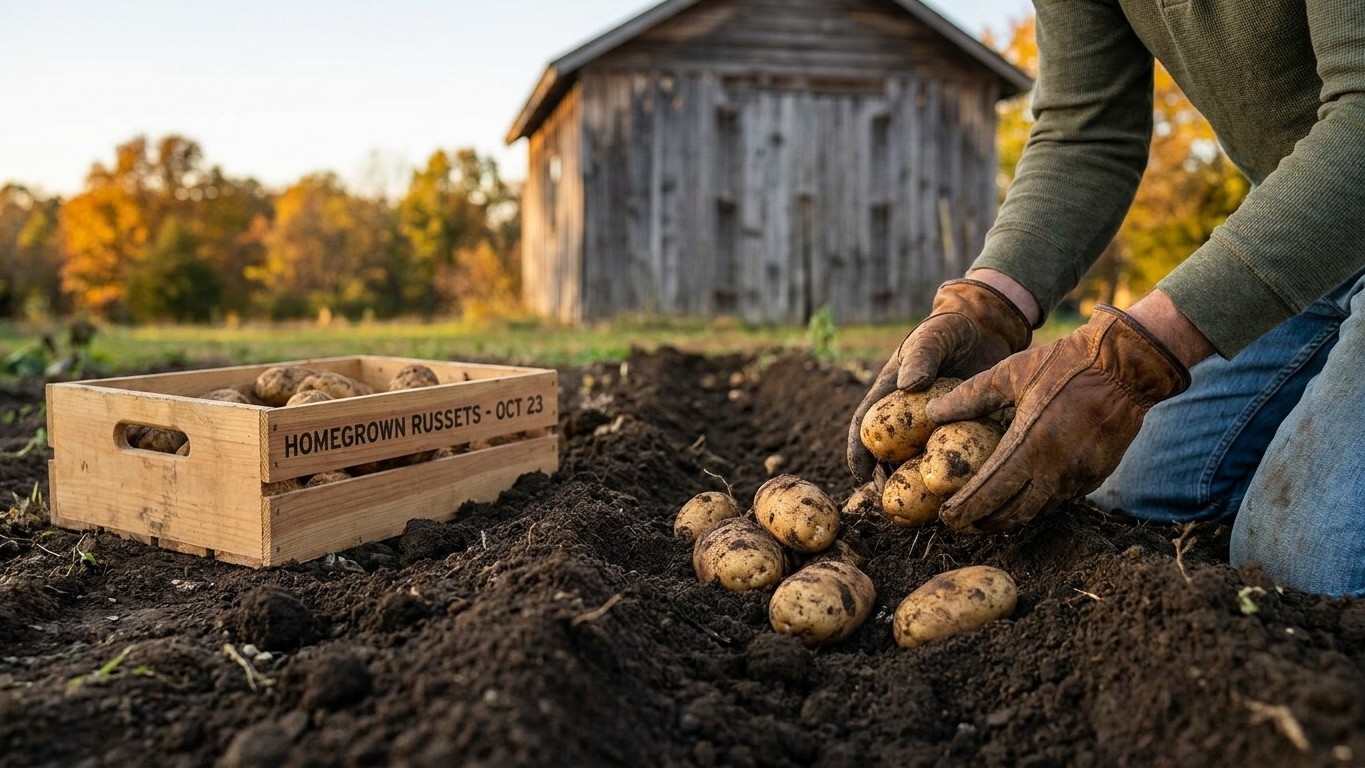

Missouri gardeners dig potatoes in the second half of September through early October, well ahead of the first fall frost window of October 18 to October 29 (NOAA NCEI 1991-2020 Climate Normals). But timing the dig is the easy part. The state’s coldest month carries a mean minimum of just 19.5°F, which means an unheated garage or shed will freeze solid by January, potatoes need a space that never gets anywhere close to that number.
The short answer
Potatoes don’t need frost to finish maturing, and leaving them in the ground once the vines have died back gains nothing. In Missouri, that die-back typically happens well before the first fall freeze arrives, so the harvest window sits comfortably in late September through early-to-mid October, with a buffer of two to three weeks before the October 18 to October 29 freeze date shows up on the calendar. Gardeners working from the Kansas City area should note that the reference station sits well north of downtown, where freezes tend to arrive about five days later in the fall pattern than the greater metro reading suggests, and gardeners in the southern part of the state can expect conditions milder still. None of that changes the basic strategy: get the crop out of the ground before the ground itself turns cold and wet, not because the tubers fear a light frost, but because wet, cooling soil invites rot at the exact moment you’re trying to store a harvest for months.
The number that actually threatens a winter’s worth of potatoes isn’t the frost date at all. It’s the 19.5°F mean minimum of the coldest month. That figure describes an average low, not a record cold snap, which means it happens routinely, not once a decade. Any storage space without insulation or heat, a detached garage, a garden shed, an uninsulated porch, will sit at or below freezing for stretches of the coldest month, and a batch of potatoes doesn’t need a record-breaking arctic blast to freeze. It needs one ordinary cold night in an unprotected space. A dead-simple test applies here: if you wouldn’t leave a gallon of water sitting in that space overnight in January without it icing over, you can’t leave potatoes there either.
So the short answer splits into two separate jobs. Harvest happens on a schedule set by the plant and the calendar, comfortably ahead of the October frost window. Storage happens on a schedule set by the building, and in a state where the coldest month averages under 20°F at night, that almost always means an interior space, a basement, or a supplemental heat source, not a garage left to the weather.
Curing, and where
Before potatoes go into winter storage, they need to cure. Utah State University Extension recommends holding freshly dug potatoes at 55-60°F with high humidity for two to three weeks, a window that toughens the skin and heals over any nicks from the digging fork. Skip this step and those small wounds become entry points for rot all winter long. The trick in Missouri is finding a spot that holds steady in that range during a season when daytime highs can still swing into the 70s and nighttime lows can already flirt with the 40s.
- Dig on a dry day and skip the wash. Brush off loose soil by hand and let the tubers sit in a single layer out of direct sun for a couple of hours before moving them indoors. Wet potatoes headed into a curing space carry surface moisture that slows the whole process down.
- Move them to a basement or an interior room, not a sunny porch. A shaded porch can work in early morning and late evening but tends to overshoot 60°F on a warm October afternoon and swing well below it after sunset, and that daily seesaw is exactly what curing is supposed to avoid. A basement, especially an older unfinished one, tends to hold a steadier band across the full 24 hours.
- Add humidity if the space is dry. An unheated basement near an exterior wall or a garage attached to the house (not a detached, uninsulated one) can sit in the right temperature range but run too dry, especially once furnaces start cycling in October. A damp towel over the crates or a shallow pan of water nearby helps.
- Keep them out of direct light. Any light source, sun through a basement window or a bare bulb left on, will green the skins, and greened potatoes aren’t fit to eat regardless of how well they cured.
- Check after two weeks. Skins that no longer rub off with light thumb pressure mean curing is finished; if they still peel easily, give them the rest of the three-week window before moving to long-term storage.
A detached garage is the one space to avoid at this stage. Even in October, before the coldest month sets in, an uninsulated garage swings too wide between a warm afternoon and a cold clear night to hold the steady range curing depends on.
Storing through this winter
Once cured, potatoes want darkness and a temperature of 40-45°F according to Utah State University Extension, or as low as 38°F at 95 percent humidity per the University of Maine Cooperative Extension. Both ranges sit well above the 19.5°F mean minimum that defines a Missouri winter night, which is the whole problem with using an unheated outbuilding for the entire season. A detached garage or a garden shed might hold in the low 40s during a mild stretch in November, but by the time the coldest month of the year settles in, that same space will regularly dip into the 20s or lower, and a hard freeze turns potato flesh soft, sweet, and unusable almost overnight.
The safer bet through a Missouri winter is a location tied to the house rather than isolated from it. An unheated basement, a root cellar dug against the foundation, or a crawl space near the furnace tends to hover in the 40s even when outdoor lows fall well below zero, simply because the surrounding earth and the adjacent heated living space buffer the swings that a freestanding structure can’t resist. A cardboard box or a wood crate lined with a few inches of straw or shredded newspaper adds another layer of insulation for potatoes stored near an exterior basement wall, which is usually the coldest corner of that space and the one most exposed to outdoor temperature swings during the coldest month.
Humidity matters just as much as temperature. A too-dry basement, especially one with a furnace running steadily through the coldest months, will shrivel potatoes even if the temperature reading looks perfect. Covering stored potatoes loosely with a damp burlap sack, or simply setting an open pan of water in the storage area, helps close the gap between what a heated home’s air naturally runs at and the 95 percent humidity the University of Maine’s storage guidance calls for. Checking the stored crop every few weeks through winter, pulling out anything that’s gone soft or started to sprout, keeps a single bad tuber from spreading rot through the whole bin before spring.
What goes wrong here
- Digging too late and hitting wet, cooling soil. Waiting until close to the October frost window means digging in soil that’s already turned cold and damp from fall rains, which bruises tubers more easily and sets up rot before curing even starts. Dig as soon as the vines have died back, well ahead of the frost date, rather than treating the frost window as the deadline.
- Curing on a porch that swings too wide. A shaded porch feels like the obvious curing spot, but October afternoons pushing past 60°F followed by nights dropping into the 40s work against the steady 55-60°F range Utah State University Extension recommends. Move the crop to a basement or interior room instead.
- Storing all winter in a detached garage or shed. This is the single biggest failure point in Missouri. The coldest month’s mean minimum of 19.5°F guarantees an unheated outbuilding will freeze repeatedly through winter, and a frozen potato doesn’t recover once it thaws. Move storage indoors, to a basement, cellar, or insulated crawl space, before the coldest stretch arrives.
- Storing too close to the furnace. The opposite mistake also happens: potatoes tucked into a basement corner near heating equipment can sit well above 45°F all winter, which triggers early sprouting. Keep stored potatoes in the coolest corner of the basement that still stays above freezing, typically along an exterior wall away from ductwork.
- Skipping the humidity fix in a dry basement. Modern basements with efficient furnaces often run drier than the 95 percent humidity the University of Maine recommends, leading to shriveled skins by midwinter even when temperature is right. A damp cloth or shallow water pan nearby corrects this cheaply.
- Leaving damaged or disease-affected tubers in the bin. A single soft or diseased potato left in storage will spread rot to its neighbors over the winter. Sorting the crop before storage and checking periodically catches this before it takes down a whole bin. If foliage showed disease pressure in the field before harvest, an appropriate fungicide applied earlier in the season reduces how much damaged material makes it to the storage bin in the first place.
Common questions
Can I leave potatoes in the ground past the first fall frost in Missouri?
It’s not recommended. Once vines die back, the crop is mature and gains nothing by staying in the ground, while cooling, wetter soil closer to the October 18-29 frost window raises the risk of rot and makes digging harder on clay soils common across the state.
Is a root cellar necessary, or will a basement work?
A basement works fine for most Missouri homes. What matters is hitting the 40-45°F range Utah State University Extension recommends and keeping the space dark; a dedicated root cellar isn’t required if an unheated basement corner already sits in that band through the coldest month.
Why do my stored potatoes shrivel even though the basement feels cool enough?
Temperature and humidity are separate problems. A basement can sit at a good 42-44°F and still run far drier than the 95 percent humidity the University of Maine Cooperative Extension recommends, especially once a furnace starts cycling through the coldest months, which pulls moisture out of stored tubers over time.
Do potatoes need any treatment before storage to prevent insect damage carried over from the field?
If insect pressure was an issue during the growing season, an appropriate insecticide applied in the field ahead of harvest reduces the number of pests carried into storage; storage itself relies on cool, dark, humid conditions rather than any additional treatment once the crop is cured and bins are stocked.