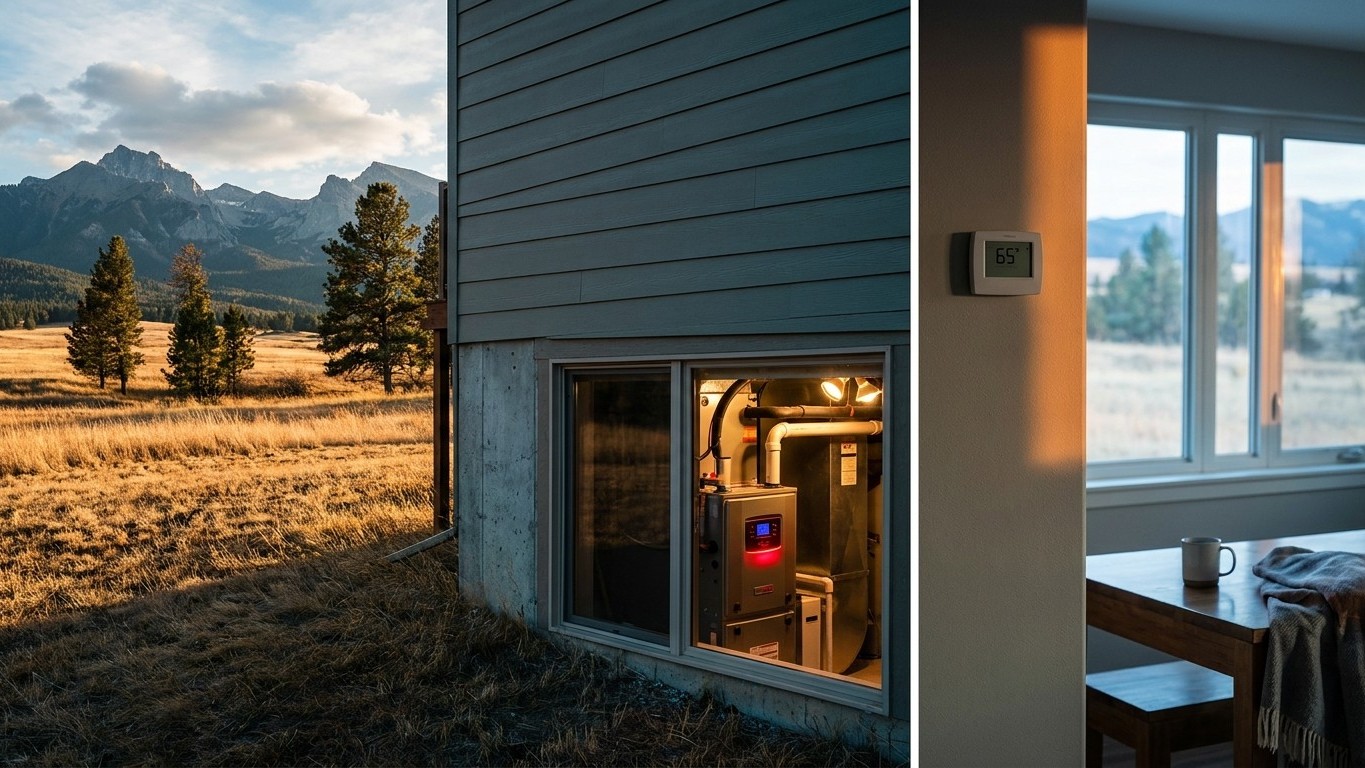

Montana’s heating season opens in September, based on 1991-2020 normals for Billings, the month the average temperature first drops below the 65 F threshold NOAA uses to count heating degree days. Demand peaks in January. From there the season stretches across roughly ten months, only easing off in June and July before climbing right back in August.
When the heating season starts in Montana
September is the month to watch, not because it’s cold yet, but because it’s the first month where the 30-year average mean temperature at Billings Logan International Airport (61.4 F) slips under the 65 F baseline NOAA uses to tally heating degree days. That threshold isn’t arbitrary marketing math: it’s the industry-standard cutoff for when a typical building needs supplemental heat to stay comfortable. Once a month’s average dips below it, degree days start accumulating, and so does fuel use.
January carries the heaviest load, with 1,180 heating degree days in the normals record, the coldest month of the thirty-year average for this station. From there the season doesn’t really let up until July, the only month where the mean climbs back above 65 F. That’s about ten months of meaningful heating demand. Even July and August are not quite free of it — the normals still record 12 and 24 degree days for those two months — but they are where the load all but disappears.
A monthly average is a thirty-year midpoint, not a forecast. The first real cold snap of the year in Montana almost always lands before September’s normal would suggest, sometimes by weeks, especially at higher elevations away from Billings. Treat the numbers below as the shape of a typical season, not a schedule.
| Month | Heating Degree Days |
|---|---|
| January | 1,180 |
| February | 995 |
| March | 839 |
| April | 577 |
| May | 314 |
| June | 90 |
| July | 12 |
| August | 24 |
| September | 168 |
| October | 534 |
| November | 864 |
| December | 1,158 |
Look at how the season builds and fades rather than just its length. October through December ramps up fast, January holds the peak, and then the decline through spring is slower than the climb into winter. That asymmetry is worth knowing if you’re budgeting fuel or planning maintenance windows around the calmer months.
How hard the winter works here
Billings racks up about 6,754 heating degree days a year, against roughly 663 cooling degree days, at the same reference station. Heating degree days are a rough proxy for fuel burned: a house that sees twice the degree days of another, all else equal, is going to burn roughly twice the fuel to hold the same indoor temperature.
That annual number alone doesn’t tell you whether a winter is long and mild or short and brutal, though, and that’s exactly what the monthly table above is for. Two places could post the same yearly total by very different routes: one with a long, moderate stretch of chilly months, another with a short, punishing deep freeze. Montana’s pattern, per the table, leans toward the second shape, with January and December alone accounting for well over a third of the annual total.
For a household, that matters practically. A furnace or boiler here isn’t cycling gently for ten months; it’s largely coasting through the shoulder months and then working hard for a concentrated midwinter stretch. Equipment sized and maintained for that kind of load pattern holds up better than a system tuned for a milder, more evenly spread climate.
What most homes in Montana actually heat with
Federal survey data on how Montana households actually heat their homes shows a clear lean toward furnaces, with natural gas and electricity as the dominant fuels.
| System | Share of homes |
|---|---|
| Furnace | 65% |
| Steam or hot-water boiler | 10% |
| Fuel: natural gas | 59% |
| Fuel: electricity | 24% |
| Fuel: propane | 9% |
Central heat pumps and fuel oil or kerosene systems didn’t generate a reliable state-level estimate in the survey, which means those figures are suppressed rather than confirmed at zero. Some Montana homes almost certainly run on those systems; the survey just didn’t capture enough of them to publish a solid number.
A furnace being the most common system in the state doesn’t make it the right one for any particular house. That share reflects what got installed decades ago when a fuel was cheap and available, not what fits today’s home, insulation, or budget. What it does tell you is what most homeowners in Montana are actually maintaining and troubleshooting every fall.
A gas or electric furnace pushes heat fast and recovers quickly after a cold snap, which suits Montana’s sharp midwinter peak well. It struggles more with even heat distribution in a large or oddly laid-out house, and it depends entirely on ductwork doing its job, which is where a lot of problems and wasted fuel actually hide. The one maintenance item that gets skipped most and punishes homeowners hardest is the air filter. A clogged filter restricts airflow, forces the blower to work harder, and can shorten the life of the whole system. For homeowners running wood heat alongside or instead of a furnace, the state’s wood heating guide covers that setup separately.
Run it once before you need it
The worst time to learn your furnace has a problem is the first genuinely cold night of the year, right when every HVAC technician in the region already has a full schedule. The fix is testing the system weeks ahead, sometime around September, while there’s still slack in the calendar if something needs fixing.
- Turn the thermostat up a few degrees and run the system for a short cycle, just long enough to hear it kick on and settle into a steady hum. Grinding, banging, or a burning smell that lingers past the first few minutes are your cues to stop and investigate.
- Expect a faint burnt-dust odor the first time heat runs after months of disuse. That’s normal, it’s dust burning off the heat exchanger, and it should fade within ten or fifteen minutes.
- Check the filter and replace it if it’s dingy or clogged. This is the cheapest, fastest step on the list and the one most likely to already need doing.
- Clear the space around vents, registers, radiators, or the outdoor unit of a heat pump. Furniture, curtains, and stored boxes blocking airflow force the system to work harder for less heat delivered.
- Test the carbon monoxide alarm and confirm it has fresh batteries. Combustion heating equipment can produce carbon monoxide if it malfunctions, and a working alarm is the simplest safeguard against it.
- Know when to stop and call a professional: persistent odd smells, a system that won’t hold a cycle, visible rust or damage on a furnace, or an alarm that trips. None of those are DIY fixes.
Even a furnace running in perfect condition can lose a meaningful share of its output before it ever reaches a room. The U.S. Department of Energy notes that “in a typical house, about 20%-30% of the air that moves through the duct system is lost due to leaks, holes, and poorly connected ducts.” That’s a separate problem from the equipment itself, and often the real explanation behind a room that never quite warms up or a bill that doesn’t match the weather.
What turning it down is actually worth
The Department of Energy states plainly: “You can save as much as 10% a year on heating and cooling by simply turning your thermostat back 7-10 F for 8 hours a day from its normal setting.” That’s a yearly figure tied to a specific setback held for a specific number of hours, covering both heating and cooling combined, not a per-degree shortcut and not a heating-only number.
In a state where heating demand runs across roughly ten months of the year, a setback like that has a lot more hours to work with than it would somewhere with a short, mild season. Overnight or workday setbacks in Montana are stacking up against a long stretch of months carrying real heating degree days, from September clear through into spring, which is exactly the kind of climate where that Department of Energy figure has room to add up.