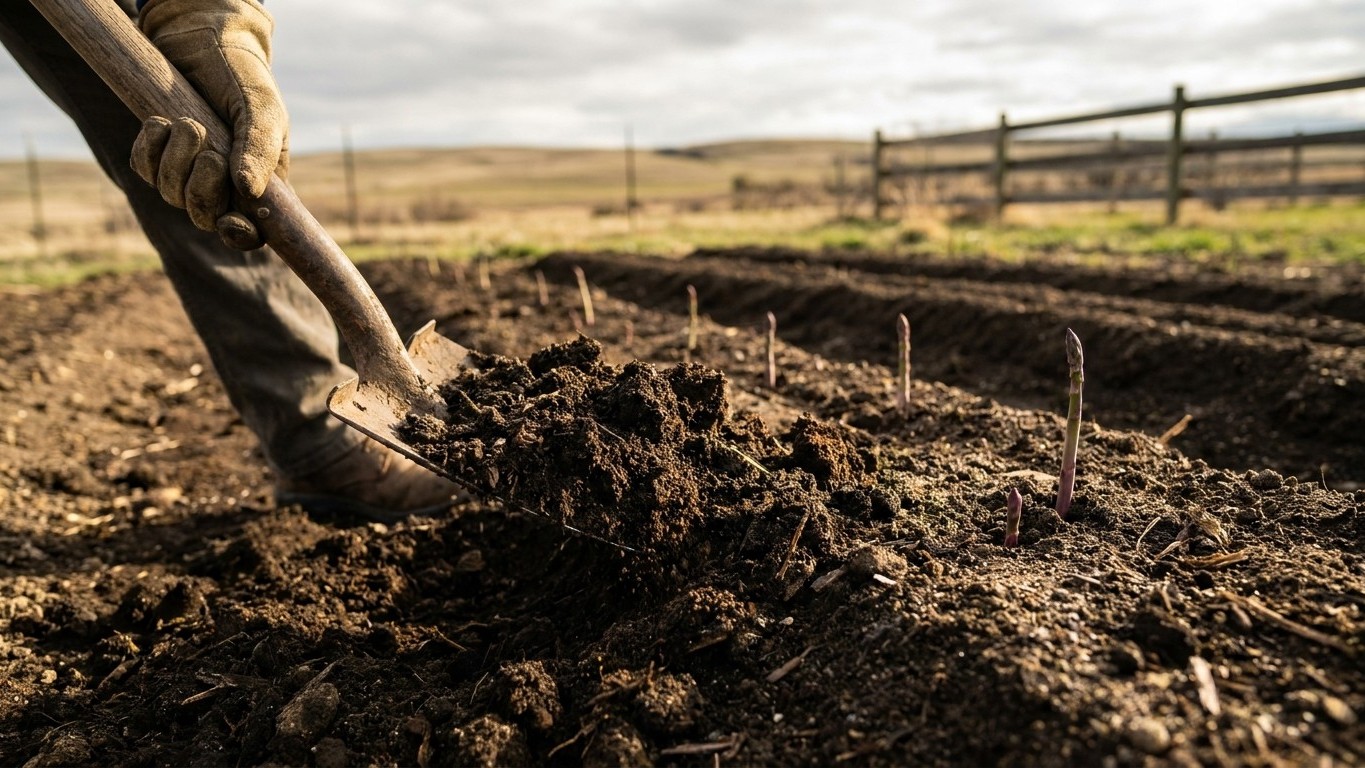

Montana can grow a productive asparagus bed for the full 10 to 15 years the crop asks for, but the answer hinges on one thing: drainage. The state’s official soil handles water well on paper. Whether the ground under your own shovel does the same is a separate question, and it’s the one that decides whether this bed thrives or drowns.
The short answer
Montana’s official soil is the Scobey series, a Mollisol, which is the deep, dark prairie soil that also built the Corn Belt further east. It was named the state soil by Montana law, and USDA NRCS records its surface horizon as roughly 35 percent sand, 31 percent clay and 34 percent silt, with organic matter around 2.0 percent and a surface pH near neutral at about 7.0. Despite that clay fraction, USDA classifies the Scobey series as well drained. That’s the detail that matters most for asparagus, because Utah State University Extension is blunt about the crop’s requirements: When to Plant Asparagus Crowns in Montana means getting crowns into 8-inch furrows in early spring, there’s no harvest at all until the third year, and after that the bed keeps producing for 10 to 15 years. Most soils will do, the extension notes, provided they drain.
That’s a long time to find out you guessed wrong. A heavy, slow-draining soil is an annoyance in a tomato patch, you amend it every spring and move on. In an asparagus bed, it’s a decision you can’t take back for a decade and a half, because the crowns sit in one place the whole time. Will Montana Soil Hold an Asparagus Bed for Fifteen Years? The state soil being well drained is a reasonable starting signal for Montana gardeners, not a verdict on any one yard. Scobey is one series among hundreds mapped across the state; river-bottom ground, hill country, and any lot a builder has cut, filled or compacted will behave nothing like the representative values above. Those numbers describe a mapped surface horizon, not a worked garden bed.
The practical move is simple: dig a hole about a foot deep where the bed will go, fill it with water, and see how long it takes to disappear. If it’s gone within a few hours, you’re likely fine. If water is still standing the next day, plant in a raised bed or a mounded row instead of fighting the native ground for fifteen years. Utah State University Extension also lists four widely available varieties by sex only, without any published word on flavor or yield differences: Jersey Giant and Jersey Knight are all-male types, while UC 157 F1 and Purple Passion are male-and-female. No nursery preference is published either, so the choice between them comes down to availability rather than performance data.
Will the summer here water it for you?
Utah State’s watering guidance is specific: the bed wants 1 to 2 inches of water every other week for its first two years, then eases back to every three weeks once established. Montana’s summer doesn’t come close to covering that on its own. NOAA’s 1991-2020 climate normals for the reference station put the June-July-August total at about 4.3 inches, and the month-by-month breakdown shows the season getting drier as it goes: June averages 2.22 inches, July drops to 1.22, and August, the leanest month, brings only 0.87 inches.
- June: at 2.22 inches, natural rainfall comes closest to meeting the every-other-week target on its own, though it still likely needs topping off during any dry stretch.
- July: 1.22 inches is well short of what a young bed needs across four weeks, so plan on supplemental watering roughly every other week regardless of what falls from the sky.
- August: the driest month of the three, at 0.87 inches, is also usually the hottest, meaning both rainfall and evaporation are working against the bed at the same time. This is the month a hose or drip line earns its keep.
- Established beds, year three and beyond: the every-three-week schedule is more forgiving, but August’s shortfall still means most Montana gardens need at least one or two manual waterings a month through the driest stretch.
These are 1991-2020 normals for one reference station, not a promise about the sky over your particular garden. A rain shadow, a slope, or even a nearby building changes how much water actually reaches the soil. A cheap rain gauge staked next to the bed will tell you more about your own watering needs in a season than any regional average can.
When to put the crowns in
Utah State University Extension calls for planting crowns in early spring, and in Montana that timing lines up with the tail end of frost season. NOAA’s 1991-2020 normals put the mean last spring freeze at around April 29 to May 10, based on the 30-70 percent probability band for 32F. That’s a mean, not a guarantee, and it comes from one reference station in one of the state’s milder valleys. Mountain valleys elsewhere in Montana can see a frost show up in almost any month, so treat that window as a rough anchor rather than a calendar promise, and check conditions locally before crowns go in the ground.
Planting itself follows a specific depth and pace. Crowns go into furrows about 8 inches deep, but the furrow isn’t filled back in all at once. Extension guidance calls for backfilling it gradually across the season, adding roughly 2 inches of soil every other month as the emerging shoots grow taller, rather than covering the crown completely on planting day. That slow fill gives the developing shoots room to push upward without being buried too deep too soon.
Crowns aren’t the only entry point. Some gardeners start asparagus from seed instead of buying dormant crowns, though that route asks for patience up front, since seedlings need time growing in containers before they’re sturdy enough to go into the furrow. For most home gardeners working around a short, unpredictable Montana spring, crowns remain the more direct path from planting to an established bed.
Checking this against your own county
Everything above describes Montana in general terms, drawn from a state soil series and a single reference weather station. Neither one is a substitute for what’s actually happening on your property. Before committing a spot to fifteen years of asparagus, contact Montana State University Extension, which can point you toward county-level soil surveys, local frost records, and planting timing that reflects your specific valley rather than a statewide average. A five-minute phone call or a look at their county office listings beats guessing based on figures built for the whole state.
Common questions
When can I actually harvest the asparagus I plant?
Not in year one, and not in year two. Utah State University Extension is explicit that harvest waits until the third year. Even then, it starts light: about 4 weeks of cutting, extending to 6 weeks the following year, then up to 8 weeks once the bed is fully established. The stopping point each season isn’t a date on the calendar; it’s a visual cue. Once most of the emerging spears are thinner than a pencil, harvest ends for the year so the plant can put energy back into the crown.
Does Montana’s winter cold hurt an established bed?
There’s no published chilling requirement for asparagus in the source used here, and no figure to substitute in its place. What is published is the crop’s long lifespan, 10 to 15 years, which suggests it tolerates a wide range of climates once established. Beyond that, this is a question worth putting directly to your local extension office rather than guessing at a number.
What soil pH does asparagus actually need?
That’s not specified in the Utah State University Extension guidance used for this article, and no other figure should stand in for it. The state soil profile above lists a surface pH near 7.0, but that describes the Scobey series as mapped, not a requirement for the crop or a reading of any particular garden. A soil test remains the only way to know your own number.
Which variety should I plant?
Utah State University Extension names four: Jersey Giant and Jersey Knight, both all-male types, and UC 157 F1 and Purple Passion, which are male-and-female. The extension source doesn’t rank them by flavor, yield, or suitability for any particular region, so the decision largely comes down to what’s available where you’re buying crowns.