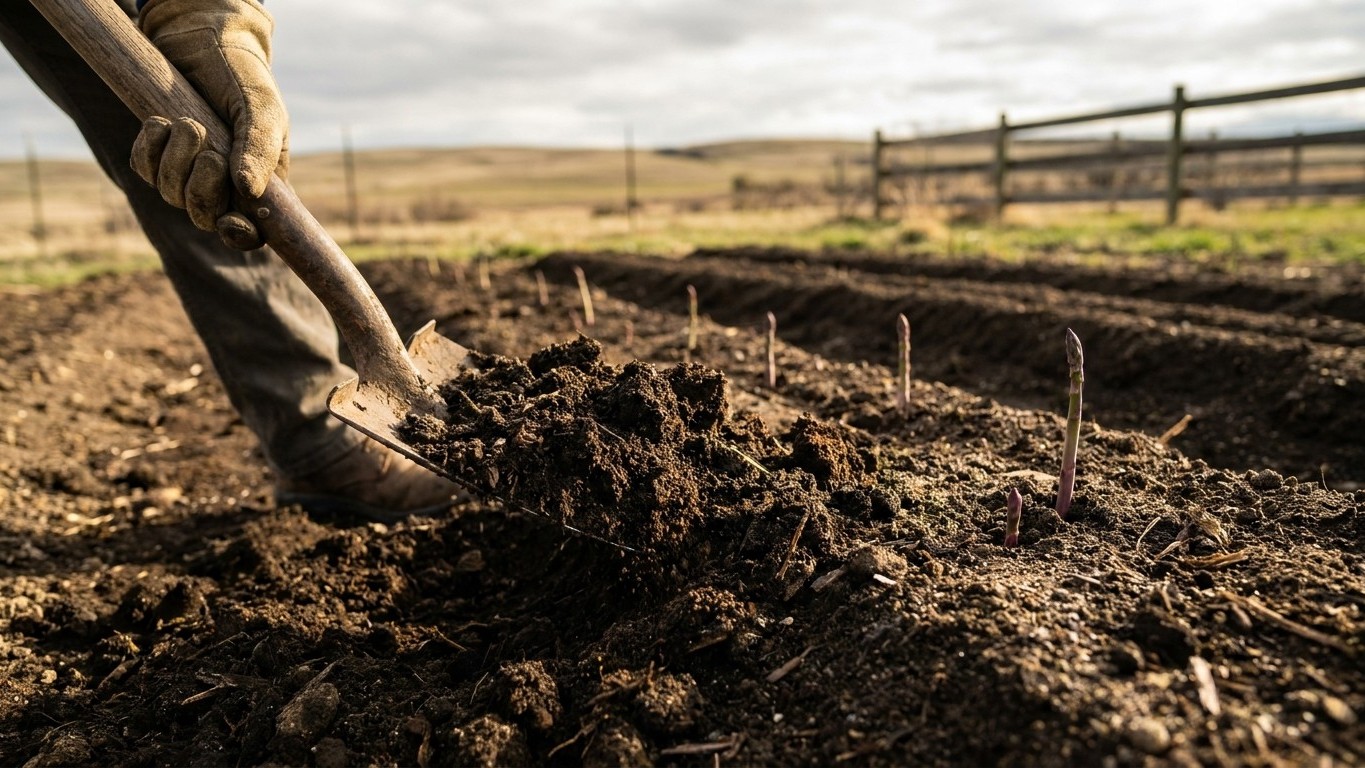

An asparagus bed planted in Oregon can keep producing for a decade and a half, so the ground you pick now is a decision you’ll live with long after the first spears show up. The state’s namesake soil, the Jory series, drains well on paper, and drainage happens to be the one trait asparagus actually asks for. But a soil survey covering the whole state doesn’t describe what’s under your own lawn or raised bed, and that gap is where the real planning starts—which raises the underlying question: Will Oregon Soil Hold an Asparagus Bed for Fifteen Years?
The short answer
Oregon’s official state soil, the Jory series, is an old and heavily weathered Ultisol: naturally acid, low in nutrients, with a surface pH around 5.6. By texture it runs 14 percent sand, 34 percent clay, and 52 percent silt, with organic matter around 5.0 percent in the surface layer. Despite that clay content, USDA soil survey data classifies it as well drained. That single fact matters more than anything else on this list, because a well-established asparagus bed sits in the same eight inches of soil for 10 to 15 years once it starts producing, and the only soil requirement Utah State University Extension publishes for asparagus is that it drains. Not pH, not fertility, not texture. Drainage.
What the Jory series does and doesn’t tell you
The numbers above describe the surface horizon of the major components mapped as Jory soil across the state, not a measurement taken in any particular backyard. A soil survey works at the scale of a county; your own plot could sit on a river bottom, a hillside cut, or fill dirt a builder brought in decades ago, and none of those behave like the representative profile. Treat the Jory figures as a description of what Oregon ground tends to do, heavy on clay and silt but still shedding water reasonably well, rather than a diagnosis of the specific spot where you’re about to sink a decade of gardening.
If your own ground doesn’t drain
The test is simple enough to run before you order a single crown: dig a hole about a foot deep, fill it with water, and time how long it takes to empty. Water still sitting there after several hours means the spot floods easily, and that’s a real problem for asparagus roots left in place for years rather than one season. The fix isn’t complicated, it’s just permanent: build a raised bed or mound the planting row six to eight inches above grade, and work in organic matter to open up a tight clay structure before the crowns ever go in the ground. Because this bed can’t be moved once it’s established, it’s worth solving the drainage question with a shovel and a bucket now, well ahead of When to Plant Asparagus Crowns in Oregon, rather than discovering it the hard way in year four. Soil pH isn’t part of this decision; the source guidance for asparagus is silent on pH entirely, so a slightly acid soil like Jory’s surface reading isn’t a reason to hold off.
Will the summer here water it for you?
An asparagus bed needs 1 to 2 inches of water every other week for its first two years while roots establish, then eases back to roughly every three weeks once it’s mature. Oregon’s summer doesn’t come close to covering that on its own, and the shortfall is bigger in some months than others.
Month by month against the target
- June: the region averages 1.63 inches for the month. Spread across two watering cycles at 1 to 2 inches each, a new bed’s target for June alone can run 2 to 4 inches, so June rainfall covers less than half of what a young bed needs even in the wetter of the three summer months.
- July: the driest month of the year here, averaging just 0.51 inches. Against a same-size target of 2 to 4 inches for the month, nearly the entire watering job falls to a hose or irrigation line.
- August: not much better, at 0.54 inches average. Same story as July: the bed is depending almost entirely on supplemental water to hit its every-other-week schedule.
- Across all three months combined: the region averages about 2.7 inches of rain total for June, July, and August, against a season’s target that can run well past 10 inches for a bed in its first two years. The gap is the gardener’s to fill.
After the first two years
Once the bed matures and shifts to a watering rhythm closer to every three weeks, the math gets easier but the conclusion doesn’t change. July and August rainfall, at roughly half an inch each, still won’t carry an established bed through a dry stretch without help. These are long-term averages for one reference station, not a forecast and not a reading of your own yard, so a rain gauge sitting next to the bed is what actually tells you when to turn the hose on in a given week.
When to put the crowns in
Crowns go into the ground in early spring, set into furrows about 8 inches deep. For this part of Oregon, the average last spring frost falls somewhere around March 6 to March 21, and that window is a reasonable anchor for timing the planting once the soil has dried out enough to work. That date range is a mean drawn from three decades of records, not a guarantee for any single year, so “around” is doing real work in that sentence rather than promising an exact day.
Planting the crowns and filling the furrow
The furrow doesn’t get backfilled all at once. Crowns go in at the bottom of that 8-inch trench, and soil is added back gradually, roughly 2 inches every other month across the year, rather than covering the crown completely on planting day. It’s a slower process than most vegetable planting, but it matches how the roots and the first spears actually develop through the season.
The seed route, and the harvest wait either way
Starting from seed instead of crowns is the alternative, though the source guidance doesn’t give a separate regional calendar for seed-grown asparagus beyond the general crown timing above, so anyone starting from seed should expect an additional year of growing before those seedlings are ready to set out as crowns themselves. Whichever route you take, patience is built into the crop: no harvest at all happens until year three. From there, the first cutting season runs about 4 weeks, the next year stretches to 6 weeks, and the year after that to 8 weeks. The signal to stop cutting for the season isn’t a date on a calendar, it’s the spears themselves: once most of what’s coming up is thinner than a pencil, harvest is over for that year. On variety, the published guidance only goes as far as sex, not flavor or yield: Jersey Giant and Jersey Knight are all-male varieties, while UC 157 F1 and Purple Passion are male/female. No nursery and no performance ranking is attached to any of them in that guidance, so the choice comes down to what’s available locally rather than a documented reason to prefer one over another.
Checking this against your own county
Everything above describes Oregon in general terms: a representative state soil, a regional rainfall average, a mean frost window pulled from one reference station. None of it substitutes for what’s true on your own property. Oregon State University Extension runs county-level offices across the state, and that’s the resource built for exactly this gap between statewide data and one backyard. A county office can point you toward local soil testing, confirm frost timing closer to your specific elevation and microclimate, and flag anything about local pests or disease pressure that a general planting guide wouldn’t cover. Find the office nearest you at extension.oregonstate.edu before you commit a 15-year bed to a single spot in the yard.
Common questions
Can I plant asparagus in heavy clay soil in Oregon?
It depends entirely on how well that specific clay drains, not on the fact that it’s clay. Oregon’s own state soil, the Jory series, is 34 percent clay by texture and still classified as well drained. Run a simple drainage test on your own ground before deciding; if water sits for hours after a soaking, raise the bed rather than planting into standing water.
How long before I get my first asparagus harvest?
No harvest happens in years one or two. The first cutting season, in year three, runs about 4 weeks, followed by 6 weeks the year after, then 8 weeks from there on. Each season ends when most spears coming up are thinner than a pencil, not on a fixed date.
Which asparagus variety grows best in Oregon?
Published guidance doesn’t rank varieties by flavor or yield for this or any region. It only distinguishes them by sex: Jersey Giant and Jersey Knight are all-male, while UC 157 F1 and Purple Passion are male/female. Local availability, rather than a documented performance difference, is what typically decides the choice.
Do I need to water asparagus during Oregon’s rainy season?
Summer, not the rainy season, is when watering matters most here. June, July, and August together average only about 2.7 inches of rain, with July running as low as 0.51 inches, well short of the 1 to 2 inches every other week a young bed needs. Supplemental watering through the dry summer months is close to unavoidable in this climate.