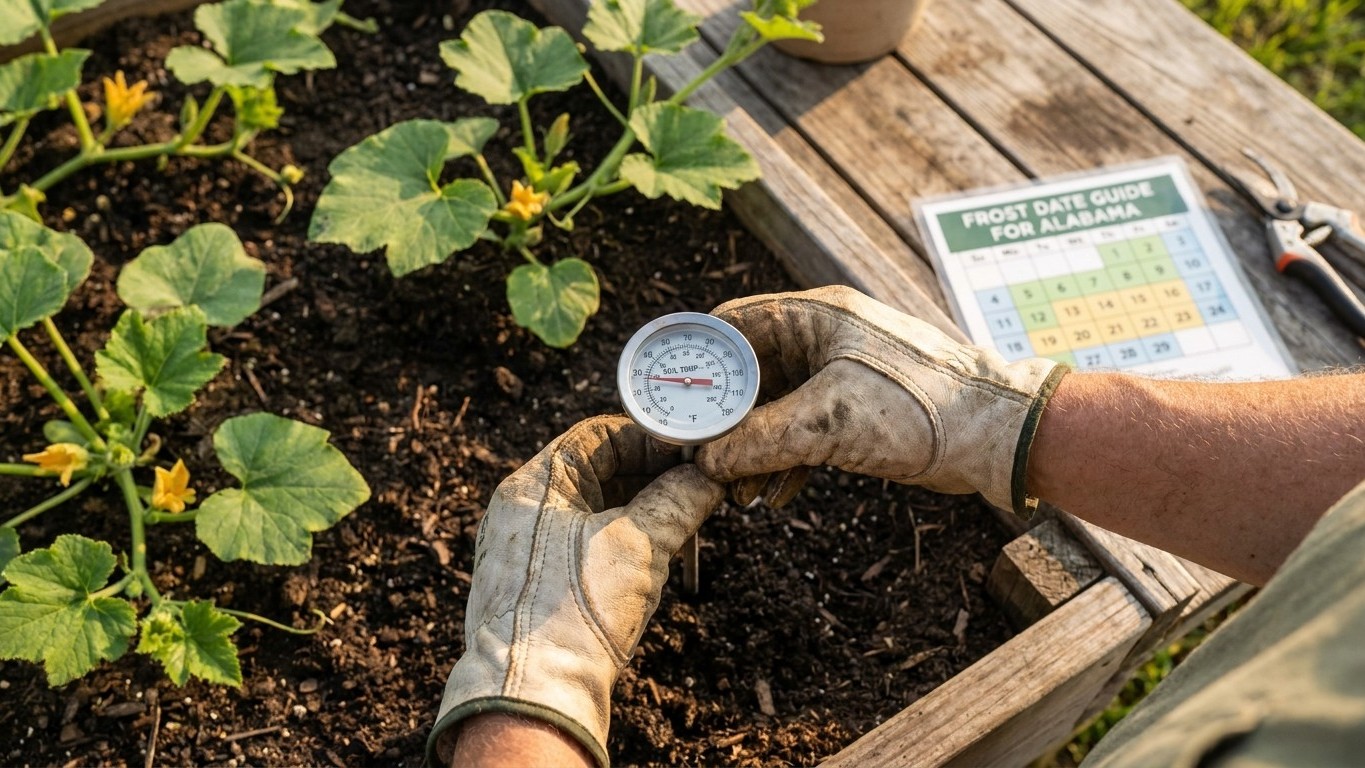

Soil is the trigger, not the calendar: Montana pumpkins go in the ground once the soil holds steady at 65°F, which lands well after the last spring frost of April 29 to May 10. Count forward 45 to 55 days from the day the plant actually flowers, then check that against the first fall frost of October 1 to October 14. That’s the whole equation.
The short answer
Start from the back end of the season, not the front. Montana’s first fall frost arrives somewhere between October 1 and October 14, depending on the year, and pumpkins need 45 to 55 days after flowering (not after sowing) to finish ripening and harden their skin. Work that backward and the flowering has to happen inside a fairly tight stretch of August.
Take the earliest end of the frost window, October 1, and subtract the full 55 days: the last safe flower has to open by August 7. Take the latest end of the window, October 14, and subtract the shorter 45-day estimate: a flower opening as late as August 30 could still make it. That’s the real spread for this state, a last-flower window running from roughly the first week of August to the last week of it, depending on which year you get and how fast that particular plant matures.
Neither edge of that spread is a safe bet to plan around. A gardener who wants margin should treat early-to-mid August as the real deadline for flowering, not the calendar’s kinder end. Flowers that open in early September are asking a pumpkin to finish coloring and harden its rind in the same weeks the region’s first freeze is statistically most likely to land.
This is why the sowing date matters less than people think, and the flowering date matters more. Two plants sown a week apart can flower on nearly the same day if one catches a warm stretch and the other doesn’t. What actually protects the harvest is knowing that whatever flowers open on your vines in August need six to eight weeks of frost-free weather behind them, and Montana doesn’t reliably offer that past the second half of October, ever.
One more layer worth keeping in mind: Billings sits in one of the state’s milder valleys. Higher, cooler valleys elsewhere in Montana carry real frost risk in any month of the growing season, which pulls that whole calculation earlier still. A gardener in a mountain valley should treat the early edge of the flowering window, not the late one, as the number to build a season around.
When to sow here
The sowing date is where a lot of Montana gardeners get tripped up, because the temptation is to sow as soon as the frost risk passes. Pumpkin seed doesn’t care about air temperature at planting time. It cares about the soil, and the soil needs to hold at 65°F before the seed will germinate reliably. That threshold arrives later than most people expect, and it’s a separate number from the frost date entirely.
- Start with the last spring frost, April 29 to May 10. That’s when the air stops threatening to kill tender seedlings, but it says nothing about the ground.
- Soil warms slower than air. Bare ground several inches down holds onto winter cold for weeks after the air has turned mild, so the gap between the last frost and a soil reading of 65°F is not a matter of days, it’s a matter of weeks.
- In practice, that pushes direct sowing in most Montana valleys into late May or into June, well past the point where the last frost has already come and gone.
- A soil thermometer, checked at planting depth in the morning before the sun has warmed the surface, is the only honest way to know the ground is ready. Guessing from the air temperature alone is how seed rots in cold, damp soil instead of germinating.
- Row covers change the arithmetic. Laid over the bed ahead of sowing, they trap solar heat and can bring that 65°F threshold forward by about two weeks, letting a gardener sow closer to mid-to-late May instead of waiting into June.
- That two-week head start matters more here than in milder states, because it buys extra days on the back end of the season too, days that help push flowering earlier into that critical August window.
None of this means the sowing date and the frost date are the same thing, and treating them that way is the single most common mistake in this climate. A gardener who sows the week after the last frost, expecting a jump on the season, is usually sowing into soil still too cold for the seed to do anything but sit.
What goes wrong here
- A late flower that never colors. When sowing gets pushed into June and the plant takes its time establishing, flowering can slide into late August or September. The fruit sets, but it runs out of warm days before the rind turns from green to orange. The remedy is upstream: sow as early as soil temperature allows, and use row covers to move that date forward by the two weeks they typically buy.
- A fruit caught by frost before it hardens. Even a pumpkin that colors up can still have a soft rind when the first fall frost arrives between October 1 and October 14. A soft-skinned pumpkin caught by frost breaks down in storage fast. Track the flowering date on each fruit, count 45 to 55 days forward, and if that date lands close to the frost window, plan to harvest early rather than gamble on a few extra days of hardening.
- A vine that dies back before the skin hardens. Vines in Montana can collapse from frost or disease before the fruit is fully ready, even if the pumpkin itself hasn’t been touched. Squash bugs and cucumber beetles are common culprits behind early vine decline in this region; both pests already have dedicated coverage on this site, so check the squash bugs in Montana and cucumber beetles in Montana pages for identification and control. Once a vine has died back, cut the pumpkin with several inches of stem attached and move it somewhere it won’t freeze; that’s the only storage guidance available, since there’s no published storage temperature or keeping time for these fruit.
Common questions
Can I start pumpkin seeds indoors in Montana?
Starting indoors doesn’t change the soil-temperature rule outdoors; it only lets a gardener control germination conditions directly. Transplants still need to go into soil that has reached 65°F, and the vine still needs to flower inside that August window to finish before the first fall frost.
What happens if a frost catches vines before harvest?
Frost damages the vine and any unhardened fruit first. A pumpkin that was still coloring or softening when frost hit won’t finish ripening on the vine, and it won’t keep well either. The only fix once frost is forecast is to harvest what’s there, stem attached, and move it somewhere it won’t freeze.
Which pumpkin varieties suit this window?
Named varieties commonly grown for fall harvest include Connecticut Field, Jack Be Little, Cinderella, Howden, Big Max, Sugar Pie, Baby Bear, Autumn Gold, and Jarrahdale. No days-to-maturity, size, or color data for these varieties is published in the sources behind this page, so treat the names only as starting points for further research, not as a shortcut around the flowering math above.
Does elevation change these dates?
Yes, meaningfully. The frost windows given here reflect one of Montana’s milder valleys. Higher and more remote valleys across the state can see frost in any month of the growing season, which shortens the safe flowering window on both ends and makes early sowing, aided by row covers, more important rather than less.