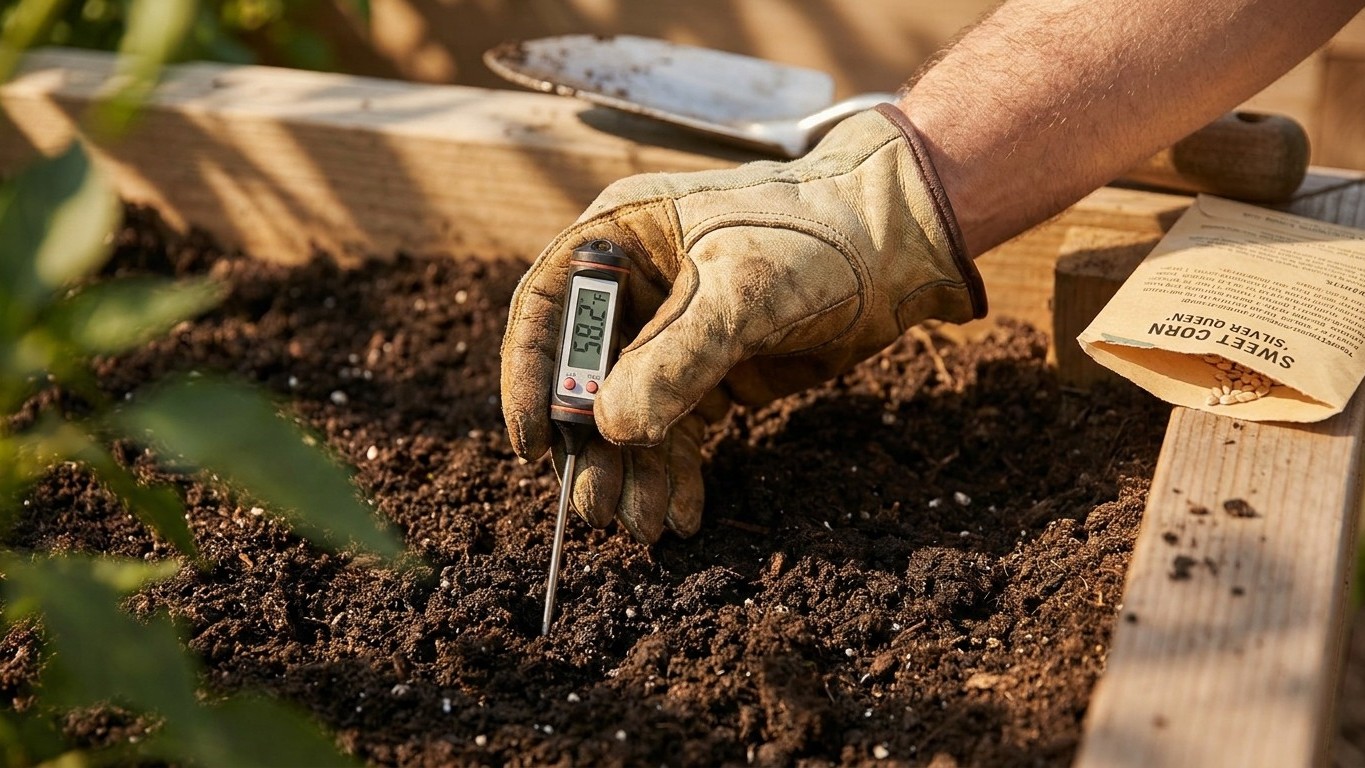

Sweet corn in Montana’s milder valleys goes into the ground once the soil, not just the air, holds steady above 60°F. That moment lands well after the last spring frost, typically not until the soil has had real time to warm under long daylight hours. From there, growers need a variety that finishes in 60 to 90 days, because the first fall frost arrives on the early side of the calendar compared to much of the country.
The short answer
Soil temperature and air temperature are not the same clock, and confusing them is the single most common mistake home gardeners make with sweet corn. In the Billings area, the last spring frost falls somewhere between April 29 and October 14… no, between April 29 and May 10, based on three decades of NOAA climate data. But 32°F air on a given morning does not mean the ground four inches down has caught up. Soil warms slowly, lagging behind the air by weeks, and sweet corn seed sown into cold, wet ground simply rots or sprouts weak and yellow before it ever reaches sunlight. That is why the planting decision has to be made with a soil thermometer, not a frost calendar.
So the practical rule is this: wait until the soil itself, measured a few inches down at midmorning, holds consistently above 60°F. That threshold, published by Utah State University Extension, is the real starting gun for sweet corn, not the last frost date. In a valley like Billings, that means the last frost passing in late April or early May is only the earliest possible marker on the calendar. The soil catching up to 60°F comes afterward, and gardeners who plant on the frost date alone are almost always planting too early for the seed’s own biology.
Once that soil threshold is met, the second calculation kicks in: does the variety have enough time to mature before the first fall frost shuts the season down? Utah State’s guidance puts sweet corn’s full cycle at 60 to 90 days from planting to harvest, depending on the variety. The first fall frost in this reference area lands between October 1 and October 14. That gives a working season, once soil warms, that still leaves a solid stretch of frost-free days for most standard sweet corn varieties, particularly the shorter-season ones.
What makes this arithmetic tighter than it looks at first glance is the region’s summer heat load. The Billings reference station averages 28.3 days a year at or above 90°F. That heat pushes water demand hard during the exact weeks when corn is tasseling and filling ears, and it means the soil-warming period itself tends to move fast once it starts. Warm spells in late spring can push soil past 60°F relatively quickly, but growers still need to check the ground directly rather than assume a fixed date, because a cool, wet spring can delay that threshold well past when the calendar “feels” ready.
The bottom line for timing: confirm 60°F soil first, then count forward. If a variety’s days-to-maturity, added to the planting date, lands comfortably before October 1, it fits. If it lands after October 14, it does not, and no amount of row cover changes the math on a crop that needs consistent late-season warmth to finish filling its ears.
Does a late variety fit here?
Not every sweet corn variety was bred with the same finish line in mind, and in a territory where the frost-free window is bounded on both ends, the number of days to maturity printed on a seed packet decides far more than most gardeners realize.
A 60-day variety
A short-season sweet corn finishing in roughly 60 days has real breathing room here. Even accounting for soil that doesn’t hit 60°F until well past the last frost date, a 60-day variety planted once that soil threshold is met still has weeks of buffer before the first fall frost on October 1 to October 14. That cushion matters in a climate that also delivers nearly a month of 90°F-plus days each summer, since a fast-finishing variety spends less total time exposed to the heat stress that can knock pollen viability down and stall ear fill. For gardeners who want a reliable harvest without cutting it close, a 60-day type is the lower-risk choice in this territory.
A 90-day variety
A full 90-day sweet corn is a much tighter fit, and in some years it may not fit at all. The problem isn’t the frost-free season on paper, it’s the compounding of two delays: soil that warms later than the frost date, and a variety that needs the long end of the maturity range. Stack those together and a 90-day type pushed into ground that only reached 60°F in late spring can easily run past the first week of October before it’s ready, right when the first fall frost is already possible. There’s no published soil-warming date for this territory to plug into that equation with precision, which is exactly why a 90-day variety carries real risk here rather than a guaranteed harvest. Gardeners set on a longer-season variety should treat it as a gamble against the calendar, not a default choice, and should have realistic fallback plans if an early frost cuts the season short.
What goes wrong here
Most sweet corn disappointments in this climate trace back to one of three specific mistakes, and none of them require a mystery to diagnose once you know what to look for.
- Soil sown too cold: Seed goes into ground that’s still cold and wet because the gardener planted on the frost date instead of testing the soil. The fix is simple: check soil temperature directly, a few inches down, at midmorning, and hold off until it reads consistently above 60°F, even if that means waiting well past when neighboring gardens have already planted.
- A variety too late for the season: A 90-day type is planted assuming the full frost-free window is available, but the soil-warming delay eats into that window before the plant ever germinates. The remedy is to choose a shorter maturity variety, in the 60- to 75-day range, that leaves margin against the October 1 to October 14 first-frost window.
- Sweetness lost to cross-pollination timing: Two sweet corn types, say a standard su variety and a sugar-enhanced se or supersweet sh2, are planted close together and tassel at the same time. Pollen drifts between them, and the resulting kernels turn starchy instead of sweet, even though nothing about the climate caused it. The fix has nothing to do with distance and everything to do with timing: stagger planting dates so the two types don’t shed pollen and silk in the same window, or grow only one type in a given season. There’s no published isolation distance to rely on here, only the rule that they must not tassel together.
Common questions
How do I know when soil has actually reached 60°F?
Use a soil thermometer pushed a few inches into the planting row, and take the reading at midmorning for several consecutive days rather than a single spot check. A one-day warm spell doesn’t mean the ground has stabilized above 60°F, especially after a cool, wet stretch.
Is the last frost date the same as when I should plant sweet corn?
No. The last spring frost in the Billings reference area falls between April 29 and May 10, but soil temperature lags behind air temperature by a meaningful stretch. Planting on the frost date alone, without checking soil temperature, is one of the most common reasons seed fails to germinate well in this territory.
Can I grow both a sweet type and a supersweet type in the same garden?
Yes, but only if you manage timing so the two don’t tassel during the same window. If su, se, and sh2 types shed pollen and silk together, the sweetness of the harvest is compromised regardless of how well the plants otherwise grew. Staggering planting dates by enough time to separate their tasseling periods is the working solution here, since no isolation distance is published for this guidance.
Does the number of 90°F days matter for planting timing?
It doesn’t change when you plant, but it does affect how much buffer you want in your variety choice. With an average of 28.3 days a year reaching 90°F or higher in the Billings reference area, heat stress during tasseling is a real risk, which is another reason a shorter-maturity variety, finishing before the hottest stretch fully passes, tends to perform more reliably than a long-season type pushed to its limit.