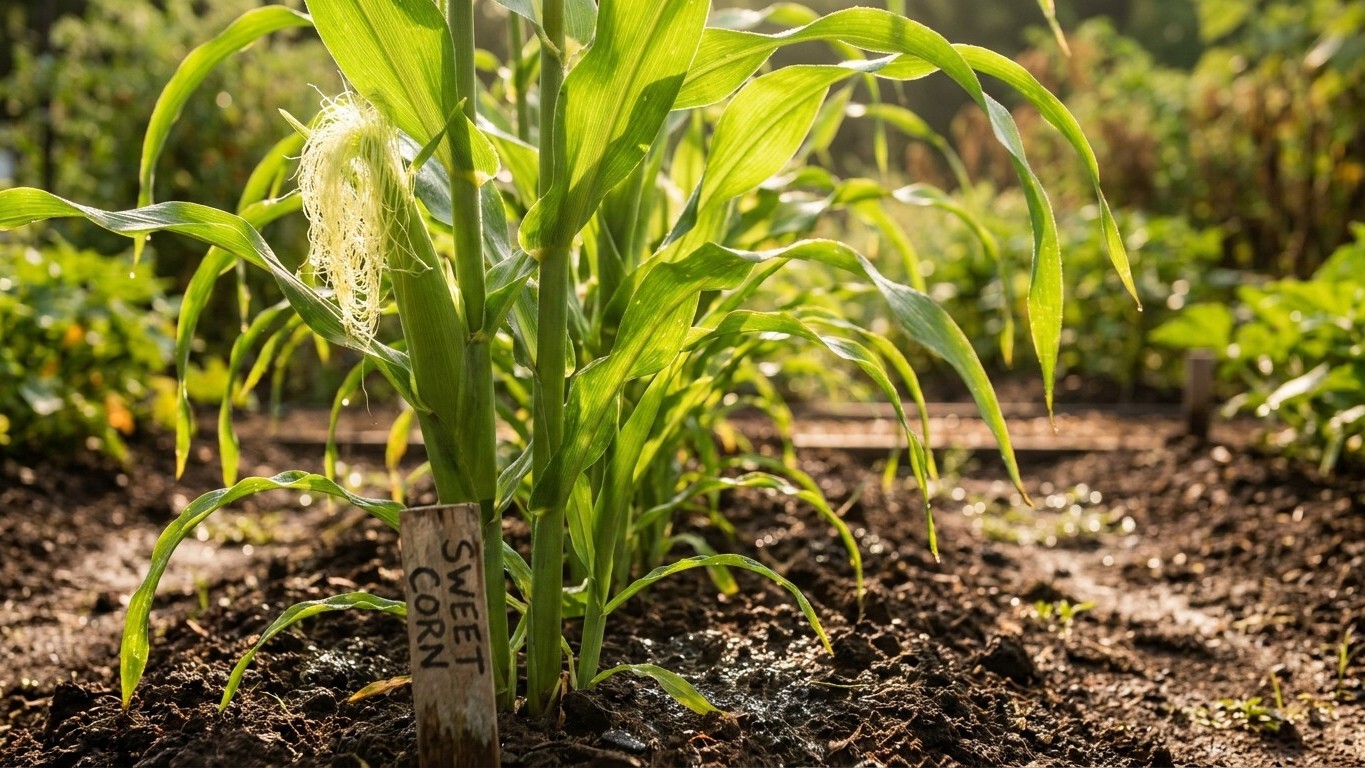

Yes, in most seasons sweet corn can ripen in Montana’s Billings valley, but the timing is tighter than gardeners moving from a milder climate might expect. The soil has to warm well past the last frost before a seed will even germinate, and once that clock starts, only a short list of varieties fit the window before the first fall frost arrives.
The short answer
Start with the soil, not the calendar. The last spring frost in this valley typically falls between April 29 and May 10, according to NOAA NCEI’s 1991-2020 Climate Normals for the region. That date matters, but it isn’t the date to plant sweet corn. Soil needs to hold above 60°F before sweet corn seed will germinate reliably, and soil doesn’t warm at the same pace as the air. It lags. A morning without frost risk doesn’t mean the ground six inches down has caught up yet, and planting into cold soil is one of the most common ways gardeners here lose a crop before it even sprouts.
What helps this valley is how fast the season builds once it turns. Billings averages 28.3 days a year at or above 90°F, a heat load that pushes soil temperatures up quickly once the frost risk clears. That means the gap between “frost is over” and “soil is finally past 60°F” tends to close faster here than in a valley with a cooler, slower spring. Even so, that gap is real, and it eats into the growing window before you’ve planted a single seed.
The other end of the season is the first fall frost, which arrives between October 1 and October 14 in an average year, per the same NOAA dataset. Sweet corn needs 60 to 90 days from planting to maturity, depending on variety, so the real question isn’t whether corn can grow here at all. It’s whether the stretch between soil hitting 60°F and that first October frost is long enough to fit a full 60-to-90-day cycle without the plant getting caught by cold at either end.
Run the numbers and the window works, with room to spare for most seasons. Even accounting for the lag between frost clearing and soil warming, the growing stretch into early October gives a 60-day variety plenty of cushion, and it gives a 90-day variety a workable, if less generous, margin. The caution worth repeating is the one in the source data itself: Billings sits in one of the milder valleys in the state. Mountain valleys elsewhere in Montana can see frost in any month of the year, and a grower there is working a very different, much tighter calendar than the one this article is built around.
Does a late variety fit here?
Not every sweet corn variety is built for the same season length, and the difference between a 60-day type and a 90-day type is the difference between a crop that finishes with weeks to spare and one that’s racing the calendar.
A 60-day variety
A 60-day sweet corn variety is the safer bet in this valley. Once soil clears 60°F, a 60-day type only needs two months to reach harvest, leaving a comfortable buffer before the first fall frost in early-to-mid October. That buffer matters because Montana springs don’t always behave exactly like the average, and a shorter-season variety gives room for a slow start, a stretch of cool weather mid-season, or a planting date pushed back a week or two by a late soil warm-up. For a gardener who wants predictability over a longer harvest window, the 60-day type is the lower-risk choice.
A 90-day variety
A 90-day variety is a tighter fit, but it isn’t automatically ruled out. Because soil doesn’t cross 60°F until after the frost-free date clears, and because the season needs to wrap up before the first fall frost between October 1 and October 14, a 90-day type is using nearly the full length of the growing window with little left over. That works in a season that runs close to average. It does not work if soil warming is delayed, if a cool spell stalls growth mid-summer, or if fall frost arrives on the early side of that October range instead of the later side. In practice, a 90-day variety here carries a real risk of being caught unfinished, and a gardener choosing one should treat it as the higher-risk option rather than the default.
| Variety type | Days to maturity | Fit for this valley |
|---|---|---|
| 60-day | 60 days | Comfortable margin before first fall frost |
| 90-day | 90 days | Tight; depends on an average-or-better season |
What goes wrong here
- Soil sown too cold. Planting before soil holds above 60°F is the most common failure in this valley, since the frost-free date arrives well before the soil actually catches up. Seed sits in cold ground, germination is slow and uneven, and a stand planted this way often needs replanting, which then pushes the whole harvest closer to the fall frost risk. The fix is to check soil temperature directly rather than planting by the frost date alone, and wait until it holds above 60°F for a run of days, not just a single warm afternoon.
- A variety too late for the season. A 90-day type leans on nearly the entire window between soil warm-up and first fall frost, and any delay at either end can leave ears unfinished when the cold arrives. The remedy is straightforward: match variety choice to the season length actually available here, and treat a 60-day type as the default unless there’s a specific reason to push for a longer-season variety.
- Sweetness lost because two types tasselled together. This one has nothing to do with Montana’s climate. Sweet corn comes in different types (su, se, and sh2 among them), and if two different types tassel at the same time nearby, cross-pollination can strip the sweetness out of both. The source gives no isolation distance to plant by, so the fix isn’t about measuring feet between rows. It’s about timing: stagger planting dates so the different types don’t shed pollen during the same window, or grow only one type in a given season. Corn is also wind-pollinated and fills out best when planted in blocks of three or more rows rather than a single thin line, which is a separate detail worth keeping in mind for a good, well-filled ear regardless of variety.
Common questions
Does the last frost date tell me when to plant sweet corn?
No. The last spring frost (April 29 to May 10 in this valley) only tells you when frost risk clears. Soil needs to hold above 60°F before sweet corn seed will germinate well, and that happens later than the frost date, not on the same day.
How do I know when the corn is actually ripe?
Check for three signs together: dry, brown silks; husks that are still moist and green; and milky juice from a kernel when you puncture it. One sign alone isn’t enough to judge ripeness. This is a separate question from days-to-maturity, which only tells you whether the season is long enough to grow the crop at all.
Can I grow both a sweet variety and a different type of corn in the same garden?
Only if their tasseling times don’t overlap. The failure mode here is timing, not distance, since the source gives no isolation figure to plant by. Stagger planting so the two types aren’t shedding pollen in the same week, or stick to one type per season if that’s easier to manage.
Is a 90-day sweet corn variety ever a good choice here?
It can work in a season that runs close to average, but it leaves little margin. Given that soil warms up well after the last frost and the first fall frost can arrive as early as October 1, a 90-day type is using most of the available window. A 60-day variety is the lower-risk choice for most gardeners in this valley.