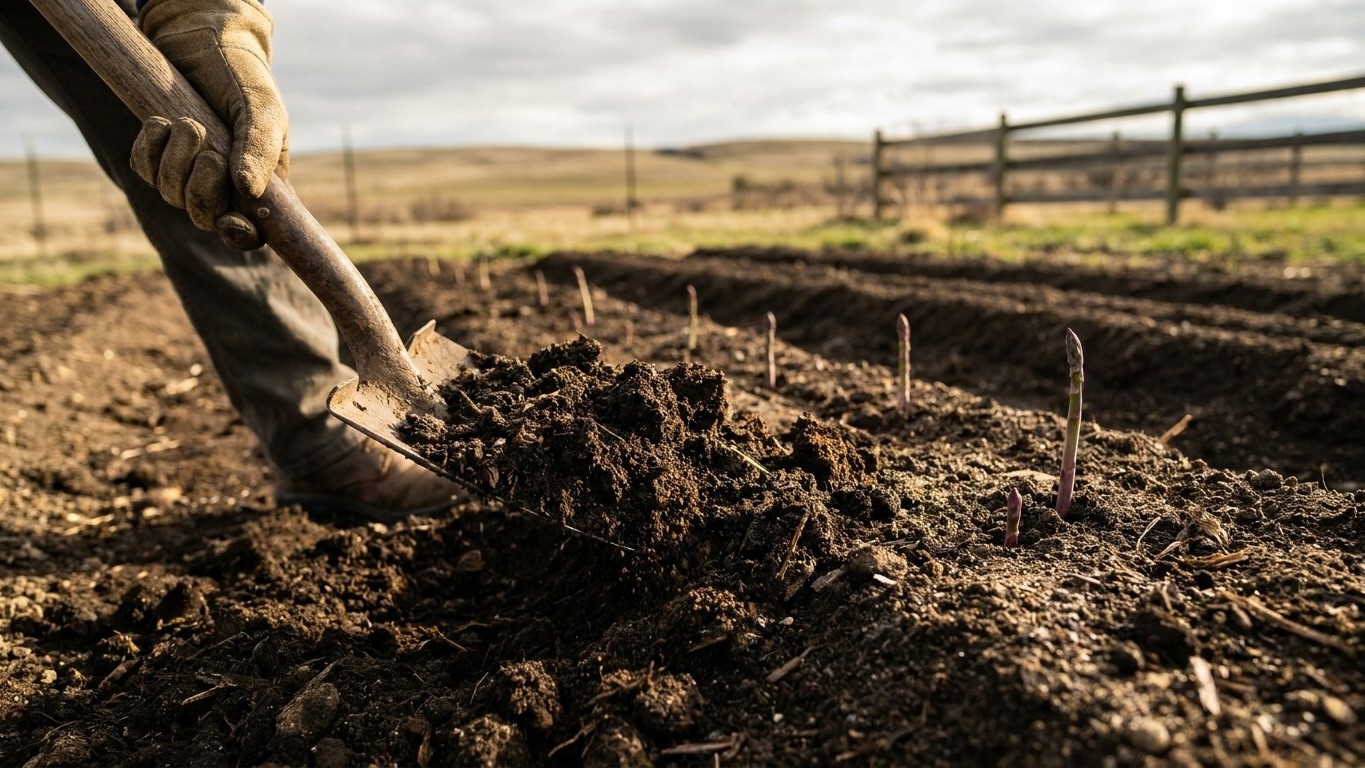

Plant asparagus in the right spot in Nebraska and you won’t touch that ground again for a decade or more. The state’s namesake soil, the Holdrege series, is well drained, which happens to be the one soil condition this crop actually demands. That’s good news for a lot of yards built on this deep prairie ground. But “most” isn’t “all,” and a fifteen-year commitment is not the place to guess. Here’s what decides whether your particular patch of dirt qualifies.
The short answer
Nebraska’s official state soil, the Holdrege series, is a Mollisol, the deep, dark type of ground that turned this part of the country into the Corn Belt. Measured at the surface, it runs about 11 percent sand, 22 percent clay and 67 percent silt, a silty loam with roughly 2.0 percent organic matter and a surface pH near 6.2, just on the acid side of neutral. USDA soil survey data lists it as well drained. That single word is the entire soil requirement Utah State University Extension publishes for asparagus. No pH range, no fertility target, just drainage.
That pairing tends to work in this state’s favor. A silty loam like Holdrege holds moisture around the roots without turning to soup after a hard rain, which is close to what a bed needs when it’s going to sit undisturbed for a decade or more. But the Holdrege figures are averaged from 248 mapped components across the state, a representative composite, not a survey of your backyard. Riverbottom ground, hillside cuts, and any lot a builder has scraped, filled or compacted can behave nothing like the state figure, holding standing water long enough after a wet spring to rot a crown before it ever breaks the surface. Watching how long water stands in a hole after a rain is a rough gut check; a soil test through your county extension office is a real one.
If a plot doesn’t drain, the usual fix is a raised bed or a mounded row, lifting the crowns above the line where water pools, or working in enough compost to open up a clay-heavy surface. Either way, Will Nebraska Soil Hold an Asparagus Bed for Fifteen Years? is the question worth answering before you dig, and getting the When to Plant Asparagus Crowns in Nebraska right matters just as much as the soil itself. Crowns go into a furrow about 8 inches down, and that furrow gets backfilled gradually, roughly two inches of soil added back every other month rather than all at once. There’s no harvest at all in the first two years. Cutting starts in year three, running about four weeks that first season, stretching to roughly six weeks the year after, then eight. From there on, the stopping point each year isn’t a date on the calendar, it’s the spears themselves: once most of what’s coming up has gone thinner than a pencil, cutting ends for the season. Handled that way, an established bed keeps producing for ten to fifteen years.
Will the summer here water it for you?
A newly planted asparagus bed wants 1 to 2 inches of water every other week through its first two years, then eases to 1 to 2 inches every three weeks once it’s established. Nebraska’s own rain record, averaged over three decades at the reference weather station, delivers about 12.6 inches across June, July and August combined, split unevenly across the three months. Whether that’s enough depends on which two weeks you’re counting.
- June averages 4.44 inches, which works out to roughly 2 inches every two weeks, matching the top end of what a first- or second-year bed asks for, on paper.
- July drops to 3.55 inches, the driest of the three months, or about 1.6 inches every two weeks, sliding toward the low end right as summer heat climbs and the bed needs it most.
- August climbs back to 4.6 inches, roughly 2.1 inches every two weeks, covering an establishing bed again, at least as a monthly average.
- Once a bed reaches its third year and the requirement eases to 1 to 2 inches every three weeks, the bar drops low enough that even July’s dry stretch comes close to covering it on paper alone.
- None of that accounts for how the rain actually lands. Nebraska summer rainfall tends to arrive as thunderstorms rather than a steady drip, and a chunk of an inch falling in twenty minutes runs off a silt-heavy surface like Holdrege before the roots ever see it, especially on a slope. A rain gauge staked next to the bed, checked against a hot, dry stretch, tells you more than the seasonal average ever will.
When to put the crowns in
Crowns go into the ground in early spring, as soon as the soil can be worked, set about 8 inches deep in a furrow rather than dropped into a shallow hole. In Nebraska, that window sits around the reference station’s mean last spring frost, which falls somewhere between April 12 and April 23. That’s an average pulled from three decades of freeze records at one airport weather station, not a promise for any single spring, and gardens away from that station, especially suburban and rural ground, tend to hold frost risk a week or two longer, sometimes more at higher elevation.
Because crowns are already dormant and a year or more old when they go in, gardeners generally work by soil condition rather than waiting out the frost date the way they would with a tender seedling. Once a shovel goes into the ground cleanly, that’s usually the practical cue. The furrow doesn’t get filled in one pass either; soil goes back over the crowns gradually, about two inches added every other month across the first year.
Seed is the alternative route, and it’s the slower one. Instead of setting a dormant crown straight into its permanent furrow, seed-grown asparagus spends its first stretch as a seedling before it’s ever moved to the bed it will occupy for the next decade-plus, pushing the eventual harvest date further out than starting from crowns does. Utah State University Extension names four cultivars, but only by sex, with no published comparison of flavor or yield between them:
| Variety | Sex |
|---|---|
| Jersey Giant | All-male |
| Jersey Knight | All-male |
| UC 157 F1 | Male and female |
| Purple Passion | Male and female |
That’s the extent of it. No stated reason to prefer one variety over another for Nebraska conditions specifically, just the two categories the source records.
Checking this against your own county
Everything above comes from statewide or single-station averages: one soil series, one weather station’s frost record, one set of climate normals. A homeowner’s actual plot might match those numbers closely, or not at all, depending on whether it sits on riverbottom ground, a hillside, or a lot that’s been graded and filled at some point. University of Nebraska–Lincoln Extension keeps county-level staff who can speak to local frost timing, soil testing and other conditions specific to where you actually garden: extension.unl.edu.
That’s also the office worth calling before digging the first furrow, since local staff can flag whether a particular county’s frost window runs later than the reference-station average used above, something that matters more in a bed meant to last fifteen years than in a crop replanted every spring.
Common questions
Can I plant asparagus in clay-heavy soil in Nebraska?
The only soil requirement Utah State University Extension publishes is drainage, not texture, so heavy clay isn’t automatically disqualifying, but it does need to shed water rather than hold it around dormant crowns. A raised bed or mounded row is the usual fix when a plot won’t drain on its own; a soil test through your county extension office settles the question for your specific ground rather than the statewide average.
How long after planting can I harvest asparagus?
Not at all in the first two years. Harvest starts in year three, running about four weeks that first cutting season, stretching to roughly six weeks the following year, then eight. After that, the cue to stop each season isn’t a date, it’s the spears themselves: once most of what’s coming up runs thinner than a pencil, cutting stops until next spring.
Which asparagus variety is best for Nebraska gardens?
Utah State University Extension names four: Jersey Giant and Jersey Knight, both all-male, and UC 157 F1 and Purple Passion, both male and female. The source records only the sex of each, not a yield or flavor recommendation, so there’s no published reason to prefer one over another for Nebraska conditions specifically.
Does asparagus need winter protection in Nebraska?
That’s not addressed in the sourced material here, which covers soil drainage, watering and planting timing but stays silent on winter chilling or cold protection. Rather than guess from the state’s hardiness zone, which isn’t the same thing as a published chilling requirement, check with University of Nebraska–Lincoln Extension for guidance specific to your county.