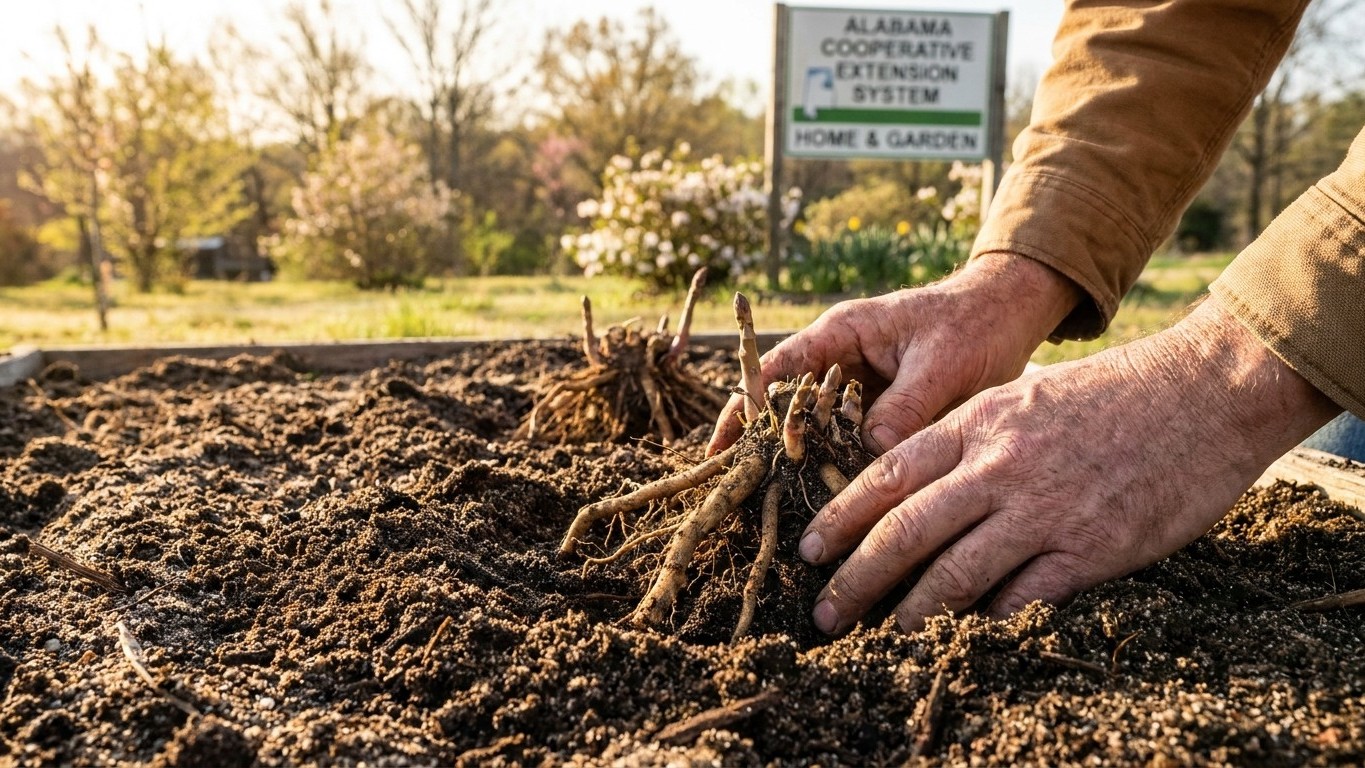

Crowns go into Nebraska ground in early spring, timed to the frost window rather than a calendar date, in furrows about 8 inches deep. That bed then sits for 10 to 15 years before it’s dug up again, so the spot you pick this spring is the spot you’re committing to for over a decade. The only soil rule that matters: it has to drain.
The short answer
Fifteen years is a long time to leave a plant in one place. Most vegetables get a fresh bed every season, but asparagus is planted once and then left to build a root system that keeps feeding the same crown for over a decade, which means the ground you choose has to work not just this year but for every year after. Utah State University Extension puts it simply: most soils will do, as long as they’re well drained. Standing water around asparagus roots for any stretch of time is what kills a bed, not cold, not wind, not a rough spring.
Nebraska’s official state soil, the Holdrege series, gives a useful baseline for what the region’s ground tends to do. It’s a Mollisol, the deep, dark prairie soil that built the Corn Belt, running loam to silt (67 percent silt, 22 percent clay, 11 percent sand) with organic matter around 2.0 percent and a surface pH near 6.2, on the slightly acid side. USDA’s own survey data lists it as well drained. That’s a reasonable sign for a lot of Nebraska gardens sitting on similar ground: water moves through it instead of pooling on top.
But a state soil describes a representative series, not the dirt behind your particular house. A garden in a river bottom, a lot that’s been graded and filled by a builder, or ground a few miles into hill country can behave nothing like the Holdrege profile. If a shovel test after a rain shows water sitting in the hole for more than a few hours, that spot isn’t right for a permanent bed as it stands. The fix isn’t complicated: build the row up into a raised mound or a framed bed several inches above grade, work in coarse organic matter to open up a heavy spot, and let gravity do the rest. What doesn’t work is planting asparagus in a low spot and hoping it dries out over the years, because by the time you find out it doesn’t, the crowns are already established.
The payoff, once the ground is right, comes on a fixed schedule that no amount of good soil will speed up. Nothing gets harvested in year one or year two. Year three brings a short first harvest window, about 4 weeks. Year four stretches to about 6 weeks, and from year five on you can typically cut for around 8 weeks each spring. The stopping point every season isn’t a date on the calendar either. It’s a look at the spears: once most of what’s coming up is thinner than a pencil, harvest ends for the year and the plant is left to grow ferns that rebuild the root system for next spring.
Will the summer here water it for you?
An established asparagus bed asks for something specific: 1 to 2 inches of water every other week during the first two years while roots are still spreading out, then a lighter routine of every three weeks once the planting matures. Nebraska’s summer rainfall doesn’t hand that over on a predictable schedule, and the shortfall shows up differently depending on which month you’re in.
- June averages 4.44 inches for the month, which lines up reasonably well with a young bed’s every-other-week need if that rain falls in two or three decent events rather than one storm that mostly runs off.
- July is the region’s driest summer month at 3.55 inches, and it’s also typically the hottest, which means whatever rain does fall evaporates faster and stretches less far across the root zone.
- August picks back up to 4.6 inches, offering some relief, but by then heat stress from July has often already left the bed behind on soil moisture.
- Across the full stretch, June through August averages about 12.6 inches, which sounds like plenty on paper but arrives unevenly, in bursts rather than the steady every-other-week rhythm a new bed actually wants.
- A mature bed on its every-three-week routine has more cushion to absorb a dry stretch like July, since the deeper, established root system reaches moisture a first- or second-year planting simply can’t get to yet.
- The practical takeaway: a rain gauge staked next to the bed is what actually answers the watering question, because normals describe the reference station’s average, not what falls on one particular row in one particular summer.
For a first- or second-year bed, that means planning on supplemental watering through most of a typical July, and checking soil moisture by hand rather than trusting the sky to handle it. A finger pushed two inches into the row tells you more than any weather normal will.
When to put the crowns in
Crowns go into the furrow in early spring, and the practical anchor for that timing is the last spring frost window. NOAA’s climate normals put that window at around April 12 to April 23 for the reference station, based on 1991-2020 freeze-probability data. That’s a mean figure covering three decades, not a guarantee for any single spring, and it’s drawn from an airport station. Suburban and rural gardens nearby often see their own last frost land a week or two later, sometimes more at higher elevation, so the local county extension office or a personal frost log is worth checking before the shovel comes out.
Because the crowns sit dormant a few inches underground at planting, many growers get the furrow dug and the roots laid in a couple of weeks before that last-frost window closes, rather than waiting until the date has fully passed. A crown resting below the soil surface isn’t exposed to the air temperature the way an emerging spear is, so a late cold snap that would nip green growth generally doesn’t reach the root itself.
The furrow itself goes in about 8 inches deep, per Utah State University Extension guidance, with the crown set at the bottom and roots spread out. It isn’t filled in all at once. The soil goes back in gradually across the season, roughly 2 inches every other month, gradually leveling the trench as the emerging shoots gain height. That staged backfill gives the developing root system room to establish before it’s under full soil depth.
Crowns versus seed
Seed is the slower alternative. It’s started ahead of the outdoor planting window and grown on before the seedlings ever go into the ground, adding time to the front end of an already long-term project. Most home gardeners skip that step and start with a one-year crown instead, since it shortens the wait to that first small year-three harvest.
Whichever route you take, variety choice on the market comes down mostly to sex, not flavor or yield, since Utah State University Extension’s guidance doesn’t publish a preference between named varieties on those grounds.
| Variety | Type |
|---|---|
| Jersey Giant | All-male |
| Jersey Knight | All-male |
| UC 157 F1 | Male/female |
| Purple Passion | Male/female |
All-male varieties tend to be favored simply because they don’t spend energy producing seed, leaving more of the plant’s resources for spear production, though no comparative yield figures are published here to size that difference.
Common questions
Does Nebraska’s frost date change when I should plant?
It shifts the window, not the method. The April 12 to 23 range is a station average, so a garden further from that reference point, or at a different elevation, may run a week or two later. Getting the furrow ready a bit ahead of the local last-frost estimate is generally fine, since the crown sits below the frost line at planting depth.
What if my soil doesn’t drain like the state soil description?
Then the bed goes up, not down. A raised mound or framed bed lifts the crowns above a slow-draining layer, and working coarse organic matter into the row loosens compacted ground. Since this planting is meant to stay put for over a decade, it’s worth testing drainage with a simple hole-and-water check before committing a permanent spot.
How long until I can actually harvest asparagus from a new bed?
Not before year three, and even then only for a short stretch, about 4 weeks. Year four extends that to roughly 6 weeks, and from year five onward a mature bed typically supports around 8 weeks of cutting each spring, stopping once most spears thin out to pencil width or less.
Do I need to water it all summer, every summer?
Heaviest need is in the first two years, when the bed wants 1 to 2 inches every other week and Nebraska’s dry stretch in July often falls short of that on its own. Once the planting matures, the routine relaxes to about every three weeks, and an established root system handles a dry month noticeably better than a first-year bed can.