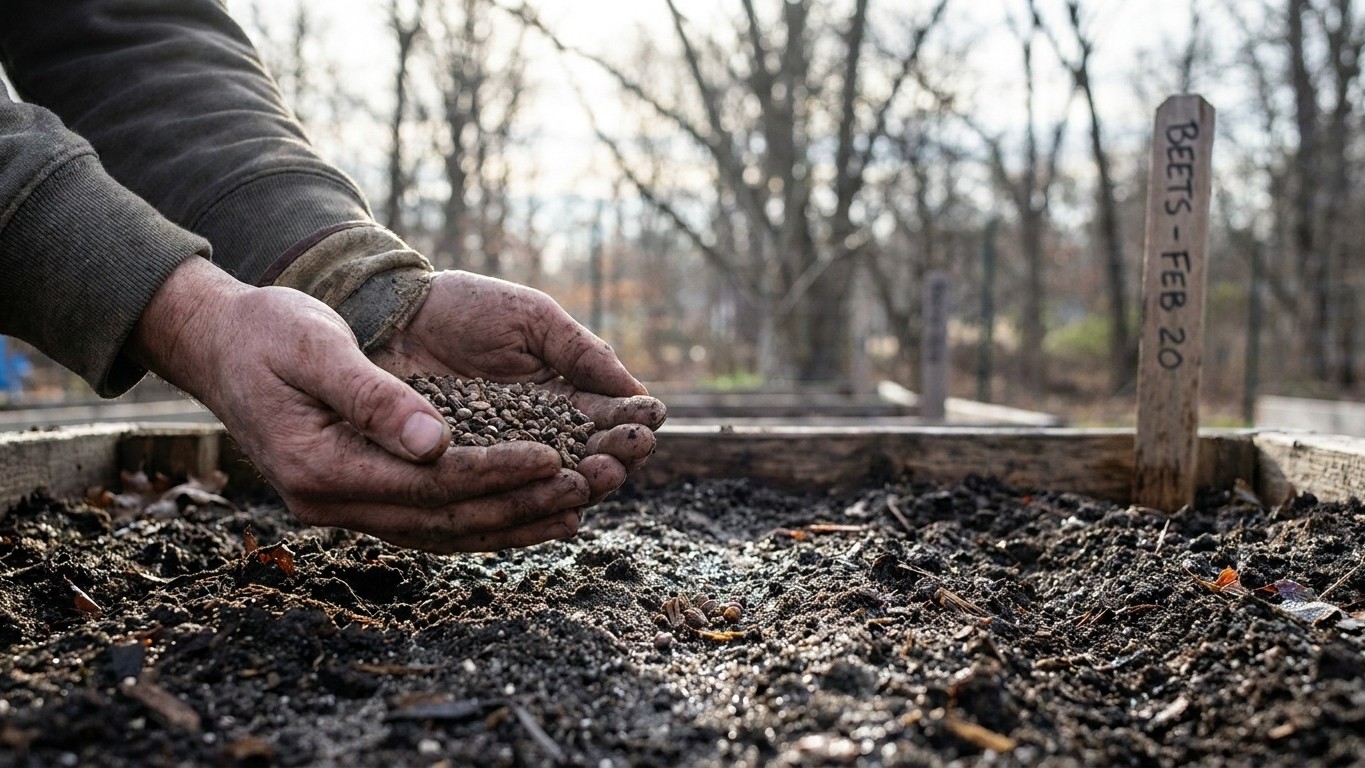

The short version: sow beet seed directly in the ground two to three weeks before the last spring frost. In Nebraska, using Lincoln’s 1991-2020 climate normal frost window of April 12 to April 23 as a reference, that puts outdoor seeding somewhere in the stretch from late March into the first half of April. Your own county’s last frost may land later than Lincoln’s, so treat that window as a starting point, not a calendar lock.
The short answer
Nebraska’s official state soil is the Holdrege series, a Mollisol, the deep, dark prairie soil that built the Corn Belt. USDA NRCS records for the surface horizon of the major Holdrege components show a texture of 11 percent sand, 22 percent clay and 67 percent silt, a surface pH near 6.2, organic matter around 2.0 percent, and good drainage. That’s a silt loam, not the deep sandy loam Utah State University Extension describes as the ideal beet bed. It’s still workable ground for beets, since drainage is good and organic matter is present, but a soil this heavy in silt tends to seal into a crust when it dries after watering or rain, and a crust is exactly what a beet seedling, which pushes up on a thin thread of a stem, struggles to break through.
That crusting tendency matters more than the pH number does here. A surface pH of 6.2 is mildly acid, workable for most vegetable gardens, and not something to chase with amendments unless a soil test says otherwise. The bigger lever a gardener has is organic matter: Extension guidance caps amendment at 1 inch of composted material per 100 square feet, worked in to loosen that silt-heavy surface without overloading it with nitrogen, which pushes leafy top growth at the expense of the root.
On heat, the published record here doesn’t give a day-count of afternoons above 90 F for Lincoln or any other Nebraska city, so that specific figure isn’t available to cite. What is documented is the mechanism that matters for beets: Utah State University Extension’s guidance states that heat above 85 F combined with water stress makes the root turn woody. Nebraska summers run hot enough, often enough, that a beet crop left to dry out on a July afternoon is a real risk, not a theoretical one. The fix isn’t a thermometer reading, it’s keeping the row from drying out once temperatures climb.
None of this describes every yard in the state. Nebraska spans hundreds of mapped soil series, and a garden in a river bottom, in the Sandhills, or on ground a builder graded and refilled will behave nothing like the Holdrege profile above. Treat the state soil as a sketch of regional tendency, silt-heavy, well drained, mildly acid, then confirm your own bed with a soil test before you plan amendments.
The six weeks that decide it here
Sowing two to three weeks ahead of the last frost puts the first six weeks of a beet’s life, from germination through the establishment of true leaves, inside a known slice of the Nebraska calendar: roughly mid-March through mid-May, depending on where the county’s frost date falls relative to Lincoln’s April 12-23 range. That window is the one Utah State University Extension flags as the danger zone for bolting: water stress during those first six weeks pushes the plant to flower early rather than build a root, and once a beet has bolted, the root is finished putting on size.
Nebraska spring in that window is not a steady, predictable ramp. It’s a season known on the Plains for swinging hard between dry, windy stretches that pull moisture out of a seedbed fast, and sudden wet spells that can leave a silt-heavy surface soggy for a few days before it dries and crusts again. That back-and-forth is the practical risk for a newly seeded beet row: the soil can go from too wet to work to dry and crusted over inside a week, with little warning either way.
The bolting risk in Nebraska, then, sits specifically in those early dry, windy stretches, the kind that show up between rain events and pull surface moisture out of a silt loam faster than the depth of the seed would suggest. A gardener who sows in late March and then gets ten days of wind and sun with no rain is looking at exactly the water-stress scenario that triggers early flowering, even though the calendar says it’s still cool. Checking the row by hand, not by the calendar, is the more reliable habit through this stretch.
It’s also worth remembering that this six-week clock starts at seeding, not at any later date. Beets don’t get transplanted the way tomatoes or peppers do; the 60 to 80 days USDA and Extension guidance count toward harvest run from the day seed goes into the ground, and so does the six-week window where bolting risk is highest.
What goes wrong here
- Crusted surface blocking germination. Holdrege soil’s 67 percent silt content means a watered or rained-on seedbed can dry into a thin crust strong enough to trap a beet seedling underneath. Water lightly and often enough to keep the top inch from drying to a hard skin, rather than soaking heavily and letting it bake.
- Bolting from a dry, windy spell in the first six weeks. A run of ten days without rain during Nebraska’s variable spring can stress a newly sown row enough to trigger early flowering. Check soil moisture by hand along the row through this stretch instead of relying on a watering schedule.
- Woody roots from summer heat on top of dry soil. Once temperatures push past 85 F, any accompanying water stress turns the root fibrous and tough. A layer of mulch over the row through the hottest weeks helps hold moisture and keeps soil temperature down at root depth.
- Over-amending the silt loam. Adding more than the recommended 1 inch of composted organic matter per 100 square feet on ground that already carries roughly 2.0 percent organic matter can push nitrogen too high, favoring leafy top growth over the root. Stick to the Extension-recommended rate and let a soil test guide anything beyond it.
Common questions
Can beets be started indoors and transplanted in Nebraska?
Extension guidance treats beets as a direct-seeded crop. The 60 to 80 days to harvest are counted from the day seed goes into the garden bed, not from a transplant date, so the two to three weeks before last frost timing applies to outdoor sowing itself.
How does the Holdrege soil’s drainage affect watering in the first weeks?
Because the series is classified as well drained, water doesn’t tend to pool on the surface, but the 67 percent silt content still means the top layer dries and hardens quickly between waterings. Frequent, light watering in the first weeks after sowing suits this soil better than infrequent, heavy watering.
Does the mildly acid pH of 6.2 need correcting before sowing beets?
That figure is a representative surface reading for the Holdrege series as mapped, not a measurement of any individual garden bed, and no beet-specific pH target is given in the sourced guidance here. A soil test of the actual bed is the only way to know whether amendment is needed.
What if my county’s last frost date is different from Lincoln’s April 12-23 window?
That range comes from the Lincoln airport weather station in NOAA’s 1991-2020 Climate Normals. Rural and suburban gardens away from that station, and anywhere at higher elevation, typically see their last frost later, often by one to two weeks, so shift the two-to-three-week sowing rule back from your own county’s actual frost date rather than Lincoln’s.