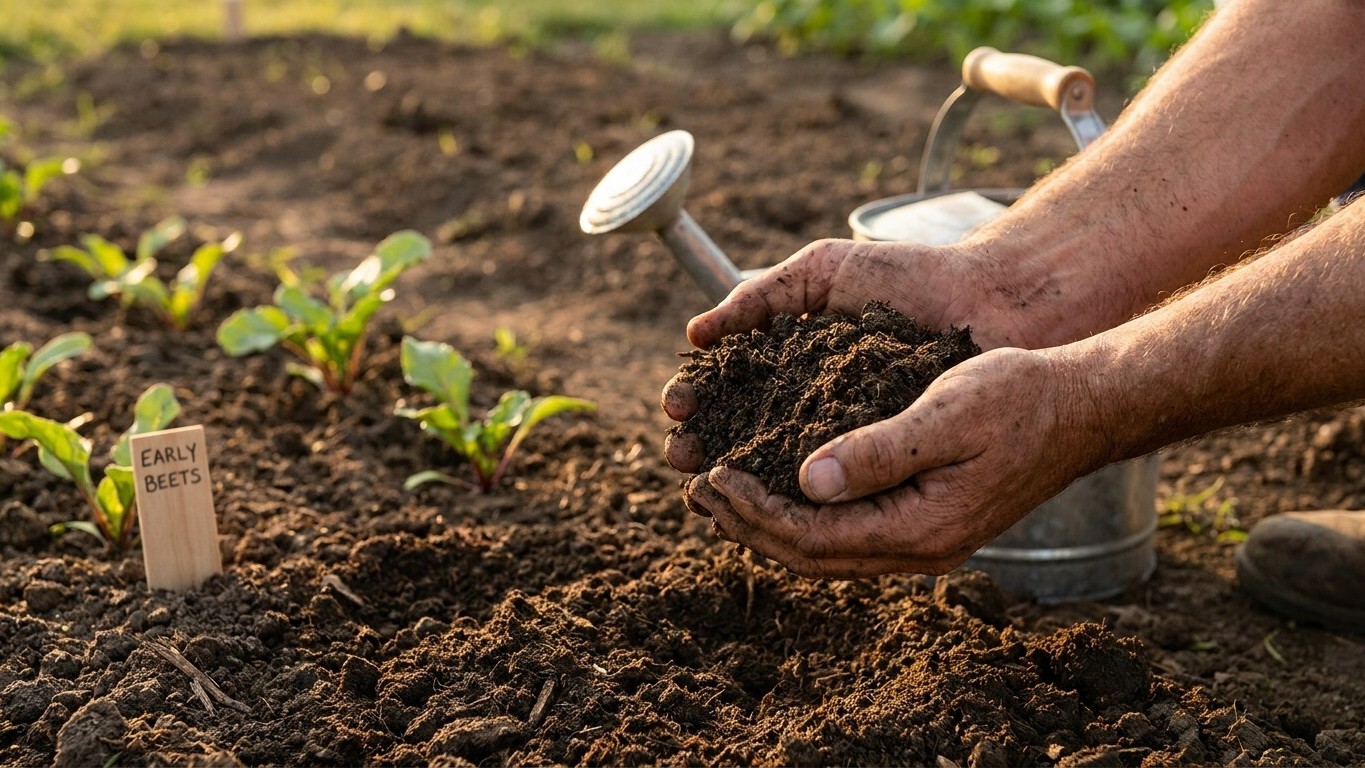

Nebraska’s official soil, the Holdrege series, is a well-drained silt loam built on prairie grass and centuries of decay, but it runs slightly acid and heavier in clay than what a beet root actually wants. When to Sow Beets in Nebraska comes down to timing it directly in the ground 2 to 3 weeks before the last spring frost, keeping that seed row from drying out, and the six weeks that follow decide whether you get a round, sweet root or a bolted, woody one.
The short answer
Nebraska’s state soil, named by state law and represented in USDA records as the Holdrege series, is a Mollisol: the deep, dark, prairie-built ground that made the Corn Belt what it is. The surface horizon runs about 11 percent sand, 22 percent clay and 67 percent silt, a silt loam texture, with organic matter around 2.0 percent and a surface pH near 6.2, slightly on the acid side. It’s classed well drained, which is a point in its favor for a root crop that hates sitting in water.
Set that against what a beet is actually looking for. Utah State University Extension describes the ideal beet bed as deep, sandy, well-drained soil rich in organic matter, amended with no more than 1 inch of composted organic matter per 100 square feet. The Holdrege series checks the drainage and organic-matter boxes reasonably well, but it’s a silt loam, not a sandy loam, and that difference matters at the seed-row level. Silt-heavy surfaces can seal over into a crust after a hard rain, and a beet seed, which is really a small dried fruit holding several embryos, doesn’t push through a crust as easily as it pushes through loose sand. The slightly acid pH is also a mismatch: beets generally prefer soil closer to neutral, and in acid ground boron, a nutrient beets are sensitive to, becomes harder for the plant to pull up.
On the heat side, the source data given here doesn’t publish a day-count of how often Nebraska’s reference weather station tops 90°F in a typical year, so no specific figure belongs on this page. What is documented is the threshold that matters for beet quality: heat above 85°F combined with water stress is what turns a root woody. Nebraska summers are widely known for stretches of that kind of heat, so the practical takeaway is to treat every warm dry week after the seedlings are established as a woodiness risk, not to wait for a specific temperature count that isn’t measured here.
None of this is a verdict on any one garden. Nebraska spans hundreds of mapped soil series, and the Holdrege profile above describes representative surface values across 248 mapped components of that series, not a number pulled from a worked garden bed anywhere in the state. A river-bottom plot, a hillside plot and a lot where a builder scraped and refilled the topsoil will all behave differently from the state soil and from each other. Treat the Holdrege numbers as a starting sketch of what the region’s ground tends to do, then confirm your own dirt with a real test — see this breakdown of Beet Soil in Nebraska for a deeper look at how local conditions stack up against what beets need.
The six weeks that decide it here
The standard advice is to sow beets 2 to 3 weeks ahead of the last spring frost. In Nebraska, that last frost falls between April 12 and April 23 at the reference weather station on record, which puts a typical seeding window somewhere around the last days of March into early April. Count forward six weeks from there and you land in mid-May, the stretch of the calendar that decides whether the crop bolts or holds.
That window sits inside a season Nebraska gardeners already know as unpredictable. Spring here doesn’t settle into one pattern; it swings. A dry spell that dries out the top inch of a silt loam bed in a matter of days can be followed by a soaking rain and then another stretch of wind and sun. For a beet seedling, that swing is exactly the wrong kind of stress. Utah State University Extension is specific on this point: water stress in the first six weeks after seeding is what causes premature flowering, the technical term for what gardeners call bolting. Once a beet plant bolts, it channels its energy into a flower stalk instead of a root, and the harvest is over before it really started.
The Holdrege-type silt loam texture cuts both ways during this window. Silt loam holds more moisture than a sandy soil would, which sounds like an advantage against the dry spells. But that same texture crusts when it dries out fast after a rain, and a crusted surface can trap a germinating beet seedling before it ever breaks through. So the six-week window isn’t just about total rainfall. It’s about the rhythm: a dry snap right after sowing threatens germination through crusting, while a dry snap three or four weeks in, once the seedlings are up, threatens bolting through water stress. Watching the calendar and the topsoil surface together, rather than trusting a general “spring is wet enough” assumption, is what separates a full stand of beets from a patchy, bolted one.
Remember, too, that April 12 to April 23 is a station-level figure, not a guarantee for every yard in the state. Rural and suburban gardens away from that station commonly see their own last frost land later, sometimes by one to two weeks, with even later dates likely at higher elevation. Anyone sowing by the reference dates alone risks pushing seed into ground that’s colder and wetter than the calendar suggests.
What goes wrong here
- Seedlings never break the surface. A silt loam bed like the Holdrege type can crust hard after a rain followed by sun, sealing over the fine beet seed before it sprouts. Rake the top half-inch loose right after any heavy rain during germination, and keep the row lightly mulched with a thin layer of compost or straw so the crust never fully forms.
- Plants bolt before making a root. This is the water-stress failure, not the heat failure, and it happens in that first six-week window after sowing. A dry stretch that lets the topsoil dry out while seedlings are small pushes the plant toward flowering instead of root growth. Water on a schedule through that window rather than waiting for wilting to show, since by the time leaves droop the bolting signal may already be set.
- Roots turn woody and fibrous later in the season. This is a separate failure from bolting, caused by heat above 85°F landing on a plant that’s also short on water once the root is already forming. Deep, consistent watering during any hot, dry stretch in summer, plus mulch to slow evaporation from that silt loam surface, keeps the root tender.
- Roots come up forked or stunted. The 22 percent clay fraction in Holdrege-type ground means some Nebraska beds run heavier than the sandy loam beets prefer, and compacted or clay-rich pockets deflect a taproot into forks. Working the amendment of composted organic matter, at the rate of no more than 1 inch per 100 square feet, into the top several inches before sowing loosens that resistance.
- Leaves yellow or growth stalls despite adequate water. The slightly acid surface pH near 6.2 in Holdrege-type soil can lock up boron, a micronutrient beets need more than most vegetables. If a soil test for your own ground comes back acid, a modest lime application ahead of the season, guided by that test rather than guesswork, corrects the availability problem.
Checking this against your own county
Everything above starts from the Holdrege series because it’s the soil Nebraska law recognizes as representative of the state, not because it’s a stand-in for any particular backyard. The only way to know what you’re actually working with is a soil test pulled from your own bed, checked for texture, pH and organic matter, then compared against the beet’s preferences laid out here.
Nebraska Extension, reachable at extension.unl.edu, runs county offices that can point you to soil testing options and give you frost-date guidance calibrated to your own location rather than to a single reference weather station. That local read matters more than any statewide figure once you’re deciding the actual week to put beet seed in the ground.
Common questions
How many days do beets take from seeding to harvest in Nebraska?
Beets are direct-sown, and the days-to-maturity count always runs from that seeding date, not from a transplant, since beets aren’t started indoors and moved out the way tomatoes are. General guidance from Utah State University Extension puts most beet varieties in the 60 to 80 day range from seed, so counting forward from your actual sowing date in late March or early April gives a workable harvest window.
Should I add compost to Holdrege-type soil before sowing beets?
Yes, within limits. Utah State University Extension recommends no more than 1 inch of composted organic matter per 100 square feet worked into the bed. Given the Holdrege series’ organic matter is already around 2.0 percent, staying inside that limit avoids over-amending a soil that isn’t badly deficient to begin with.
Does the slightly acid pH of Nebraska’s state soil hurt beets?
It can. A surface pH near 6.2, as recorded for the Holdrege series, sits on the acid side of what beets generally prefer, and acid soil can limit boron uptake, a nutrient beets rely on. That’s a reason to test your own bed’s pH rather than assume it matches the state figure, since garden soils vary widely from the mapped series.
What’s the real difference between bolting and woodiness in beets?
They’re two separate failures with two separate causes. Bolting is premature flowering triggered by water stress in the first six weeks after seeding, according to Utah State University Extension, and it happens early in the season. Woodiness is a texture problem in the root itself, caused later in the season when temperatures pass 85°F while the plant is also short on water. Watering on a schedule addresses both, but they strike at different points in the growing calendar.