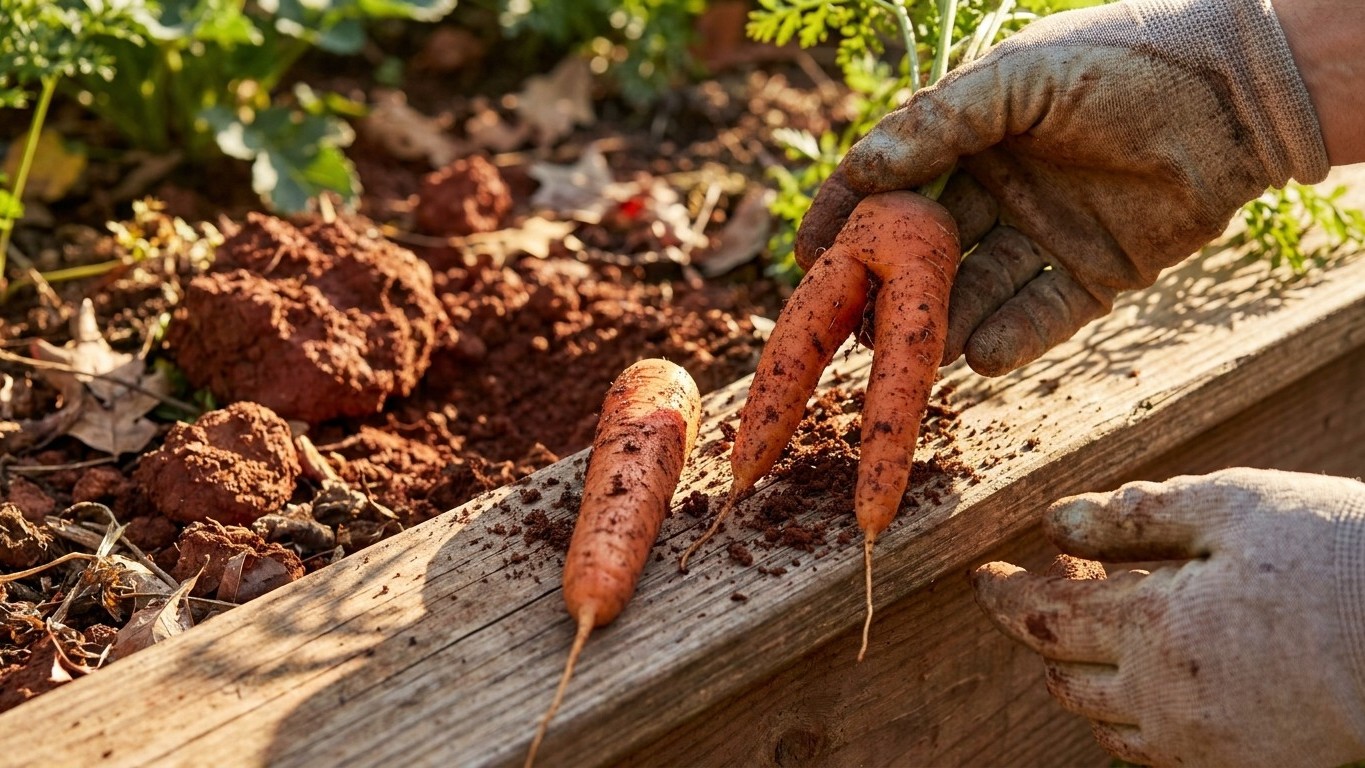

The short answer is no, not automatically. Nebraska’s own state soil, the Holdrege series, is a well-drained silt loam, not a dense clay, so it doesn’t carry the traits that typically split a carrot root in two. But that single soil series covers only part of what’s actually in the ground across the state, and the real answer for any one backyard depends on what’s under the topsoil there, not on what represents the state as a whole.
The short answer
Nebraska’s designated state soil, named by state law, is the Holdrege series, a Mollisol, which is the deep, dark prairie soil that built the Corn Belt. Surface samples from the major components of this series run slightly acid, with a pH around 6.2, and the texture comes out to 11 percent sand, 22 percent clay, and 67 percent silt, classifying it as a silt loam. Organic matter sits near 2.0 percent, and drainage is rated well drained. Those numbers come from the USDA NRCS Soil Survey Geographic Database, drawn from measurements across 248 mapped components of the series.
What that means for a carrot bed: a silt loam with only 22 percent clay and good drainage is on the friendlier end of what root vegetables need. Utah State University Extension, which studies carrot soil requirements, notes that carrots want deep, sandy, well-drained soil rich in organic matter, and that heavy or rocky soil is what makes the root fork. Twenty-two percent clay isn’t heavy clay. It’s a manageable middle ground, and combined with good drainage, it doesn’t automatically doom a straight taproot the way a dense clay pan would.
So if your garden actually matches the Holdrege profile, the odds favor a straight carrot, not a forked one. Working in compost before planting still helps, since organic matter loosens silt loam further and gives roots less resistance to push through. Double digging isn’t strictly necessary on a soil this open, but it never hurts, especially in a bed that’s been walked on or compacted by equipment.
Here’s the catch, and it’s a big one: Nebraska spans hundreds of distinct soil series, not one. The Holdrege series is the one chosen to represent the state, largely because it underlies so much of the farmland that made Nebraska a Corn Belt state. It says nothing about the soil in a specific yard, especially near a river bottom, on a hillside, or on any lot where a builder scraped off the topsoil and backfilled with subsoil or fill dirt. Those situations are common, and they can carry far more clay, far more rock, or far worse drainage than the state soil profile suggests. Treat the Holdrege numbers as a regional baseline, a hint about what the wider landscape tends to do, not a diagnosis of the dirt under your own carrots.
If a soil test or a hand dig turns up something heavier than a silt loam, the fix Utah State University Extension points to is straightforward: add plenty of compost and double dig the bed, or skip the guesswork altogether and build a raised bed filled with a loose, sand-rich mix. A raised bed sidesteps the question of what’s underneath entirely, which is often the fastest route to straight carrots regardless of what the county’s dominant soil series happens to be.
The test that settles it in your own garden
- Pick a spot in the actual bed where carrots will grow, not a corner of the yard that’s easier to reach, and dig down with a spade or garden fork as deep as the tool allows.
- Look at the sides of the hole for changes in color or texture. A hard, dense layer partway down, often lighter or grayer than the topsoil above it, signals a compacted layer or subsoil that a carrot’s taproot will have to fight through or fork around.
- Pull out any stones, gravel, or chunks of old construction debris you find in the excavated soil. Carrots hit these obstacles and split or curve around them, so the more you find in a single hole, the more likely forking becomes.
- Grab a handful of moist soil from the hole and squeeze it. Soil that forms a slick, sticky ribbon between your fingers is clay-heavy. Soil that falls apart immediately and feels gritty is sandy. Soil that holds a loose shape but crumbles with light pressure is closer to the loam carrots prefer.
- Fill the hole with water and watch what happens over the next several hours. Water that vanishes quickly points to fast, sandy drainage. Water that sits and barely moves points to a heavy or compacted subsoil that will need amending, or a bed built above it, before carrots go in.
- Repeat the dig in two or three spots across the bed. Soil can change dramatically over a few feet, especially in yards that were graded or partially filled, so one hole rarely tells the whole story.
None of this requires a lab, and none of it requires guessing at numbers you can’t actually measure at home. What it gives you is a direct answer specific to your own dirt, which matters far more than any statewide figure when the goal is a straight carrot instead of a forked one.
What goes wrong here
- Forking in heavy or compacted ground. Wherever the local soil runs heavier than a silt loam, either from natural clay content or from compaction near a foundation or driveway, the taproot meets resistance and splits. Utah State University Extension’s remedy is to work in plenty of compost and double dig the bed before sowing, loosening the soil well below where the root will travel, or to plant in a raised bed filled with a looser mix instead of fighting the native ground.
- Poor germination during a hot, dry stretch. Carrot seed is small and sits near the surface, and a crusted, dried-out top layer of soil, common in silt-heavy ground once it dries and cakes, keeps seedlings from pushing through. Keeping the seedbed consistently moist until seedlings emerge, rather than watering heavily and then letting it dry out, keeps the surface soft enough for germination.
- Splitting from uneven watering. Carrots that go through a dry spell and then get soaked, whether by a heavy rain or a catch-up watering session, tend to split as the root expands faster than its skin can stretch. A steady watering routine, rather than sporadic deep soakings after neglect, keeps this from happening regardless of what the underlying soil texture looks like.
- Rocky or debris-filled subsoil that never gets checked. Because carrots are sown directly in place with no transplanting step, there’s no second chance to inspect the root zone once seed goes in the ground. Any stones or hardpan left in the bed from the start will affect the whole crop, which is exactly why the hand-dig test matters before seeding, not after.
Common questions
Does the Holdrege series mean my whole county has the same soil?
No. The Holdrege series was chosen to represent Nebraska as a state soil because it underlies a large share of the farmland that shaped the Corn Belt, but the USDA maps hundreds of other series across the state. Soil near a river, on a slope, or on a lot that’s been graded or filled can differ completely from the Holdrege profile.
Is a pH of 6.2 the right number for my garden?
That figure comes from the surface horizon of Holdrege series components as mapped by USDA NRCS, not from a measurement of any individual worked garden bed. A cultivated bed can carry a different pH depending on past fertilizing, mulching, or amendments, so a soil test on your own bed is the only way to know your actual number.
How long do carrots take to mature after seeding?
Utah State University Extension’s guidance runs 70 to 100 days from seeding, since carrots are sown directly in the garden and never transplanted. There’s no separate transplant date to count from with this crop.
Is a raised bed always necessary in Nebraska?
Not if the native soil tests out close to a loam or silt loam with decent drainage, similar to the Holdrege profile itself. Raised beds become the practical answer mainly where a hand dig turns up heavy clay, compacted subsoil, or a lot of buried stone, since building up and filling with a looser mix sidesteps those problems entirely.