
Nebraska’s official state soil, the Holdrege series, is a deep, well-drained silt loam built from prairie grass and glacial dust, the kind of ground that made the Corn Belt possible. That’s a decent starting point for carrots, but it isn’t a guarantee. What actually decides whether your roots grow straight or fork into a wishbone is what’s sitting under your own raised bed or garden row, not what USDA maps for the state as a whole.
The short answer
The Holdrege series is classified as a Mollisol, the dark, organically rich soil order that built the Great Plains breadbasket. The Nebraska legislature named it the official state soil in 1979, and USDA NRCS records its surface horizon as roughly 11 percent sand, 22 percent clay and 67 percent silt, a loam-to-silt texture with a surface pH near 6.2, slightly on the acid side of neutral. Organic matter sits around 2.0 percent, and the drainage class is well drained.
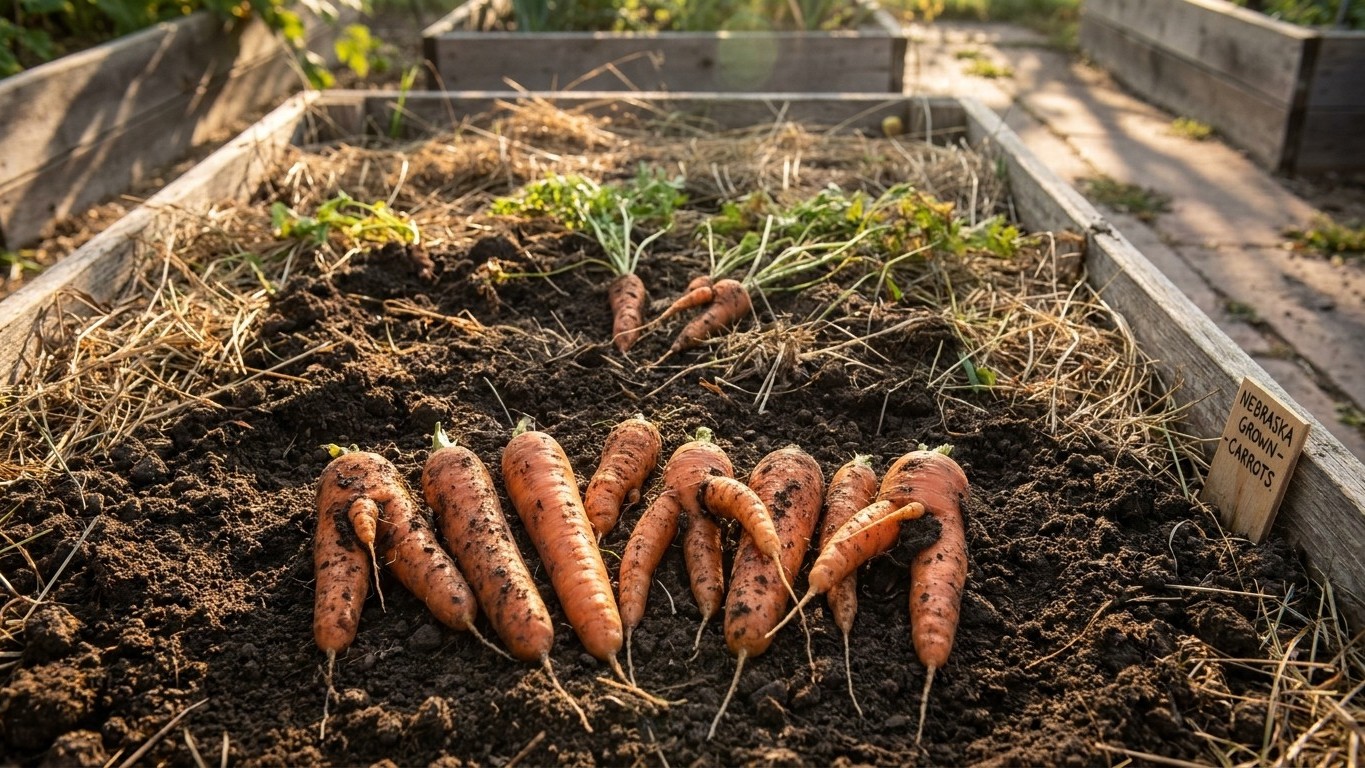
For carrots, that combination is more promising than most people assume. Utah State University Extension is blunt about what carrots need: deep, sandy, well-drained soil rich in organic matter. Heavy or rocky ground makes the taproot fork, split or grow stubby, because the root hits resistance and forks around it instead of pushing straight down. A silt-dominant, well-drained soil like Holdrege isn’t the loose sandy loam carrots love best, but it doesn’t fight the root the way a dense clay pan does either. Will Carrots Fork in Nebraska Soil? The 22 percent clay figure is enough to matter, though, especially if your particular patch compacts more than the mapped average.
So the practical answer: if your garden soil behaves anything like this state soil, you’re not starting from a bad place, but you’re also not starting from an ideal one. Working in compost before sowing loosens the texture and feeds the organic matter carrots want, and double digging breaks up any compacted layer sitting just under the surface where a taproot would otherwise stall. If your particular bed runs heavier than that, wetter, stickier, slower to drain, a raised bed filled with a loose, sandy-loam mix sidesteps the problem entirely rather than fighting it every season.
None of this is a diagnosis of your yard. Nebraska spans hundreds of mapped soil series, and Holdrege represents only the type judged most characteristic of the state as a whole. River bottoms drain differently than upland fields, clay pockets show up where you least expect them, and any lot a builder graded or filled has a soil history that has nothing to do with what NRCS mapped decades ago. Treat the state soil as a hint about what the region’s ground tends to do, not a reading of the dirt under your carrots.
The test that settles it in your own garden
State soil surveys tell you about the region. They tell you nothing about the twelve square feet where you’re planning to sow a row of carrots this spring. That takes a few minutes with a shovel, not a lab.
- Dig a test hole. Pick the actual bed you intend to sow, not a random spot in the yard, and dig straight down. Note how much effort it takes: does the shovel slide through cleanly, or does it hit resistance partway down?
- Check the depth and the stones. Carrots need clear, unobstructed depth to grow straight. If you hit a hardpan layer, a rock bed, or heavy clay within the first 10 to 12 inches, that’s exactly the kind of obstruction that forks a taproot.
- Feel the texture. Grab a handful of moist soil and squeeze it into a ball. If it holds a slick, ribbon-like shape and resists breaking apart, you’re dealing with clay-heavy ground. If it falls apart the instant you open your hand, it’s sandy. Something in between that holds loosely and crumbles with a little pressure is closer to the loam carrots prefer.
- Watch how water moves through it. After a rain, or after you water the bed, come back and look. Standing water that lingers for a long stretch points to poor drainage. Water that disappears almost as fast as it falls suggests a sandier, faster-draining mix.
Run through those four checks before you commit seed to the ground, and you’ll know more about your actual bed than any state soil map can tell you.
When to sow here
Carrots are sown directly into the ground as seed. There’s no transplant date to count from, and no seedling tray involved, so every timing rule here starts from the day seed goes into soil.
- Start with the local frost window. NOAA’s 1991-2020 climate normals, measured at the Lincoln area reference weather station, put the last spring occurrence of a 32°F freeze, at a 30 to 70 percent probability, between April 12 and April 23.
- Count backward two to three weeks. Carrots tolerate cool soil better than many vegetables, so the sowing window falls before that frost date rather than after it. Counting three weeks back from April 12 lands around March 22; counting two weeks back from April 23 lands around April 9. That stretch, roughly late March into early April, is the target sowing window for this reference point.
- Check the soil, not just the calendar. None of that arithmetic matters if the ground itself isn’t ready. Soil temperature needs to reach a minimum of 40°F before carrot seed will germinate at all. Push a soil thermometer a couple of inches into the bed rather than guessing from air temperature.
- Aim for the real sweet spot. Germination is fastest and most reliable between 55°F and 65°F. If your soil is sitting right at that 40°F minimum, seed will still sprout, just more slowly and less evenly than if you wait for warmer ground.
- Adjust for your own county. The April 12 to April 23 window comes from one reference weather station, not a statewide promise. Rural gardens, higher elevations and spots away from that station often see their last frost run one to two weeks later than the airport reading.
What goes wrong here
- Forked roots in heavy ground. Where clay content runs higher than average, or a compacted layer sits under the topsoil, the taproot meets resistance and splits around it instead of driving straight down. Working in compost and double digging the bed before sowing breaks up that resistance; if the whole bed runs heavy, a raised bed filled with a looser, sandier mix avoids the problem from the start.
- Poor germination during a hot, dry spell. Carrot seed germinates best between 55°F and 65°F, and a sudden warm snap right after sowing can dry out and crust the soil surface before seedlings ever emerge. Keeping the top inch of soil consistently moist, with light, frequent watering rather than one heavy soak, gets more of the row to actually sprout.
- Split roots from uneven watering. Carrots that go through a dry stretch and then get hit with a heavy watering or a hard rain tend to split as the root swells too fast after being stunted. A steady, regular watering schedule, rather than a drought-then-deluge pattern, keeps growth even from seed to harvest.
Checking this against your own county
Everything on this page comes from a statewide soil series and a single reference weather station, useful for setting expectations but not a substitute for local knowledge. Nebraska Extension, run through the University of Nebraska-Lincoln, keeps county-level guidance on soil testing, frost timing and vegetable planting that reflects conditions closer to your actual garden.
Find your local office and current guidance at Nebraska Extension. A county-level soil test in particular is worth the small cost: it gives you an actual pH and nutrient reading for your bed instead of a statewide average, which matters more for carrots than almost any other root crop.
Common questions
Does Nebraska’s clay content mean carrots will always fork?
No. The state soil averages 22 percent clay with a well-drained classification, which is manageable with compost and proper bed preparation. Forking becomes a real risk mainly where a garden’s actual soil runs heavier or more compacted than that average, which is why testing your own bed matters more than the statewide figure.
Can I sow carrots earlier than the frost window suggests?
The frost date isn’t really the limiting factor for carrots since they tolerate cool soil well. The 40°F soil temperature minimum is the real gate. If your soil hits that mark before the frost window opens, sowing can start earlier, provided you’re prepared for slower germination in cooler ground.
Why did my carrots come up patchy instead of an even row?
Uneven germination usually traces back to soil temperature swinging outside the 55°F to 65°F sweet spot, or the surface drying out and crusting between waterings. Keeping the top inch of soil consistently moist during the germination window addresses most patchy stands.
Is a raised bed necessary, or is double digging enough?
It depends on how heavy your particular soil runs. If double digging and compost get you a loose, obstruction-free profile to at least 10 to 12 inches, that’s usually enough. If the ground stays dense and slow-draining even after working it, a raised bed with a purpose-built loose mix solves the problem more reliably than repeated soil amendment.