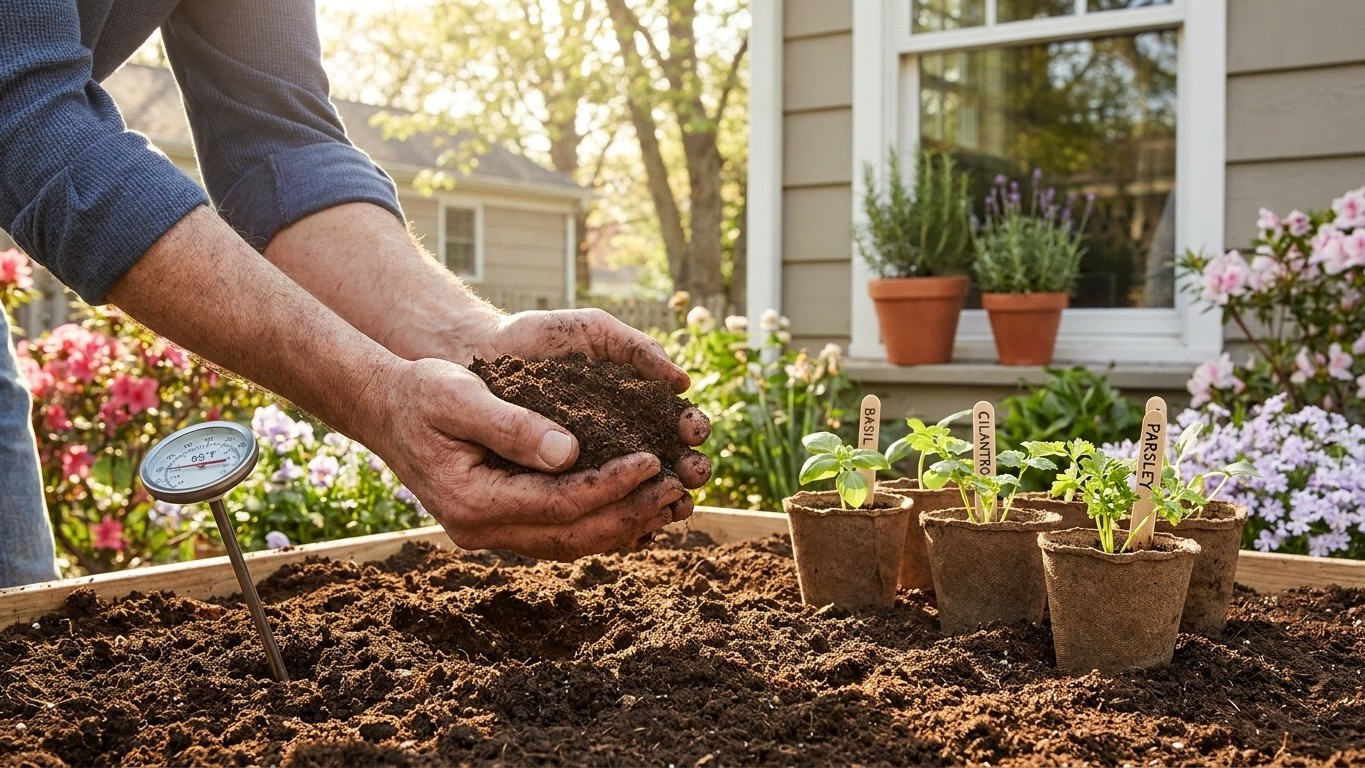

Plant tender herbs like basil, cilantro, and dill outdoors only after the soil has warmed past the mid-40s, which in most of Nebraska falls between late April and mid-May. Hardy perennial types such as thyme, sage, and chives can go in earlier. The bigger question for this state isn’t the last frost, though. It’s winter: Nebraska’s cold decides which herbs live outside year-round and which need a pot and a windowsill.
When the soil is warm enough in Nebraska

The frost calendar for the reference station in Omaha, drawn from NOAA’s 1991-2020 Climate Normals, puts the last spring freeze somewhere between April 12 and April 23 (source: NOAA NCEI, station USW00014942). That’s not a single day marked on a calendar. It’s a probability band, the window where the 30 to 70 percent chance of a 32°F freeze sits. Some years the freeze risk clears earlier, some years later, and the further you are from that Omaha station, the less it applies directly.
Suburban yards and rural properties across the state typically see their last frost land later than the airport figure, sometimes by one to two weeks, and more if you’re gardening at elevation in the Panhandle or in a low frost pocket near a creek bottom. Treat April 12-23 as a starting reference for eastern Nebraska, not a promise for your particular county.
Frost date, soil temperature, two different things
Here’s the part that trips up a lot of new herb growers: frost date and planting date are not the same thing. Frost is air temperature at a specific low point overnight. Soil temperature is a slower, steadier measure, and it’s the one basil, cilantro, and other warm-season herbs actually respond to. Soil needs to sit consistently in the mid-40s to low 50s before those seeds germinate reliably or transplants stop sulking. That threshold is usually reached one to three weeks after the last frost risk has passed, not the same week.
Cold-hardy perennial herbs don’t play by that rule at all. Chives, thyme, oregano, and sage tolerate a light frost and can go into the ground while the soil is still cool, often two to three weeks before the frost-free date arrives. That’s a meaningful head start if you’re building a permanent herb bed rather than replanting annuals every spring.
One note that applies to every herb page on this site: some herbs carry a long-standing reputation for medicinal use. This page doesn’t evaluate those claims one way or the other, and none of what follows should be read as health guidance. It’s a garden and kitchen page, nothing more.
How long the season lasts here
Run the two frost windows against each other and Nebraska’s frost-free season lands somewhere between roughly 175 and 197 days, depending on which end of each range you draw from: April 23 to October 15 on the short end, April 12 to October 26 on the long end (both from NOAA NCEI 1991-2020 Normals, Omaha station). That’s a wide spread for one state, and it says something real: eastern Nebraska gets close to six and a half months of workable growing weather in an average year, while a grower dealing with a later spring and earlier fall might only see five and a half.
That range changes how you plan the herb bed, not just when you start it. On the long end of the window, there’s real room for a second sowing of fast annual herbs like cilantro or dill once the first planting bolts in the heat of July. Cilantro in particular runs through its life cycle quickly once temperatures climb, and a mid-summer resow timed for a fall harvest is a realistic move if your local frost date leans toward late October.
On the short end, that second sowing gets risky. If your first fall frost tends to land closer to October 15, a summer-planted batch of cilantro or basil may not mature before the cold shuts it down, and you’re better off treating the spring planting as the only shot for the year. This is exactly the kind of judgment call that’s worth working through in detail, and the site’s guide to succession sowing herbs walks through how to time a second planting against your own local frost dates rather than a statewide average.
The season length also affects whether transplanting versus direct-seeding makes sense. A shorter window rewards starting slow annual herbs indoors weeks ahead and moving out transplants with an intact root ball, so the plant isn’t losing growing days to germination in the garden. A longer window gives more slack to direct-seed and let things catch up.
Heat and water in Nebraska

Nebraska summers run hot and generally dry through the peak of the season, with afternoon heat building steadily from June into August across most of the state and rainfall tapering off compared to spring. That combination pushes many culinary herbs, especially the Mediterranean types like rosemary, thyme, and oregano, toward better performance than they’d get in a humid, cloudier climate, since these herbs evolved for lean, well-drained, sun-baked ground and don’t appreciate wet feet or heavy humidity sitting on their leaves.
But summer heat isn’t really the variable that decides what belongs in a Nebraska herb garden long-term. Winter is. The coldest month here runs a mean daily minimum of 15.2°F at the Omaha reference station (NOAA NCEI 1991-2020 Normals), and the state spans USDA Plant Hardiness Zones 4a to 5b, a range built entirely around one measurement: the average annual extreme minimum temperature.
Why winter reorganizes the whole herb bed
That single number, the coldest-month minimum, splits Nebraska’s herb options into two very different groups. Cold-hardy perennials like chives, thyme, oregano, sage, and mint can generally handle a Zone 4-5 winter in the ground, especially with a layer of mulch over the crown once the ground starts to freeze. Rosemary and bay, by contrast, are perennial only in much milder zones, typically 7 or 8, and simply don’t survive an outdoor winter here. In Nebraska those two have to be grown as container plants, brought indoors before the first hard freeze and set on a bright windowsill until spring.
That’s a different way of organizing a herb garden than a lot of national planting guides assume. Instead of asking “is this herb easy to grow,” the Nebraska question is “does this herb come back on its own next April, or does it need a pot and a spot indoors for five months.” Once you sort your herb list that way, the rest of the planning gets a lot simpler.
Where summer humidity does play a role is disease pressure, not survival. A cooler, damper stretch of June or a wet July raises the risk of powdery mildew on herbs like mint and bee balm, and slows ripening on anything that wants full, steady sun. Spacing plants for airflow and avoiding overhead watering late in the day matters more here than chasing extra heat tolerance.
Which herbs suit Nebraska
Sort by type rather than variety and the choices get clearer fast. A short frost-free window on the low end of Nebraska’s range favors quick, early annual herbs: dill, cilantro, and basil all move fast enough to fit inside a five-and-a-half-month season, especially with a resow of cilantro once the first crop bolts. A long window on the high end gives more slack for slower-maturing annuals and for a genuine second sowing of the fast types.
For the permanent part of the bed, cold-hardy perennial types carry the state through winter without help: chives, oregano, thyme, sage, and mint all sit comfortably within Zone 4a-5b once established, particularly with a mulch layer for insulation. Tender perennials, rosemary and bay chief among them, need to come inside before the first fall frost and spend winter as houseplants, since Nebraska’s coldest-month minimum of 15.2°F is well below what keeps their roots alive outdoors.
Humidity swings in a given summer make disease resistance worth weighing alongside earliness, particularly for anything in the mint family that tends to mat down and trap moisture at the base. Airflow, not heat tolerance, is the practical fix.
Local variety trial data is the real guide to what to plant. The varieties actually tested and recommended for Nebraska conditions change from year to year and come from field trials. That work belongs to the University of Nebraska-Lincoln Extension, whose regional offices track which basil strains resist downy mildew locally, which dill holds up to wind, and which thyme overwinters best in a given county. A call or visit to your county extension office turns everything above, from frost dates to hardiness zone, into an actual variety list worth planting.