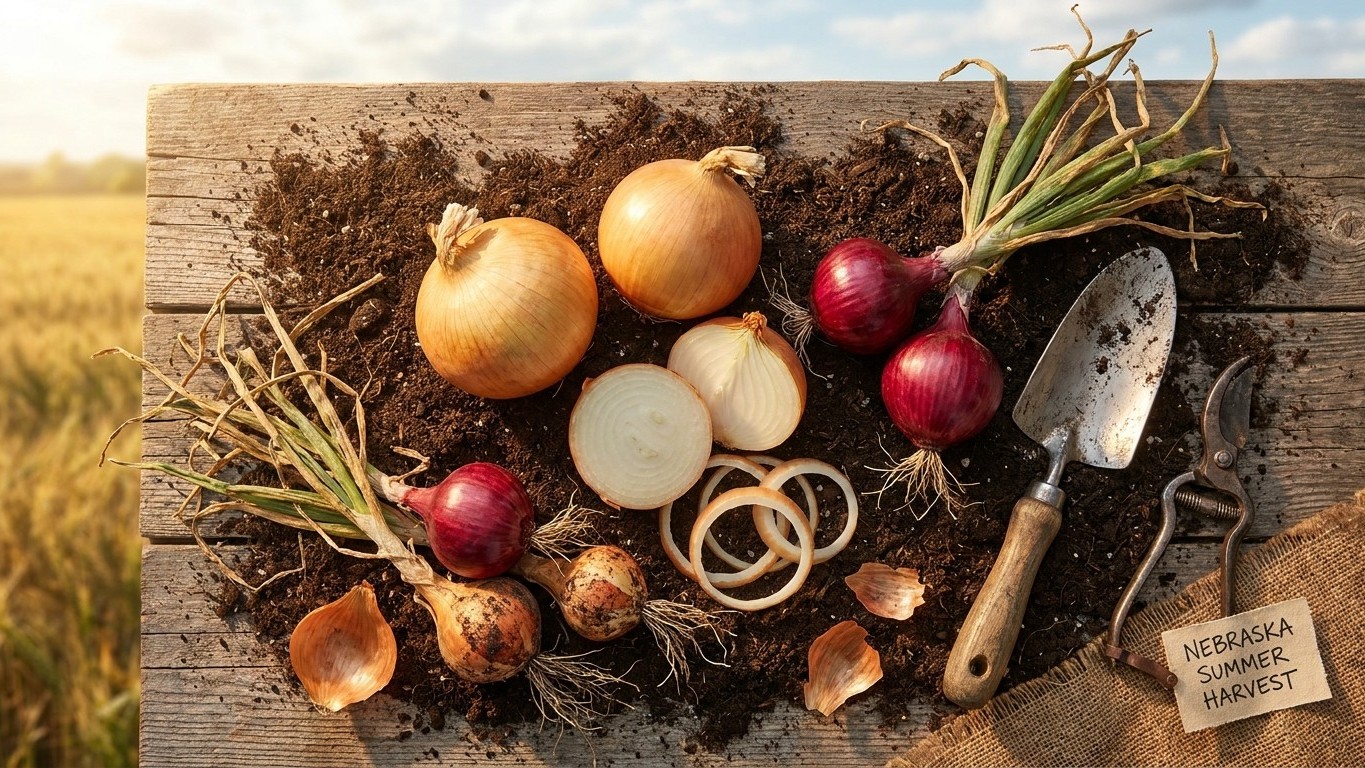

Nebraska sits at roughly 41.31°N, where the longest day of the year delivers 14 hours and 59 minutes of daylight. That number puts the whole state solidly in long-day and intermediate-day onion territory — the varieties that wait for 14 to 16 hours of daylight before they start forming a bulb. Short-day onions, the kind bred for the Gulf Coast, have no business in a Nebraska garden.
The short answer for Nebraska

At 14 hours 59 minutes of daylight on the June solstice, Nebraska gardens clear the bulbing threshold for long-day onions with room to spare, and they clear the lower threshold for intermediate-day types too. That’s the number that matters here, not the average summer temperature and not the last frost date. Onions don’t bulb because the weather warms up. They bulb because the day gets long enough, and 41.31°N gives them plenty of length to work with.
Of the 31 documented varieties tracked on this site, 19 have a published latitude range that covers 41.31°N outright. Among the long-day group, that includes Ailsa Craig, Barolo, Blush, Bridger, Frontier, New York Early, Patterson, Red Carpet, Rossa di Milano, and Walla Walla Sweet. Among the intermediate-day group, the fit includes Cabernet, Calibra, Elsye, Expression, Monastrell, Red Long of Florence, Red Long of Tropea, Scout, and Sierra Blanca.
Three more sit close enough to the edge of their published range to call it a toss-up rather than a clear yes. Candy, an intermediate-day variety rated for 33-40°N, sits about a degree and a half south of the reference latitude, it may still perform, but it’s working near the southern limit of what it’s bred for. Safrane and Talon, both long-day varieties rated for 42-50°N, sit just north of 41.31°N. Neither of these three should be written off, but neither should be treated as a sure thing either. That’s the honest read on a continuum, not a cutoff line.
Everything else on the list falls outside the range in one direction or the other, and that’s the subject of the next section.
What will not work here
This is the part that actually saves a gardener a wasted season. Two failure modes exist at this latitude, and they look nothing alike in the garden, even though both end with no onion in the root cellar.
The first failure mode is planting a short-day variety. Short-day onions are bred to start bulbing at around 12 hours of daylight, which Nebraska reaches well before the plant has had time to grow real leaf mass. The bulb starts forming while the plant is still small, and a small plant makes a small bulb, not a bulb that comes later, a bulb that stays undersized permanently. Seven varieties on this list are published for latitudes well south of Nebraska and fall into this trap:
- Gabriella (short-day, 20-35N), bulbs far too early here, gives an undersized onion
- Madalyn (short-day, 20-35N), same problem, bulbing triggers before the plant has grown enough
- Red Rock (short-day, 30-36N), still south of Nebraska’s range, still bulbs too soon
- Red Sensation (short-day, 25-35N), a Gulf Coast and Deep South variety, mismatched here
- Texas Grano 1015Y (short-day, 25-35N), a classic short-day type, wrong latitude entirely
- Vidora (short-day, 25-35N), same mismatch, tiny bulbs are the result
- White Castle (short-day, 30-38N), the closest of the seven, but still south of 41.31N
The second failure mode runs the opposite direction, and it’s worse, because it doesn’t just shrink the harvest, it erases it. Powell (long-day, 43-47N) and Redwing (long-day, 43-65N) are bred for latitudes north of Nebraska, where summer days stretch even longer than 14 hours 59 minutes. Plant either one at 41.31°N and the day never gets long enough to flip the bulbing switch. The plant keeps making leaves all season long, because as far as it’s concerned, bulbing season never arrives. Eventually the plant just rots in the ground. No small onion. No onion at all.
What changes across Nebraska
Nebraska is not a single point on a map. The state runs roughly three degrees of latitude, from close to the Kansas line near 40°N up to the South Dakota border near 43°N, and that spread matters more than it looks on paper. The figures above (14 hours 59 minutes of daylight, and the variety list built around it) come from a reference station at 41.31°N, roughly in the eastern part of the state. A gardener in the far south or far north isn’t necessarily working with the same numbers.
| Location | Approximate latitude | Daylight on longest day | What it changes |
|---|---|---|---|
| Reference station (eastern NE) | 41.31°N | 14 h 59 min | Baseline used for the variety list above |
| Southern border area | ~40°N | A few minutes less than 14 h 59 | Still firmly long-day territory; intermediate-day types bulb without issue |
| Northern Panhandle | ~43°N | A few minutes more than 14 h 59 | Extra daylight margin; the borderline varieties (Safrane, Talon) lean toward success |
Practically, that means a reader gardening near Chadron or Valentine, in the far north, has slightly more daylight to work with than one gardening near Falls City on the Kansas line. It’s not enough of a gap to push anyone into short-day territory, nowhere in Nebraska gets that low, but it is enough to tip a borderline variety like Candy, Safrane, or Talon one way or the other. If you’re gardening within a hundred miles of either state line, it’s worth checking your own coordinates rather than assuming the reference figure applies exactly to your row of onions.
Sweet now, or onions that last
Nebraska gardeners face a real trade-off, and it comes down to chemistry rather than luck. The compounds that give an onion its bite are volatile sulfur compounds, and those same compounds are what protect the bulb once it’s sitting in a bin over the winter. Fewer sulfur compounds means a sweeter onion at harvest, but a shorter shelf life. More of them means a sharper onion in July, and one that’s still solid in March.
University of Missouri Extension states it plainly: as a rule, sweet onions do not store as well as the more pungent types (University of Missouri Extension, G6355). Because Nebraska’s daylight pushes gardeners toward long-day and intermediate-day varieties rather than short-day ones, the state already leans toward the sharper, longer-keeping end of the spectrum compared to a Gulf Coast garden growing something like Texas Grano. But within that long-day and intermediate-day lineup, the same trade-off still plays out. Walla Walla Sweet is a long-day variety bred for mild flavor, and it will not carry a pantry through winter the way a variety like Frontier, Patterson, or Red Carpet will.
A Nebraska gardener who wants onions to eat fresh off the vine in August plants for sweetness and accepts a shorter window. A gardener who wants onions in the root cellar come March plants the sharper, more pungent varieties and accepts a stronger flavor at the cutting board. Growing both, in separate rows, is the practical answer most gardeners land on.
Checking this against your own garden
Every figure above comes from one reference point at 41.31°N. That’s a solid baseline for most of Nebraska, but it’s not a guarantee for every backyard in the state, and a few quick checks this week will tell you where you actually stand.
- Look up your own latitude if you garden more than fifty miles from the eastern part of the state, especially near the Kansas or South Dakota line
- Check your local average last spring frost date, since onion transplants or sets still need to go in before summer daylight ramps up
- Call your county extension office : Nebraska Extension keeps localized planting calendars and can confirm frost dates specific to your county
- If you’re growing a borderline variety like Candy, Safrane, or Talon, plant a small test row rather than committing your whole onion bed to it the first year
- Note your garden’s daylight hours around the solstice yourself if you’re unsure how close you sit to the 14 h 59 min reference figure