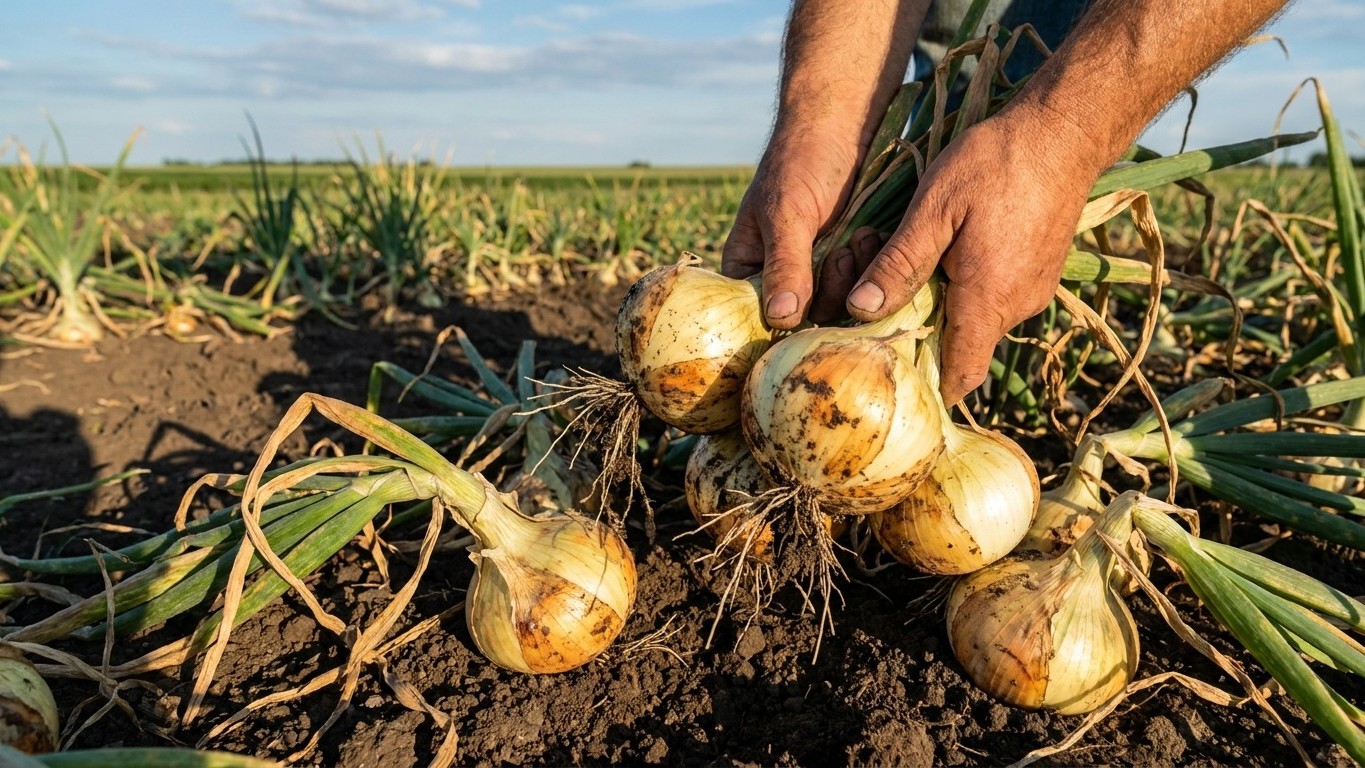

At 41.31 degrees north, Nebraska sits in the long-day onion belt, but the state stretches far enough that a gardener near its northern edge should double-check before ordering seed. Here’s what the daylight numbers actually mean for your onion patch, which varieties will bulb here, when to get them in the ground, and what kind of onion you’ll actually be pulling out of storage come winter.
How long your longest day is

The weather station behind these numbers sits at 41.31 degrees north, and on the longest day of the year that spot gets 14 hours and 59 minutes of daylight. That single number decides almost everything else on this page. Onions don’t bulb because the weather warms up. They bulb because the day gets long enough to flip a switch in the plant, and different varieties need a very different day length to flip.
Short-day onions start bulbing once the day reaches about 12 hours, a threshold documented by Clemson Cooperative Extension’s Home and Garden Information Center. At 14 hours 59 minutes, Nebraska blows right past that mark, which is exactly the problem. A short-day onion planted here doesn’t wait around for its 12-hour trigger. It hits that threshold in early spring, while the plant is still small, and bulbs immediately, small and early, no matter how well you feed it.
Long-day and intermediate-day onions need something closer to 14 to 16 hours before they start putting energy into a bulb instead of leaves. Nebraska’s summer daylight lands right in that window, which makes it long-day and intermediate-day territory, plain and simple. That’s the whole story in one sentence: this is a place for varieties that wait for a long day, not for ones that trigger early.
One caution worth repeating. Nebraska covers several degrees of latitude, and 41.31 is one point on that stretch, not an average of the whole state. A garden near the South Dakota line gets noticeably more summer daylight than one near the Kansas border, and a few extra minutes of daylight can push a borderline variety from “might bulb” to “will bulb,” or the reverse. If you’re farming near either edge of the state, it’s worth checking your own latitude against the ranges below rather than assuming the reference figure applies exactly to you.
Which varieties bulb in Nebraska
Nineteen varieties documented on this site have a published latitude range that covers 41.31N, meaning the catalogue data says they should bulb reliably here. They split between long-day and intermediate-day types, which fits the daylight math above.
- Long-day: Ailsa Craig, Barolo, Blush, Bridger, Frontier, New York Early, Patterson, Red Carpet, Red Long of Florence, Rossa di Milano, Walla Walla Sweet
- Intermediate-day: Cabernet, Calibra, Elsye, Expression, Monastrell, Red Long of Tropea, Scout, Sierra Blanca
Three more sit close enough to the published edge of their range that they fall in a blurred zone rather than a clear yes: Candy, Safrane, and Talon. Their catalogue bounds put them within a degree and a half of 41.31N, and those bounds are a continuum, not a hard line on a map. Treat these as varieties that may bulb in Nebraska, worth trying in a small bed before committing a full row to them, rather than a sure thing.
What actually happens if you plant the wrong ones
Now the part that matters more than the list of winners. Six documented varieties will not bulb in Nebraska, and they fail in two completely different ways.
- Gabriella, Madalyn, Red Rock, and White Castle are short-day varieties bred for latitudes between 20 and 36 degrees north. Planted this far north, they hit their 12-hour trigger while the plant is still young and small, so they bulb early and tiny. This is the mistake behind the classic story: a gardener buys a bag of sets at a big-box store, has no idea it’s a short-day variety, plants it in a Nebraska bed, and pulls up golf-ball onions in July wondering what they did wrong. It wasn’t the soil or the water. It was the variety.
- Powell and Redwing are long-day varieties bred for latitudes of 43 to 47 degrees north and higher, meaning they need more daylight than Nebraska’s 14 hours 59 minutes ever provides. Planted here, they never get the signal to bulb at all. The plant keeps making leaves through the whole season, then the top eventually collapses and the bulb, such as it is, rots in the ground. There’s no small onion to salvage. There’s no onion.
Both failures look like a growing problem from the outside, wilted leaves, disappointing harvest, but they trace back to a seed packet that never matched the latitude it was planted in.
When to plant onions in Nebraska
Because Nebraska is long-day and intermediate-day territory, planting follows a spring schedule rather than the fall-planting pattern used in mild-winter southern states. Onions here go in as sets, transplants, or seed in late winter to early spring, giving the plant a long stretch of cool weather to build leaves before the long summer days trigger bulbing.
The frost window at the reference station runs from a last spring frost between April 12 and April 23, to a first fall frost between October 15 and October 26. That gives a growing season of roughly five to six months between the two average dates, plenty of time for onions to bulb and cure before cold weather returns in fall.
Onion transplants and sets tolerate a light frost better than most vegetable seedlings, so many Nebraska gardeners set them out several weeks ahead of the average last frost date rather than waiting for it to pass, giving the plants more cool-season growth before the long days of June and July arrive. Direct-seeded onions typically go in even earlier, since they need extra time to size up before bulbing starts.
The frost dates above are averages pulled from 30-year climate normals at one weather station, not a promise about any single spring. Suburban and rural gardens away from that station commonly see their last frost run later, and their first fall frost arrive earlier, sometimes by one to two weeks, with even bigger swings at higher elevation. Treat April 12 to April 23 as a starting point for planning, then adjust based on what your own county typically does and what the extended forecast says in the actual week you’re planting.
Sweet onions or onions that keep
Nebraska’s daylight puts it in long-day and intermediate-day territory, and that has a second effect beyond timing: it shapes whether your harvest leans toward eating fresh or storing through winter. According to University of Missouri Extension, “as a rule, ‘sweet’ onions do not store as well as the more pungent types.” That’s not a marketing distinction. Pungency in an onion comes from volatile sulfur compounds, and those same compounds that make an onion sharp are also what protect it in storage. A sweet onion simply has fewer of them, which is exactly why it tastes milder raw and why it also breaks down faster in the pantry.
That trade-off tracks with day length in a fairly direct way. Short-day varieties, grown in the South, tend to run sweeter and shorter-keeping. Long-day and intermediate-day varieties, the kind that actually bulb in Nebraska’s near-15-hour summer days, tend to run more pungent and keep longer in storage. A Nebraska garden growing something like Patterson, Frontier, or Red Carpet, for instance, is working with varieties bred for exactly this daylight range and generally built for storage rather than quick eating.
Walla Walla Sweet is worth calling out on its own, since it’s a long-day variety that bulbs fine in Nebraska’s daylight but is bred specifically for sweetness rather than shelf life. It’s a reminder that “long-day” and “keeps well” aren’t the same claim. Choosing it means choosing flavor over pantry life, and that’s a fair trade if you plan to eat the crop within a few months of harvest rather than store it into next year.
For a gardener planning a winter’s worth of onions rather than a few weeks of fresh eating, the practical takeaway is to lean toward the more pungent, longer-day varieties on the bulbing list above and treat sweet varieties as a smaller planting meant for the table now, not the shelf in March. Storage onions cured properly and kept cool and dry can realistically carry a Nebraska household from an October harvest into late winter; sweet varieties from the same harvest are usually gone long before then, simply because their chemistry doesn’t hold.