
Most sweet and many hot pepper varieties can go from seed to ripe fruit within a Nebraska growing season, but only if the timing lines up with two hard limits: a frost-free window that runs roughly six months and a stretch of summer heat that can shut down fruit set for days at a time. Get the start date right and watch the extremes, and a full crop is realistic.
The short answer

Omaha’s reference station logs an average of 28.1 days a year at or above 90 F, based on NOAA’s 1991-2020 Climate Normals. That’s not a curiosity for the record books. It’s the number that decides whether your pepper plants set fruit through July and August or just sit there holding blossoms that drop before they ever become a pod. Pepper flowers are picky. Once daytime highs push past 90 F for several days running, pollen turns sterile or fails to transfer properly, and the plant aborts blossoms rather than waste energy on fruit that won’t fill out. With nearly a month of such days built into a typical Nebraska summer, most of it clustered in July, gardeners should expect at least one and likely several stretches where flowering stalls even on healthy plants.
The cool end matters just as much
Heat gets the attention, but pepper fruit set fails at both ends of the thermometer. Nights that drop below 55 F cause the same kind of blossom drop as extreme heat, just for a different reason: pollen doesn’t develop properly when it’s too cold overnight, even if the daytime temperature looks perfectly pleasant. This is where the data gets tricky. This site tracks daytime heat loads, specifically the count of days at or above 90 F, but it does not carry summer night minimum temperatures for any Nebraska location. That’s a gap worth being honest about rather than papering over with a guess.
Don’t assume your nights are warm enough just because you’re farther south in the state, and don’t assume they’re too cool just because you’re near the Sandhills or up toward the Panhandle. Latitude alone doesn’t tell you what a thermometer on your own porch would show at 4 a.m. in mid-June. Nebraska’s climate swings by elevation, by proximity to rivers, and by local terrain in ways that a statewide or even regional average can’t capture. If you’ve had a season where pods set heavily in June and stalled through a stretch of July, cold nights or hot days are usually the reason, and the fix is watching your own backyard readings rather than relying on a map.
When to start seed here
Working out a start date for pepper seed isn’t guesswork. It’s arithmetic, and once you know the pieces, you can redo the math for your exact county rather than trust a generic planting chart.
- Start with the frost window. At the Omaha airport reference station, the last spring frost typically falls somewhere between April 12 and April 23, according to NOAA’s 32 F freeze probability data for 1991-2020. That’s a band, not a single date, and it reflects a 30 to 70 percent probability range at that station specifically.
- Adjust for where you actually garden. Suburban and rural sites tend to see their last frost later than an airport station, often by one to two weeks, and elevation pushes that later still. If you garden outside the immediate Omaha metro, treat April 23 as an optimistic marker, not a guarantee, and check frost records for your own county extension office.
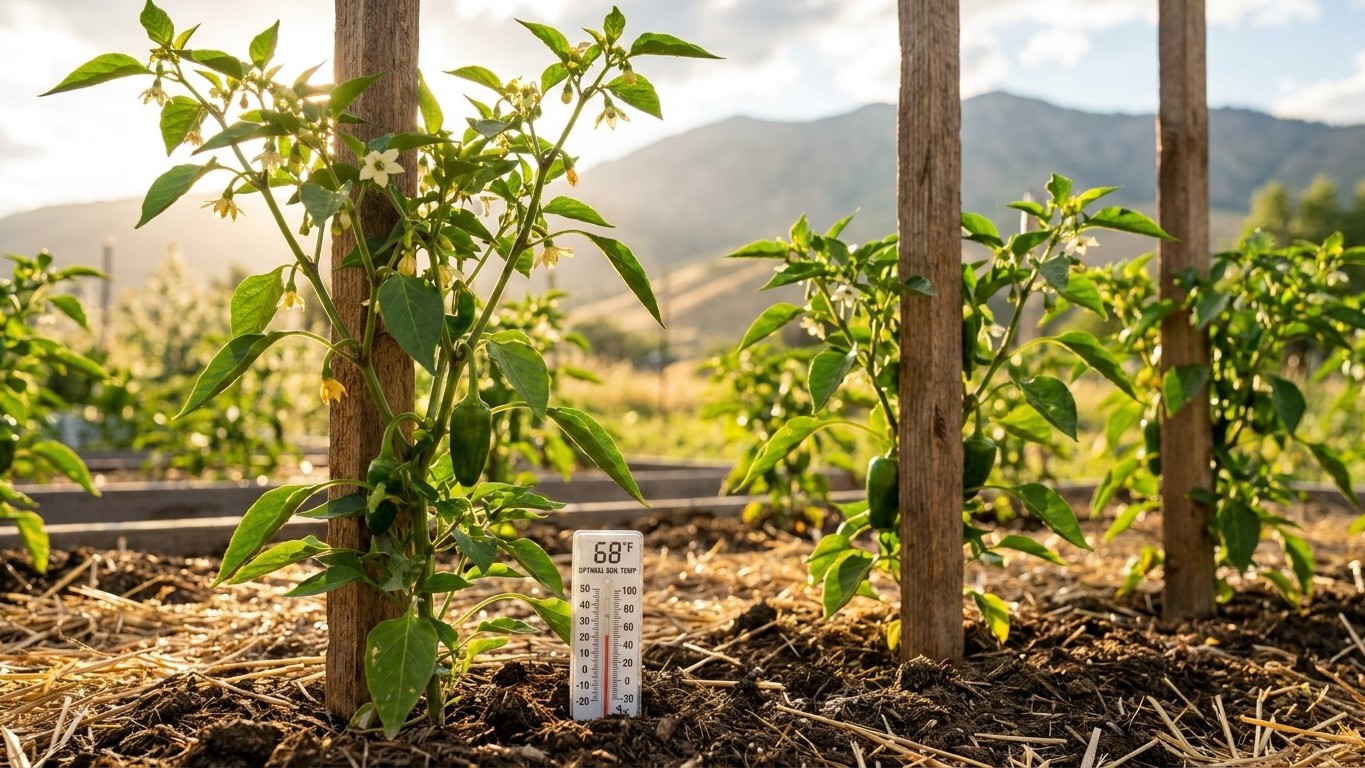
- Don’t transplant on the frost date alone. Peppers need more than an absence of frost. Utah State University Extension notes that transplants should go into the ground only after frost has passed and once soil temperature has reached 60 F, since cold soil stalls root growth regardless of air temperature.
- Count backward 8 to 10 weeks for indoor seed starting. If your realistic transplant date lands in the first week of May, for example, that puts seed starting somewhere between the last week of February and the second week of March, depending on which end of that 8 to 10 week window you plan around.
- Build in a buffer for a slow spring. Soil warms unevenly from year to year, and a cool, wet April can push the 60 F soil mark back by a week or two even after the air has cleared of frost risk. Starting seed a few days early gives you flexibility rather than forcing a rushed transplant into soil that isn’t ready.
Run this same sequence with your own county’s frost data and you’ll land on a start date that fits your actual garden, not a statewide average.
What goes wrong here
- Blossom drop from a hot spell. When daytime highs push into the 90s for several days in a row, a Nebraska summer’s specialty, flowers drop before they set fruit. There’s no fixing the weather, but afternoon shade cloth over the row and consistent deep watering reduce the stress that makes drop worse, and plants typically resume setting fruit once temperatures ease.
- Blossom drop from a cool night. The same failure shows up when nighttime temperatures dip too low, and since this site doesn’t track summer night minimums for Nebraska, the only reliable fix is watching your own thermometer through late spring and early summer, especially if you garden at elevation or in a low-lying spot that collects cold air overnight.
- Sunscald on exposed fruit. Nebraska summer sun is strong enough to bleach and blister pepper skins where leaf cover thins out, usually after aggressive pruning or when a plant loses foliage to wind or pests. Leaving more foliage in place, or providing light shade during the hottest afternoon hours, protects fruit that would otherwise scald on the side facing full sun.
- Blossom-end rot. Peppers develop this dark, sunken patch on the fruit bottom when calcium uptake gets interrupted, almost always because of uneven watering rather than a true calcium shortage in the soil. Consistent moisture, achieved with mulch and a regular watering schedule instead of feast-or-famine soakings, prevents most cases without needing a soil amendment.
Common questions
Can I direct-sow pepper seed outdoors in Nebraska instead of starting indoors?
It’s possible in theory, but the season is rarely long enough. Between the frost-free window and the time peppers need from seed to first flower, direct-sowing usually leaves too little time to reach a full harvest before fall frost risk returns. Starting indoors 8 to 10 weeks before transplant is the more reliable route.
Does the number of days above 90 F mean I should avoid growing peppers outdoors in Nebraska?
No. It means you should expect a pause in fruit set during the hottest stretches rather than a total crop failure. Most gardeners see flowering resume once a heat wave breaks, so the 28.1-day average is a planning number, not a reason to skip peppers altogether.
How long after flowering does a pepper actually ripen?
Utah State University Extension notes that fruit typically takes 35 to 45 days from flowering to ripen, not from the sowing or transplant date. That distinction matters when you’re estimating harvest timing, since the clock starts once blossoms appear, which itself depends on when heat and cold stress allow flowering to proceed.
Should I trust my county’s frost dates to match the Omaha reference station exactly?
No. The April 12 to April 23 window comes from the Omaha airport station specifically. Rural and suburban gardens commonly see frost linger one to two weeks later in spring, and elevation extends that further. Treat the reference figure as a starting point, then check local extension data or your own garden’s frost history for a more accurate date.