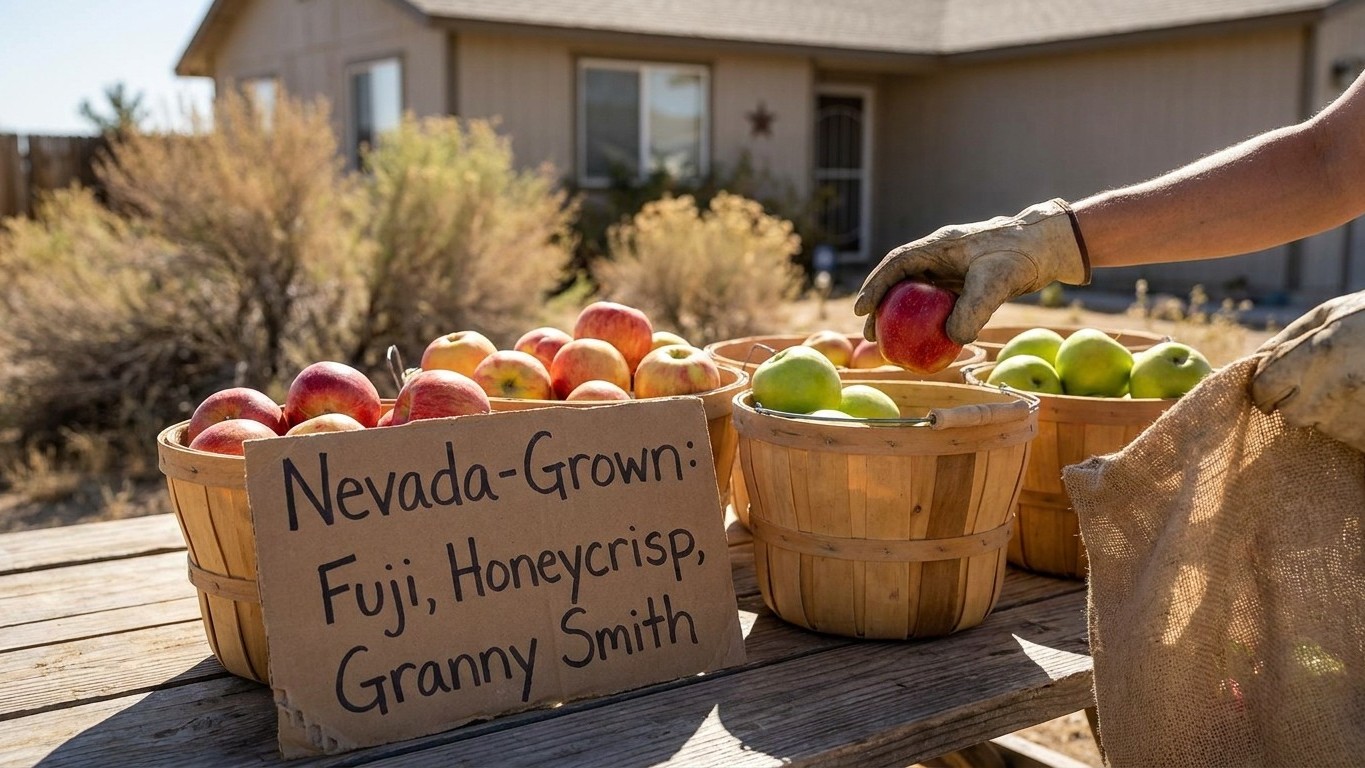

Nevada’s winters aren’t one thing — a Las Vegas valley floor and a Reno bench don’t share a climate, so they can’t share an apple. The right variety for your ground depends on two questions only your own yard can answer: will the wood survive your coldest nights, and will it bank enough winter chill to bloom on schedule instead of straggling into spring half-awake. Before you fall for a name on a nursery tag, find out how cold your actual patch of ground runs and how many chill hours it logs, then match the variety to that number.
The short answer for Nevada
The right apple for your yard depends on two separate questions, and neither is answered by a variety’s popularity. The first is winter hardiness: will the wood survive your coldest nights without dying back. The second is winter chill: will the tree bank enough cold hours to break dormancy evenly and bloom on schedule, instead of flowering in fits and starts or barely at all. A tree that survives winter but never chills out properly still won’t fruit well.
Nevada spans both extremes inside one state line. Las Vegas’s valley floor runs mild by orchard standards. NOAA’s 1991-2020 climate normals put the average low in the coldest month at 38.7°F there, which is barely below the temperature apples need to start banking chill at all. A tree bred for a harsh Midwest or New England winter sits at the low end of its hardiness range in that kind of desert valley, and it may also struggle to log enough cumulative chill in a mild year, leading to patchy bloom. Reno, Carson City and anywhere with real elevation see a properly cold winter, closer to what most apple breeding programs assume, and hardiness stops being the limiting factor there.
No single named cultivar is documented as the statewide pick for Nevada, because no single climate covers the state. What actually decides the outcome is matching a tree’s published chill-hour category and hardiness rating to your own elevation and valley, something your county’s UNR Extension office can help pin down once you’ve worked through the basics of growing apples in Nevada.
Working through it

Ranking apples for Nevada means ranking chill categories against elevation, not brand names against each other. Low-chill types are the ones bred for mild-winter regions and they break dormancy on the least cold. Moderate-chill types need a real but not extreme winter. High-chill types, the kind bred for the upper Midwest and New England, need the most sustained cold and will sit dormant later into spring even where the wood itself is perfectly hardy. Once you’ve settled on a category, the stage-by-stage progression from dormancy through green tip to bloom is what actually times your spring work here. See The Nevada Apple Calendar, Stage by Stage for how those stages line up against this territory’s frost window.
Matching chill category to elevation
| Region type | Typical winter | Chill category to choose | Main risk |
|---|---|---|---|
| Low desert valley floor (Las Vegas area) | Mild, short cold season. NOAA’s 1991-2020 normals put the coldest month’s average low at 38.7°F there | Low to moderate chill | Not enough cumulative cold for a high-chill tree to bloom evenly |
| Mid-elevation valley (Reno, Carson City and similar basins) | A genuine winter with hard freezes on most nights of the coldest months | Moderate to high chill | Low-chill trees breaking dormancy during a warm spell, then losing bloom to a later freeze |
| High mountain slopes and cold-air pockets near the Sierra front | Long, hard winters and a short frost-free season | High chill, cold-hardy scion and rootstock | Marginal hardiness selections dying back in the coldest years |
What each choice costs you
A low-chill tree planted in a valley that actually gets cold will often flower earlier than it should, and an unseasonable freeze after that early bloom can wipe out the whole crop for that year even though the tree itself comes through fine. A high-chill tree planted on a warm valley floor may leaf out unevenly, drop blossoms, or need a second variety nearby just to get enough overlapping bloom for pollination. Splitting the difference with a moderate-chill selection is usually the safer bet anywhere you’re not certain which side of the line your yard falls on, until you’ve tracked a season or two of your own cold hours.
Rootstock matters almost as much as the variety grafted onto it. A dwarfing rootstock buys you a smaller tree and an earlier first crop, but it tends to be less cold-hardy and less drought-tolerant than a full-size seedling rootstock, which matters more on a high mountain planting than in a mild valley.
What changes across Nevada
Elevation is the single biggest variable inside this state, and it works in both directions. Las Vegas sits low in the Mojave basin, which is why NOAA’s 1991-2020 normals show such a mild coldest-month average there: the desert floor holds heat and the freeze season is short. Head north and up, and the same kind of climate record looks completely different, because Reno and Carson City sit in high desert basins well above Las Vegas in elevation, with a real winter that lasts longer and bites harder.
Large bodies of water change things too. The stretch of the Sierra front closest to Lake Tahoe gets a moderating effect from the lake itself on the slopes nearest the water, while low-lying valleys a short drive away, without that thermal mass nearby, pool cold air on clear nights and can run noticeably colder than a hillside just above them. This kind of local cold-air trap catches new orchardists who plant in the lowest, flattest part of a valley because it looked convenient, only to find it is also the coldest spot on the property.
Rural high-desert valleys in the northern and eastern parts of the state, the kind that never show up in a Las Vegas-based climate record, run colder and shorter-season again. No statewide frost date exists for Nevada, and the Las Vegas figures should not be read as a planting calendar for anywhere outside the Las Vegas basin itself. A grower in one of these higher valleys needs their own county’s data, not an extrapolation from the desert floor.
The mistakes this climate punishes
Planting a low-chill selection in a valley that gets real winter cold is the most common mismatch. It doesn’t kill the tree, but it fools it into blooming during the first mild stretch of late winter, and Nevada’s high desert valleys are known for exactly that kind of false-spring warm spell. The bloom opens, a freeze follows days or weeks later, and the crop is gone for that season even though the tree looks fine going into summer.
The opposite mistake shows up on the warm desert floor: planting a high-chill tree bred for a harsher climate and expecting it to perform the way the catalog describes. In a valley like the Las Vegas basin, where NOAA’s 1991-2020 normals put the coldest month’s average low at 38.7°F, a high-chill tree may never accumulate enough cold in a mild winter to break dormancy on a normal schedule. The symptoms are late, uneven leaf-out and a thin, straggling bloom rather than outright death.
Feeding a tree too late in the season punishes trees at every elevation. Nitrogen applied in late summer pushes soft new growth right when the tree should be hardening off for winter, and that soft growth is what dies back first at the season’s first hard freeze. NOAA’s 1991-2020 normals put the first fall freeze at the Las Vegas airport station in the December 8 to December 23 window, and growers at higher elevations elsewhere in the state see their first freeze months earlier than that. Stop nitrogen well before your local first-frost window, whatever that window turns out to be once you check it against your own county.
Underwatering during the stress of a desert summer is a fourth failure mode worth naming. A tree that goes into fall already drought-stressed hardens off poorly and takes more winter damage than a tree that entered dormancy well-watered, even at the identical temperature.
Checking this against your county
Every climate normal figure was measured at Las Vegas, and that station is a genuine outlier, not a stand-in for the rest of Nevada. Contact UNR Extension for your county before you buy a tree. UNR Extension maintains local offices that can tell you the winter chill and frost pattern that actually applies to your address, not the nearest big airport’s. Bring your elevation and your nearest reference town when you call, since both can change the answer inside the same county.
Common questions
Can I grow apples in Las Vegas itself, on the valley floor?
Yes, but stick to varieties bred for a low chill requirement, and expect an early bloom that needs frost protection some years even though NOAA’s 1991-2020 normals show a mild average low for the coldest month there. A high-chill tree is the more common failure on that valley floor, not cold damage.
Do I need two apple trees for pollination?
Most apple varieties need a second, different variety blooming nearby to set fruit, and a genuinely self-fertile apple is the exception rather than the rule. Check the pollination group listed on the tag or in the catalog description before you buy just one tree.
How do I find my own yard’s winter chill instead of guessing from a nearby city?
A cheap min/max thermometer left in the yard over one winter, logged by hand, tells you more about your own microclimate than any regional average, especially if your property sits in a low spot or against a south-facing slope. UNR Extension can also point you to any chill monitoring already underway near your county.
My tree bloomed in January. Did I do something wrong?
Not necessarily. A low-chill variety planted where winters run mild, or an unusually warm stretch inside an otherwise normal winter, can trigger bloom well before the last freeze has passed for your area. It’s a sign to check your variety’s chill category against your elevation, not evidence of a care mistake.