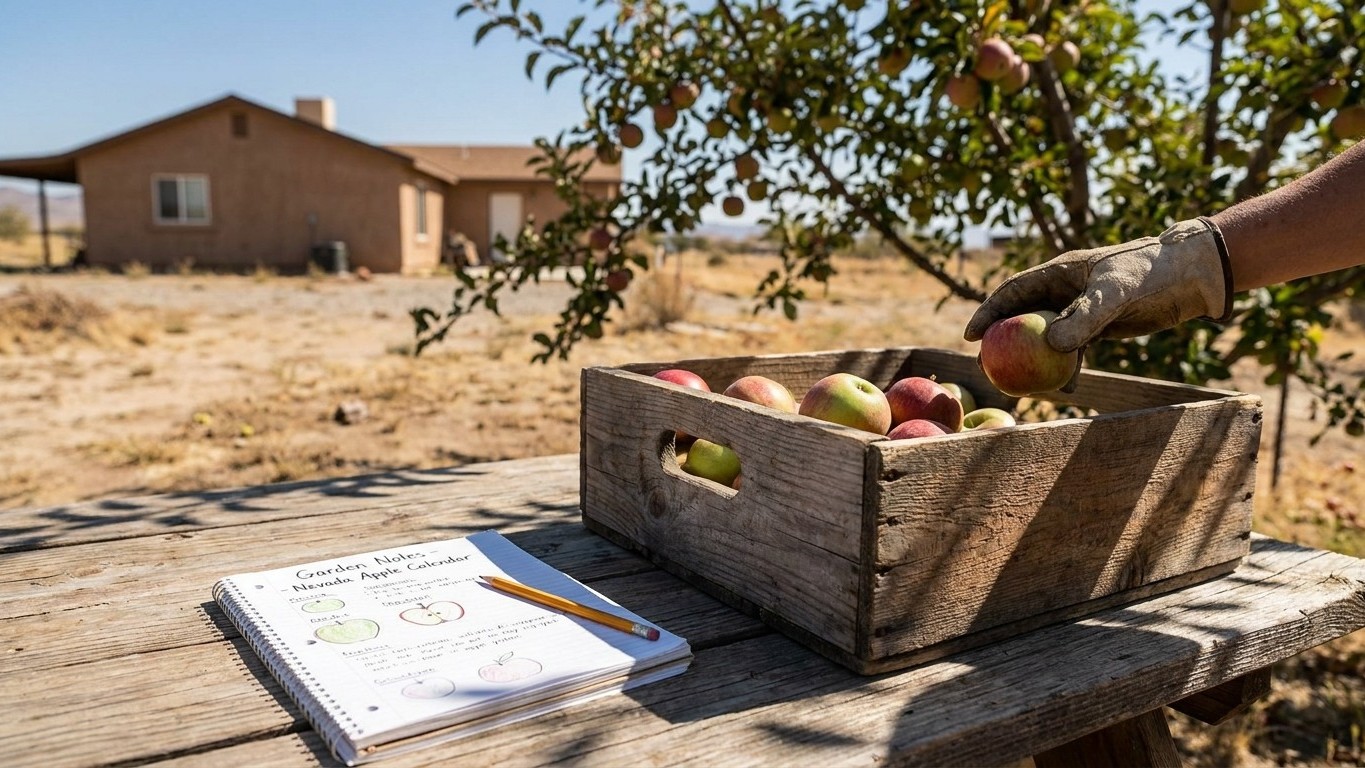

Las Vegas winters average 38.7°F on the cold end, barely a nap for a high-chill apple tree, while orchards up around Reno and Carson City stay locked in real cold for months after the Las Vegas valley has already pushed bud break. That gap is the whole story. One statewide spray date or bloom date can’t serve both places, so the only calendar worth trusting is the one written on your own tree’s buds, at your own elevation, right now.
The short answer for Nevada
There is no single spray date, bloom date, or harvest date that works for the whole state. Las Vegas’s cold-month average minimum sits at 38.7°F (NOAA NCEI, 1991-2020 normals), a winter mild enough that it barely qualifies as real dormancy for a high-chill apple, while the valleys around Reno and Carson City drop far colder and hold that cold long past the date Las Vegas has already broken bud. The bud stage on your own tree, not the date on a calendar, decides when to act.
NOAA’s 1991-2020 freeze normals put the Las Vegas area’s last spring frost (32°F, 30 to 70 percent probability) between January 7 and February 1, and the first fall frost between December 8 and December 23. Both figures come from the Las Vegas airport gauge, one of the mildest and most urban-heated points in the state. They describe almost nothing about the rest of Nevada: Reno, Carson City, and any orchard sitting at real elevation freeze earlier in fall and later in spring, sometimes by months rather than weeks. Treat the Las Vegas numbers as the warm edge of Nevada’s range, not as guidance for your own yard.
What the real answer depends on is your elevation, whether your site sits on a valley floor that traps cold air or on a slope that drains it, and whether the cultivar you planted matches both your winter’s severity and its chill requirement. A ‘Honeycrisp’ scheduled off a Las Vegas planting chart will have already bloomed and set fruit before a ‘Honeycrisp’ at a colder, higher site has even reached green tip.
Working through it

Apple trees move through the same sequence everywhere: dormancy, green tip, pink, bloom, petal fall, fruit set, and harvest. What changes across Nevada is not the order but the date each stage falls on, because that date follows temperature, not the month on the wall.
Dormancy

The tree is bare, buds closed and scaled tight against the wood. This is the pruning window and the last chance to apply dormant oil for scale and mite eggs before growth resumes. It is also when winter chill accumulates, the hours of cold a bud needs before it can flower normally. Las Vegas’s mild cold-month minimum of 38.7°F (NOAA NCEI, 1991-2020 normals) rarely delivers enough chill for a high-chill cultivar, which is one reason variety choice matters more in the valley than at elevation. If you haven’t matched a cultivar to your own site yet, The Best Apple Varieties for Nevada breaks down chill and hardiness by cultivar.
Green tip

A small point of green tissue pushes through the bud scales, the first visible sign that dormancy has broken. Dormant oil applied after this point does far less good and can burn young tissue, so the stage, watched on the actual tree, matters more than any date printed on a chart.
Pink

Individual flower clusters show color through the bud but haven’t opened yet. Trees at this stage are close to their most frost-vulnerable window. In Las Vegas, this stage tends to arrive near the tail end of NOAA’s January 7 to February 1 last-frost window, while at colder, higher sites the same cultivar reaches pink weeks or months later, once its full chill requirement has been met.
Bloom

Open flowers are the single most frost-sensitive stage an apple tree passes through. A hard freeze during bloom can kill the flowers outright and erase the year’s crop even if the tree itself survives undamaged. The stage matters more than the calendar: a Las Vegas tree that blooms during its own mild spring rarely meets a damaging freeze, while a tree at a colder site can bloom straight into a late cold snap if the site or the cultivar was chosen wrong.
Petal fall and fruit set

Petals drop and small green fruitlets swell at the base of each flower. If a frost hit during bloom, this is the stage that reveals it: flowers that browned and dropped without leaving a fruitlet behind mean that portion of the crop is gone. This is also the standard thinning window, when growers remove excess fruitlets to size the remaining apples.
Harvest

Fruit color, firmness, and background color under the blush tell you more than a date ever will, since maturity is timed from bloom rather than from the start of the season. If you’re still deciding what to plant before you reach this stage at all, Growing Apples in Nevada covers site selection and rootstock choice, the steps that come before any of the calendar work here.
What changes across Nevada
Nevada’s apple-growing conditions split mainly along elevation and valley geography, not latitude. The Las Vegas valley floor sits in the warmest, most heat-island-affected corner of the state, which is why its NOAA-normal frost dates run so much milder than anywhere else discussed on this page. Reno and Carson City sit in higher desert basins where cold air pools overnight, so both cities see frost arrive earlier in fall and linger later into spring than Las Vegas does, even though no single NOAA figure in this piece covers them directly.
Valleys that trap cold air overnight, rather than draining it downslope, run colder at bud level than an open slope a short distance away, even at the same elevation. This is why two orchards a few miles apart can be weeks apart in bloom date. Ask about local cold pockets before you plant, not after a frost takes the bloom.
| Region | Frost pattern relative to Las Vegas | Practical effect on the calendar |
|---|---|---|
| Las Vegas valley floor | Mildest in the state; NOAA’s 1991-2020 normals put last frost January 7 to February 1 and first fall frost December 8 to December 23 | Low-chill cultivars needed; bud break and bloom run earliest |
| Reno and Carson City basins | Colder and longer winters than Las Vegas; frost arrives earlier in fall and lingers later in spring | Full chill met for most cultivars; bloom is delayed, but late-frost risk during bloom is real |
| Cold-air-pooling valleys elsewhere in the state | Can run colder still, depending on local topography | Check with your county extension office before assuming any regional figure applies |
None of this is precise enough to replace a local check. NOAA’s Las Vegas figures are the only dated frost numbers in this piece, and they describe one city. For anywhere else, the stage on the tree combined with a call to your county extension office is the only reliable guide.
The mistakes this climate punishes
Some errors cost nothing in a mild, even climate and everything in Nevada’s swing between desert floor and cold basin.
- Planting a high-chill cultivar in the Las Vegas valley. Winters there rarely deliver enough chill hours, so the tree leafs out unevenly, blooms sparsely, or skips years entirely. It shows up in the second or third spring, once the tree is mature enough that a bad bloom is obvious.
- Planting an early-blooming cultivar at a colder, higher site. If the tree breaks dormancy and blooms before the site’s own late frost has passed, a single cold night during bloom can erase the crop even though the tree survives. It shows up the first spring the tree blooms.
- Feeding nitrogen late in summer. New growth pushed late stays soft and unhardened into fall. In a year when the first fall frost arrives at the early end of a range rather than the late end, that soft growth is what gets killed back, weakening the tree going into winter. It shows up as blackened, dead tips the following spring.
- Spraying dormant oil by the date instead of the bud. A warm stretch can push green tip earlier than last year’s calendar entry, and oil applied after that point burns tissue instead of smothering eggs. It shows up as scorched new leaves within days of the spray.
A fifth mistake is confusing hardiness with chill. A rootstock and cultivar combination can survive a Reno winter’s cold easily and still fail to flower well if it never sees enough of that cold accumulate as chill hours, or the reverse can happen, a low-chill selection can flower fine in a mild valley and still die back in an unusually sharp cold snap because the wood itself was never bred for that cold. The two filters have to be checked separately for any given site.
Every one of these is a timing mistake dressed up as a climate problem. The climate itself is workable across most of the state if the cultivar, the site, and the spray calendar all key off the tree’s actual stage instead of a date carried over from somewhere else.
Checking this against your county
Nothing on this page substitutes for a call to your own county office. UNR Cooperative Extension (extension.unr.edu) maintains offices across Nevada and can tell you the frost pattern, elevation effect, and chill accumulation for your specific address, none of which the statewide NOAA figures above can do on their own.
Ask specifically for freeze probability data for your county, not just a general frost date, and ask whether your site’s elevation or valley position runs colder or milder than the county average. A five-minute call before you order trees is cheaper than a lost crop after you plant the wrong cultivar.
Common questions
Can I just use the Las Vegas frost dates for my county?
No. NOAA’s 1991-2020 normals for Las Vegas describe one of the mildest, most urban-heated sites in the state. Reno, Carson City, and any elevated orchard freeze earlier in fall and later in spring, sometimes by months, so call your county extension office for a figure that actually applies to your address.
How many chill hours does my area get?
This page doesn’t have a sourced local chill figure, and neither does most public data at the county level. UNR Cooperative Extension is the right place to ask, and in the meantime a cultivar bred for low or moderate chill is the safer bet anywhere warmer than the coldest mountain valleys.
My tree bloomed and then we got a cold night. Is the crop a total loss?
Not necessarily. Damage depends on how cold it got and for how long, and different flowers on the same tree open on different days, so some may have escaped. Check a few days later for fruitlets forming behind the fallen petals before writing off the year.
Should I prune before or after green tip?
Prune during dormancy, before green tip appears. Pruning after the buds have already pushed removes wood the tree has invested sugar into breaking, and it delays the cuts past the window when the tree tolerates them best.