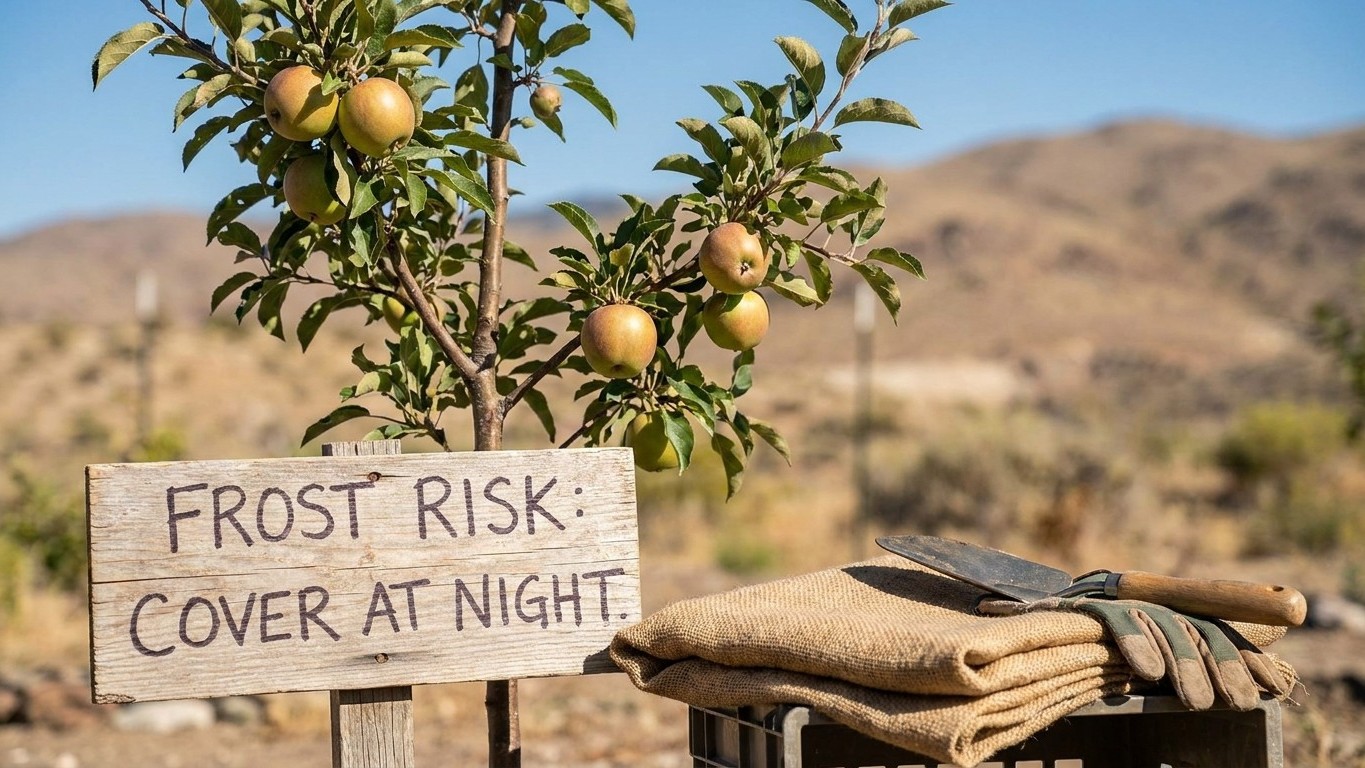

Nevada apples split into two completely different plants depending on where you live. Up north around Reno and Carson City, cold winters let you grow the classic varieties everyone knows, like Honeycrisp and Liberty; down in the Las Vegas basin, that same cold barely arrives, so you need low-chill varieties like Anna and Dorsett Golden instead, or you’ll get a tree that flowers late and fruits poorly for years. Before buying a tree, check your elevation and typical winter cold snap, then match your variety to that end of the state.
Can you grow apples in Nevada
Apples grow across nearly the whole state, but Nevada covers a climate span that most single states never see. That USDA range of zone 4a to 10a is a wider climate spread than most single states cover, on par with the difference between growing apples in the Northwest Territories and growing them in a warm southern valley, a spread wide enough that choosing from a list of Nevada apple Best varieties matters more here than in most states. Zone 4a means an average winter low that can fall to -30°F or colder, a cold that only a short list of northern apple cultivars is bred to survive. Zone 10a, at the other end, barely freezes in a typical year.
At that warm end, NOAA’s 1991-2020 climate normals record a coldest-month minimum of just 38.7°F at Las Vegas, meaning the average low on the coldest nights of the year rarely reaches a hard freeze. That’s mild enough to keep citrus alive in a sheltered yard, but it works against an apple tree, which needs sustained winter cold to break dormancy properly and flower on schedule the following spring. This is the same cold requirement, called winter chill, that The Nevada Apple Calendar, Stage by Stage uses to filter varieties.
Where apples do best in Nevada
The high desert valleys of northern Nevada, around Reno, Carson City and the ranching country toward Elko, run much closer to a standard zone 6 to zone 7 climate, with real winter cold and warm, dry summers. This part of the state is the most reliable apple country, close to conditions in established apple-growing parts of the Mountain West, and standard cultivars perform there without any special accommodation. Low desert basins near Las Vegas can still grow apples, but growers there need to choose varieties bred specifically for mild winters, and should expect a shorter list of cultivars that perform reliably than growers a few hundred miles north.
Which varieties suit this climate

Hardiness zone tells you whether a tree survives the winter. Winter chill, the number of hours a tree spends below roughly 45°F while dormant, tells you whether it flowers and fruits well the following spring, and it is a separate filter from hardiness. A variety bred for the Deep South’s short, mild winters planted in a cold Nevada valley will still survive, but it may break dormancy in fits and starts. Planted the other way, a high-chill northern variety put into the mild winters near Las Vegas will bloom late, thin and uneven, because it never banks enough cold hours to wake up all at once. Nevada’s zone-4a-to-10a spread means the state sits at both ends of the chill scale depending on where you garden.
| Variety | Winter chill needed | USDA hardiness | Typical harvest |
|---|---|---|---|
| ‘Honeycrisp’ | High, roughly 800-1000 hours | zone 3-8 | early to mid fall |
| ‘Liberty’ | High, roughly 800 hours; scab-resistant | zone 4-7 | mid fall |
| ‘Haralson’ | Very high | zone 3-7 | mid fall |
| ‘Zestar!’ | High, early ripening | zone 3-7 | late summer |
| ‘Anna’ | Low, roughly 100-200 hours | zone 5-9 | mid summer |
| ‘Dorsett Golden’ | Low, roughly 100 hours | zone 5-9 | mid summer |
For the cold high country around Reno and Carson City, high-chill cultivars such as ‘Honeycrisp’, ‘Liberty’ and ‘Haralson’ perform close to their catalogue figures without any adjustment. For the mild low desert near Las Vegas, low-chill cultivars bred for southern climates, such as ‘Anna’ and ‘Dorsett Golden’, are the more dependable choice, since they can set a full crop on a fraction of the cold hours a northern variety requires. Neither UNR Extension nor USDA publishes a Nevada-specific list of recommended apple cultivars, so treat the chill-hour figures above as catalogue data you cross against your own site and elevation, not as a local recommendation.
Planting a pair that works here
Apples need cross-pollination from a second tree blooming at the same time, and at least one of that pair has to carry fertile pollen. Some well-known cultivars, including ‘Jonagold’, ‘Gravenstein’ and ‘Winesap’, are triploids that produce little or no usable pollen of their own. Planting two of these together, or planting just one alone, means a poor crop even in a year with a heavy bloom.
In the cold valleys of northern Nevada, ‘Honeycrisp’ and ‘Liberty’ bloom in the same mid-spring window and each supplies fertile pollen for the other, making them a workable pair without adding a third tree. ‘Zestar!’ blooms slightly earlier and pairs well with ‘Haralson’ if you want an early harvest and a mid-season harvest off the same two trees.
In the mild low desert near Las Vegas, ‘Anna’ and ‘Dorsett Golden’ are the standard low-chill pairing. Both bloom early and reliably at low chill-hour totals, and both carry fertile pollen. A flowering crabapple planted nearby also works as a universal pollen source for almost any apple variety, and it blooms over a long enough window to overlap with most cultivars, which is useful where space allows only one full-size apple tree. Whatever pair you settle on, check the bloom date and pollen fertility for that exact named cultivar before you buy. A nursery tag that only says “needs a pollinator,” without naming which cultivars are sterile, is not enough to plant from.
The frost that costs a crop here

Nevada’s frost dates vary enormously by elevation, and the only local figures available come from one station. NOAA’s 1991-2020 climate normals put the last spring freeze at the Las Vegas airport station in the January 7 to February 1 window, with the first fall freeze arriving December 8 to December 23. Both figures reflect the extreme warmth of that single desert-basin city and its urban heat island, and they are not a planting calendar for the rest of Nevada. Reno, Carson City and any orchard at real elevation freeze far later in spring and far earlier in fall than these dates suggest, sometimes by months, so check your own freeze dates with your county extension office before relying on any single figure.
The frost that actually costs a Nevada grower a crop is rarely the hard winter freeze. It’s a light frost that arrives after the flower buds have opened enough to show pink, the stage just before bloom. At that point the buds are far less cold-hardy than the dormant wood around them, and a frost the tree itself shrugs off entirely can kill the flowers outright. The tree leafs out fine and looks healthy all summer. It simply carries no fruit, because the flowers that would have become apples were killed weeks earlier, often before the grower even notices anything was wrong.
Watch the extended forecast once buds reach the pink stage, not the calendar date. If a freeze is forecast overnight, running an overhead sprinkler through the night or draping frost cloth over young trees can hold flower Temperature a few critical degrees above the surrounding air. Neither measure is practical over a full mature orchard, which is why the more dependable protection in an area with a late, unpredictable frost is choosing a late-blooming variety in the first place. A cultivar that blooms later buys time for the frost risk to pass before the flowers, the most vulnerable part of the tree, are ever exposed.
The apple year in Nevada
Apple growers work off the tree’s stage, not the date on a calendar, and each stage should be checked against your own local freeze dates rather than the Las Vegas figures above, since a mountain valley and a low desert basin reach these stages weeks or even months apart.
- Dormancy: no leaves, buds tight and closed. Prune while the tree is fully dormant, before any bud swell, so you aren’t encouraging growth ahead of a possible late freeze.
- Green tip: the first sliver of green shows at the bud tip. Start checking short-range frost forecasts from this point forward, since bud cold tolerance drops with every stage after this one.
- Pink: the flower bud swells and shows color before opening. This is the most frost-vulnerable stage described above, and the point where frost protection matters most.
- Bloom: flowers open fully. Pollinators need calm, mild weather to move pollen between your paired trees, so a cold, windy bloom week can hurt the set even without a frost.
- Petal fall: petals drop and the small fertilized ovary becomes visible. A late frost at this stage can still damage the young fruitlet.
- Fruit set: the tree naturally sheds a portion of its fruit over the following weeks. This is normal thinning, not frost damage, and no action is needed.
- Harvest: timing follows the variety’s catalogue maturity window counted from bloom, running from late summer for early cultivars like ‘Zestar!’ to mid fall for cultivars like ‘Liberty’ and ‘Haralson’.
Utah’s high-desert orchards move through the same sequence of stages on a similarly elevation-driven schedule, and growing apples in Utah follows a comparable month-by-month calendar if you want to check your timing against a neighboring high-desert climate.
Local help
For variety recommendations and spray timing built around your specific county and elevation, contact UNR Extension, Nevada’s land-grant university extension service. Local offices track chill-hour totals, freeze dates and pest pressure county by county, information no statewide guide can substitute for. Bring your address or elevation when you call, since advice for a Las Vegas backyard and advice for an Elko orchard can be opposite in almost every respect.
Common questions
Can you actually grow apples in Las Vegas?
Yes, but only with low-chill cultivars such as ‘Anna’ or ‘Dorsett Golden’ that are bred to flower well on a small number of cold hours. A standard high-chill variety planted in that mild winter climate will bloom thin and ragged even though the tree itself survives fine.
Do I need two apple trees, or will one tree fruit on its own?
Almost all apple varieties need a second tree blooming at the same time to set fruit, and a small number of popular cultivars produce sterile pollen and can’t act as that second tree. A flowering crabapple nearby works as a pollen source if you only have room for one full-size apple tree.
How long before a young apple tree in Nevada actually bears fruit?
It depends mainly on rootstock rather than climate. Trees on dwarfing rootstock generally bear sooner than trees on full-size seedling rootstock, but expect several years of growth either way before a meaningful crop, and even then a killing frost at the pink or bloom stage can wipe out that year’s fruit regardless of the tree’s age.
My apple tree bloomed heavily but set almost no fruit, what happened?
The three most common causes are a late frost that killed the open flowers, a missing or poorly timed pollinator partner, or cold windy weather during bloom that kept pollinators from moving between trees. Check whether your paired variety actually blooms in the same window and carries fertile pollen before assuming frost was the cause.
Does Nevada’s soil cause problems for apple trees?
Desert soils in much of the state tend to be alkaline and low in organic matter, which can show up as yellowing leaves from iron deficiency on a tree that otherwise looks healthy. Working compost into the planting hole and mulching well helps, and a county extension soil test is the most reliable way to know what your specific site needs before you plant.