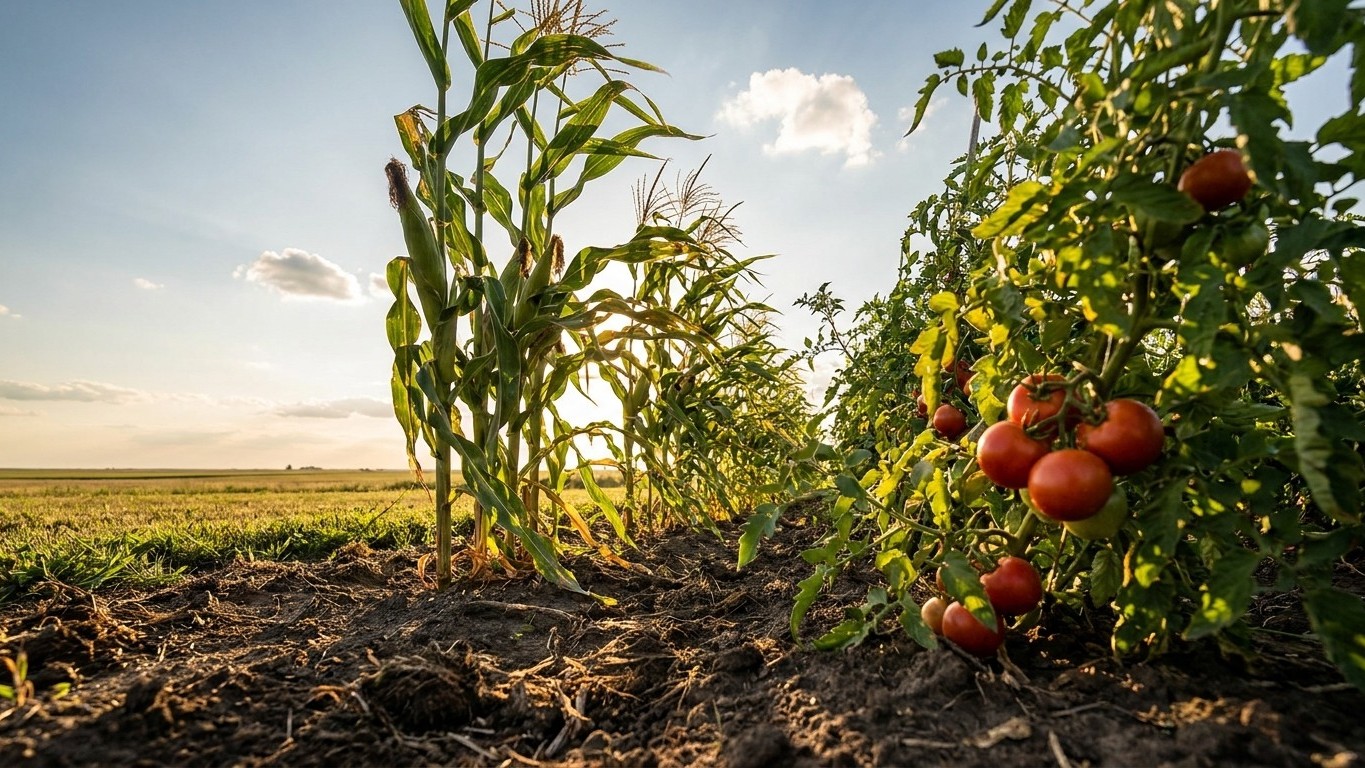

Sweet corn is ready 60 to 90 days after planting, and the planting itself waits for warm soil, not for the last frost. The picking window is narrow, about 17 to 24 days after the first silks appear. Sugar starts draining from the kernels once the ear comes off the stalk. Nevada runs from low desert to high mountain valleys, so the same corn can fit one garden’s season easily and miss another’s entirely.
The short answer
Soil first, then the season
Soil reaches 60 F later than the last frost, and the two dates are not the same day. The last freeze tells you when ice stops threatening seedlings. Soil temperature tells you when a kernel will sprout and keep growing. Utah State University Extension sets the bar at soil above 60 F, and in a Nevada spring that can arrive weeks after the final freeze.
Clemson Cooperative Extension adds a depth and a second threshold that matter. Its factsheet says: “Do not plant before the soil temperature at the 4-inch depth is at least 50 ºF. Wait to plant extra-sweet varieties until soil temperatures reach 65 °F.” The two numbers are not interchangeable. Fifty is the floor for ordinary sweet corn, and 65 is for extra-sweet (sh2) types. A surface reading runs warmer than the soil at 4 inches, so a thermometer pushed in that deep keeps you from sowing too early.
No single calendar date can serve the whole state. The NOAA NCEI climate normals for the Las Vegas airport put the last 32 F freeze between January 7 and February 1, and the first fall freeze between December 8 and December 23, using the 30 to 70 percent probability band. That is a desert urban-heat-island extreme, not Nevada guidance. Reno, Carson City and anywhere at elevation freeze months earlier in fall and months later in spring. Your county extension office holds the local dates.
Whether 60 to 90 days fit follows from that range. In the low desert the frost-free stretch is long enough for either length. In the cold, high valleys the stretch between 60 F soil and the first fall freeze can be short enough to rule out the longer varieties. The When to Sow Sweet Corn in Nevada page covers the sowing side in detail.
Picking day and the fade
Two clocks run here, and they answer different questions. Sixty to ninety days from planting says whether a variety fits your season. Seventeen to 24 days from silk emergence says which week to pick. Keep them apart.
Ripeness takes three signs together: dry brown silks, husks still moist and green, and milky juice when you puncture a kernel. Any one alone misleads. Silks can brown before the kernels fill, and a green husk says nothing about the juice.
After picking, the sugar clock starts. Clemson states it plainly: “Sweet corn loses sugar from the kernel rapidly at high temperatures… Sweet corn can be stored under optimal conditions for about five days, but will lose sweetness with each day of storage.” Read “about five days” as a ceiling under ideal conditions, not a promise.
Heat is the accelerant, and Nevada has plenty. The Las Vegas reference station averages 131.3 days a year at 90 F or higher. Genotype also matters: su loses sugar fastest, se holds it longer, and sh2 holds it longest.
Does a late variety fit here?
A 60-day variety
Start the count on the day your soil hits its threshold, not on the last frost. Add 60 days. In the low desert, that lands far ahead of a first freeze that the Las Vegas airport normals place in December. In a high valley, it still lands with room to spare if the soil warmed by late spring, and the ears get picked before fall weather turns.
That margin is why a 60-day type is the safer bet for northern and high-elevation gardens. It leaves slack for a cold snap that delays germination, or a slow start in clay that warms late.
One wrinkle: extra-sweet types wait for 65 F soil, which pushes the planting date later than for ordinary sweet corn. An early-maturing sh2 therefore gives back some of the days it saved.
A 90-day variety
Here the answer splits by elevation. In the low south, 90 days fits on paper. The calendar leaves months between planting and the first freeze, though the heat load, 131.3 days a year at 90 F or more at the reference station, brings its own demands for water and for fast handling after picking.
In the high, cold parts of Nevada, a 90-day variety does not fit reliably. Soil reaches 60 F late, and the first fall freeze comes months earlier than at the Las Vegas airport. Three months of growth starting from a late-spring planting can run straight into that frost. The ears may be half filled when the plants die, and corn cannot finish ripening after that.
The test takes five minutes. Note the date your soil at 4 inches reaches 60 F (65 F for sh2). Count forward 90 days. Compare that date with the first fall freeze your county extension office gives you. If the freeze comes first, choose an earlier variety. The Growing Sweet Corn in Nevada guide covers variety choice more broadly.
What goes wrong here
Three failures account for most disappointing corn in the state. Two come from the climate, and one has nothing to do with it.
- Seed sown into cold soil. Kernels sitting in soil below their threshold rot instead of sprouting. A supersweet seed sown at 50 F is the classic case, which explains why a gardener can succeed one year and fail the next after switching variety. Remedy: push a thermometer 4 inches down, read it in the morning, and wait for 50 F (ordinary types) or 65 F (extra-sweet). Do not go by the date or the air temperature.
- A variety too late for the season. The plants are green and tall when the first hard freeze arrives, and the ears are not ready. Remedy: count your days from 60 F soil to your local first fall freeze before you buy seed, and drop to a shorter-season type if the count runs out.
- Sweetness lost to cross-tasselling. This one happens in a desert garden and a mountain garden alike. When su, se and sh2 types tassel at the same time, the sweetness is lost. The source gives no isolation distance, so no number is offered here. The problem is timing. Remedy: grow a single type per season, or plant different types so their tassels do not overlap. Plant in blocks of three or more rows instead of one long row, which is a shape of garden, not a date.
A fourth trouble shows up once ears fill: animals and insects want the corn on their own schedule. What Eats Corn in Nevada, and When maps that out.
Common questions
Can I plant as soon as the last frost has passed?
No. Soil warms well after the last frost, and kernels need soil above 60 F to do well. Check at the 4-inch depth, and wait for 65 F if you are sowing an extra-sweet variety.
How long after silks appear is corn ready?
Plan on 17 to 24 days from silk emergence. That is the picking-week clock, separate from the 60 to 90 days counted from planting.
How do I know an ear is ripe?
Look for three signs together: dry brown silks, husks still moist and green, and milky juice from a punctured kernel. One sign by itself can mislead.
How long does picked corn stay sweet?
Less long than most people hope. Clemson says sweet corn “can be stored under optimal conditions for about five days, but will lose sweetness with each day of storage.” Heat speeds the loss. Su types fade fastest, se types hold sugar longer, and sh2 types hold it longest, which is the practical reason to choose sh2 if you cannot cook the ears the day you pick them.