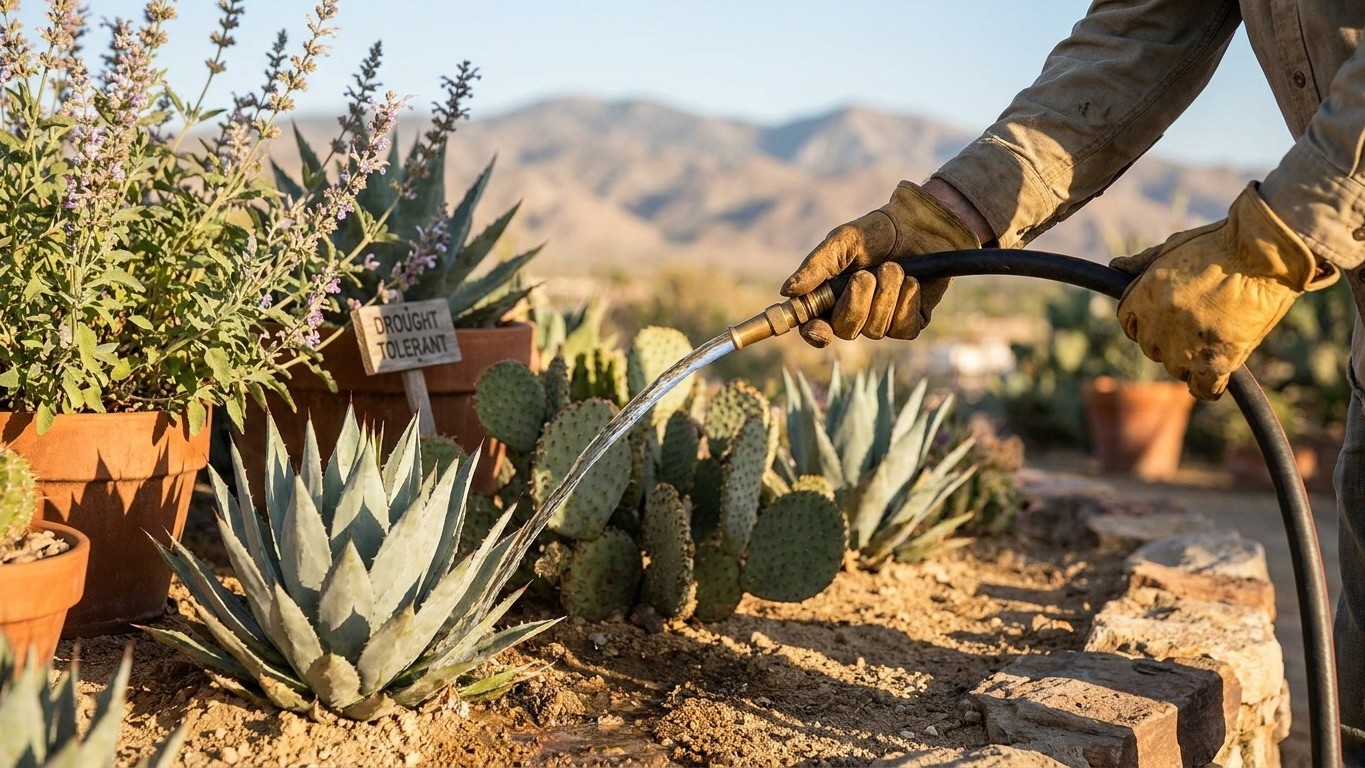

Nevada gardeners water more, and more carefully, than almost anyone else in the country. The state sees 131.3 days a year hitting 90F or higher at the Las Vegas reference station, and its USDA hardiness zones stretch from a frigid 4a in the high desert to a mild 10a in the low valleys. That spread means there’s no single answer to “how much water” that works from Reno to Las Vegas. Here’s how to figure out what your own yard actually needs, and where to check the rules before you install a timer.
What the climate asks of you

Start with the number that rules out any illusion of an easy lawn: 131.3 days a year above 90F, measured at the Las Vegas reference station over the 1991-2020 normals period. That’s not a summer average, it’s a count of days hot enough to push moisture out of leaves and soil faster than most plants can pull it back in. A cool-season grass simply can’t survive that stretch without heavy irrigation, which is why so much of the Mojave portion of the state has shifted toward drought-adapted landscaping.
The USDA hardiness map tells the other half of the story. Nevada spans zones 4a to 10a, a range wide enough to cover both subarctic mountain valleys and low desert basins in the same state. Las Vegas anchors the warm end of that range, but Reno, Carson City, and the higher elevations of the Great Basin sit in a colder, shorter-season world entirely. If you’re reading general Nevada advice, including this article, treat it as a starting point and confirm specifics with your county extension office, because a rule that fits Las Vegas can be backwards for Elko.
Why the numbers don’t average out
What the state’s climate data doesn’t offer is a tidy summer rainfall figure that applies everywhere, and that’s worth being honest about rather than guessing. What’s certain is that Nevada’s low valleys go through long summer stretches without meaningful precipitation, and extension offices across the state plan irrigation schedules assuming the sky won’t contribute much between June and August. That’s a different starting assumption than a gardener in Ohio or Georgia gets to make. If your property sits on sandy, fast-draining desert soil, which is common across the valley floors, water moves through even faster, and a schedule built for “average” garden soil will leave roots thirsty within a day or two.
How much, how often
The core rule doesn’t change by zone: water deeply and infrequently. Shallow, frequent watering trains roots to stay near the surface, right where the sun bakes them during those 131 days above 90F. Deep watering pushes roots down where soil holds moisture longer and temperature swings less. The way to know it’s time is simple: push a finger, or a trowel, two inches into the soil near the plant’s base. If it’s dry at that depth, water. If it’s still damp, wait.
Soil texture changes the timing more than most gardeners expect, and knowing how to keep plants alive when the rain disappears for weeks is its own skill, one covered in detail in Watering Through a Dry Spell in Nevada, and the same logic applies to plants grown above ground: if you rely on pots and other containers rather than garden beds, see Watering Pots and Containers in Nevada for guidance tailored to that faster-drying setup. Sandy soil, common across Nevada’s desert valleys, drains fast and holds little reserve, so it often needs shorter, more frequent soakings rather than one big weekly dose. Heavy clay, more typical in some higher-elevation or riverside pockets, holds a week’s worth of water but drowns roots if it’s soaked again before it’s had a chance to dry out, and should never be worked or irrigated while still wet, since compacted wet clay can take a season to recover its structure. A basic soil test, through your local extension office, settles the question instead of guessing.
A watering sequence that works for most Nevada yards
- Check soil moisture first. Push a finger or trowel two inches down; only water if it’s dry at that depth.
- Water in the early morning. Watering before 9 a.m. cuts evaporation loss during the hottest stretch of the day.
- Apply water at the base, not the leaves. Wet foliage in dry heat invites scorch and fungal issues without adding any real benefit to the roots.
- Water slowly and deeply, aiming for roughly an inch of coverage. A slow soak lets water reach root depth instead of running off hardened desert soil.
- Adjust frequency by soil type. Sandy soil may need watering every two to three days in peak summer; heavier soil can often stretch to once a week.
- Recheck before every watering. Skip the calendar-based schedule and let the soil, not the day of the week, decide.
Because Nevada’s low valleys go through their hottest, driest stretch with almost nothing falling from the sky, treat summer watering as full irrigation rather than a supplement to rainfall. That’s a different mindset than gardeners in wetter states get to use, and it’s the single biggest adjustment newcomers to the state have to make.
Restrictions and rules
Watering restrictions are common across Nevada, and they change from year to year and from one water district to the next, so nothing here should be treated as a fixed schedule. Some districts limit which days of the week outdoor watering is allowed, others cap watering to certain hours, and drought years can bring tighter limits with little notice. Given how little rain falls across the state’s driest months, restrictions here are more likely, and more consequential, than in wetter parts of the country.
Before setting an irrigation timer or planting a new bed, check with your local water authority or municipal utility for the current rules in your zip code. Your county’s University of Nevada Cooperative Extension office is also a reliable place to ask, since staff there track both water-district rules and what’s realistic to grow given your elevation and soil. Rules that apply in Clark County won’t necessarily match what’s in force in Washoe County, so don’t assume a rule you read online still applies once you cross a county line.
Using less
Cutting water use in a Nevada yard isn’t about one trick, it’s a handful of separate habits that each save water in a different way. Stacked together, they can cut outdoor water use dramatically without giving up a green, functional yard.
- Mulch, two to three inches deep. A layer of wood chips or bark over exposed soil slows evaporation and keeps root zones cooler on days above 90F, which here means most of the summer.
- Drip irrigation instead of sprinklers. Drip lines deliver water at the root zone with far less loss to wind and evaporation than overhead spray, a meaningful difference in a state this dry and this hot.
- Group plants by water need (hydrozoning). Keeping thirsty vegetables separate from drought-tolerant natives means you’re not overwatering the natives just to satisfy the vegetables on the same line.
- Add organic matter to the soil. Compost worked into sandy desert soil improves its ability to hold water between irrigations, stretching the time between waterings.
- Rain barrels, where local rules allow them. An inch of rain falling on a 1,000-square-foot roof yields roughly 600 gallons of runoff, a useful number anywhere. In Nevada’s valleys, that math matters less in the driest summer months, when there’s little rain to catch, and more during the wetter shoulder seasons, when a full barrel can carry a garden through a few extra dry stretches before summer irrigation takes over completely.
Common questions
What time of day should I water in Nevada?
Early morning, ideally before 9 a.m. Watering at that hour lets moisture soak into the soil before the day’s heat, which regularly exceeds 90F on more than 130 days a year in the Las Vegas area, drives evaporation up.
Do watering restrictions apply statewide?
No. Restrictions are set by local water districts and municipalities, not by the state as a whole, and they change over time. Check with your specific water provider, and use your county extension office as a second source.
Why does the same watering schedule work differently across Nevada?
Because the state spans USDA zones 4a through 10a, elevation, average temperature, and typical soil all shift dramatically from one part of Nevada to another. A schedule built for low-desert Las Vegas can be far too aggressive, or too light, for higher-elevation towns near Reno or Carson City.
Can I rely on published Nevada frost dates to plan my garden?
Be cautious. Published frost-date ranges for the Las Vegas area reflect an urban heat-island effect and run much later in fall and earlier in spring than most of the rest of the state. Higher-elevation and rural areas can see frost arrive months earlier in fall and linger months later in spring. Your county extension office can give you a frost window that actually matches your location.