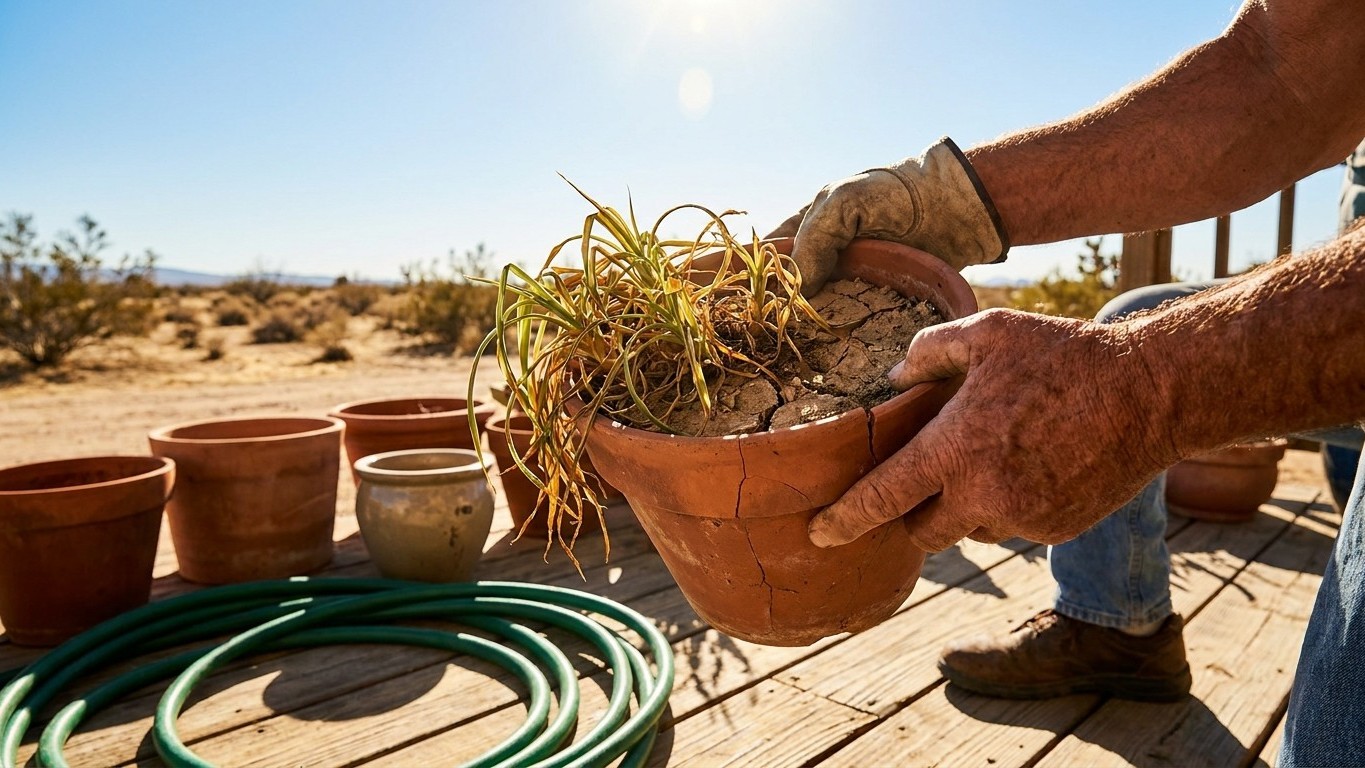

Nevada’s containers and garden beds face one of the toughest combinations in the country: almost no summer rain and more than four months’ worth of 90-degree days. That means potted plants and raised beds alike depend on the gardener, not the sky, for nearly every drop they get between June and August.
What changes here

Start with two numbers. The driest summer month at Nevada’s reference station is June, and it averages just 0.04 inches of rain. Over the same year, the region logs 131.3 days at or above 90 degrees. Put those together and you get a stretch of the calendar where heat load is near its peak almost every single day, while the sky contributes almost nothing to keep soil or potting mix moist.
A typical garden bed wants roughly an inch of water a week to keep most vegetables and ornamentals from stalling. Do the arithmetic for June: 0.04 inches spread across a month works out to about 0.01 inch for an average week. That leaves the gardener responsible for carrying almost the entire inch, hose or drip line doing essentially all the work that rain would otherwise share in a wetter climate. July and August aren’t much better, at 0.38 and 0.32 inches for the whole month respectively, still far short of a weekly inch on their own.
Containers feel this gap even faster than beds do. A pot holds a fraction of the soil volume of an in-ground bed, so the same 90-degree heat that slowly dries a bed’s root zone can pull moisture out of a container in a single afternoon. Soil texture matters too: a fast-draining, sandy mix lets water pass through within hours, while a denser, water-retentive mix holds it longer but risks staying soggy if watering happens before it’s had a chance to dry. Either way, the number that decides how often to water isn’t the calendar. It’s how quickly that particular container or bed loses what it just received.
How to water when it matters
Deep, infrequent watering at the base of the plant, done in the morning, is the method that holds up against Nevada’s heat load. Deep watering pushes moisture down where roots actually live, encouraging them to grow downward instead of clustering near a surface that bakes dry within hours. Watering at the base, rather than overhead, keeps foliage dry and reduces the standing moisture that invites fungal problems. Morning watering gives the plant a full day to take up what it needs before the day’s heat peaks, and lets any splashed leaves dry before nightfall.
Checking soil moisture at root depth matters more than checking the surface, especially with 131.3 days a year pushing past 90 degrees, since a hot surface can look bone dry while two inches down still holds moisture, or the reverse. A finger pushed two inches into the mix, or a small trowel pulled up for a quick look, tells the real story.
Texture changes the rhythm. A sandy container mix or bed holds little water and asks for shorter, more frequent soakings, sometimes daily in peak summer. A heavier, clay-rich bed can hold a week’s worth of water but drowns roots if it gets watered again before that reserve has actually dried out. The sequence below is a starting point, not a fixed rule. Adjust it against what a finger test actually finds in your own soil or mix.
- Check moisture two inches down before watering at all; skip the session if it’s still damp.
- Water slowly at the base until it drains from the bottom of the pot, or soaks a bed to a depth of about six inches.
- Water in the early morning, before the day’s heat sets in.
- For sandy mixes or beds, plan on watering every one to two days during the hottest stretch of summer.
- For clay-heavy beds, wait until the top few inches have dried before watering again, even if that means going closer to a week between sessions.
- Add two to three inches of mulch on beds, or a thin layer on top of container soil, to slow evaporation between waterings.
What goes wrong
“I water a little every day, just to be safe”
A light daily sprinkle wets only the top inch or so of soil, which trains roots to stay shallow and close to the surface. With 131.3 days a year hitting 90 degrees, that shallow root zone is exactly the layer that heats up and dries out fastest, leaving the plant more vulnerable to stress than if it had been watered less often but more deeply.
“I water in the evening so it doesn’t waste through the day”
Evening watering leaves foliage wet overnight, and that standing moisture is what fungal and bacterial diseases need to take hold. It matters more in humid climates than in Nevada’s dry air, but the risk doesn’t disappear just because the region is arid; it’s still an unnecessary gamble when morning watering does the same job without it.
“It rained, so I skipped watering this week”
With June averaging just 0.04 inches of rain, a single summer shower rarely does more than wet the top half-inch of soil before evaporating in the day’s heat. Trusting that shower instead of checking is the mistake that costs the most here. A quick finger test two inches down settles it faster than guessing.
“I didn’t bother with mulch this year”
Bare soil or bare potting mix left exposed to more than four months of 90-degree days loses water to evaporation almost as fast as it’s applied. A layer of mulch on a bed, or even a thin topping on a container, keeps that water in the root zone longer instead of handing it straight back to the air.
Local help
The University of Nevada, Reno Extension service offers guidance suited to the state’s soils and climate; find it at extension.unr.edu. Outdoor watering restrictions vary by water district and change over time, so check current rules with your local water provider rather than relying on a general schedule.
Common questions
How often should I water container plants in Nevada during summer?
With 131.3 days a year reaching 90 degrees and virtually no rain in June, most containers need checking daily and often watering every one to two days, depending on pot size and mix.
Does rain in Nevada reduce how much I need to water?
Rarely during summer. June averages just 0.04 inches, and July and August only 0.38 and 0.32 inches for the whole month, so irrigation carries nearly the full load.
Is morning or evening watering better here?
Morning. It lets plants take up water before peak heat and keeps foliage dry overnight, lowering the risk of fungal problems that evening watering can invite.
How do I tell if my soil or potting mix actually needs water?
Push a finger or small trowel about two inches down. If it’s dry at that depth, water; if it’s still damp, wait, regardless of how the surface looks.