
Yes, Insulation helps keep a New Brunswick home cooler, but the honest answer here leans toward winter. The reference station at Moncton logs essentially zero days a year above 90°F, and the heating season runs long and cold. Insulation still cuts summer heat gain, it just earns most of its keep from October through April, not August.
The short answer for New Brunswick

Start with the number that actually describes summer here: 0.0 days a year above 90°F at the Moncton reference station, based on the 1981-2010 Canadian Climate Normals from Environment and Climate Change Canada. That is not a rounded-down small figure. It is the recorded average, and it tells you plainly that this is not a place where the attic bakes for weeks on end the way it does in the American South or the Prairies. A house here does not need to survive a stretch of 95-degree afternoons; it needs to survive a long, cold season on the other side of the calendar.
That other side is where the climate math actually lives. Moncton sits at roughly 4,696 heating degree-days below 18°C, which places it in Natural Resources Canada’s climate zone 6, one of the colder bands in the national system, out of zones running from 4 (mildest) up through 8 (harshest). Zone boundaries are set purely by annual heating degree-days: zone 6 covers 4,000 to 4,999. That number belongs to the reference station, not to every corner of the province — a reader further north or inland should check their own municipality’s degree-days before assuming the same zone applies.
Put those two facts side by side and the picture is consistent: a long, demanding heating season and a summer that barely registers on the thermometer’s upper end. Insulation still matters in July here, a well-sealed attic keeps upstairs bedrooms tolerable on the handful of genuinely warm days, and it slows heat gain through the roof deck regardless of season. But the bulk of the return on that investment shows up as a lower furnace bill in January, not a lower air conditioner bill in August. If someone tells you this region needs the same summer-first Insulation strategy as a Gulf Coast attic, that is simply not what the climate data says.
What happens above the ceiling
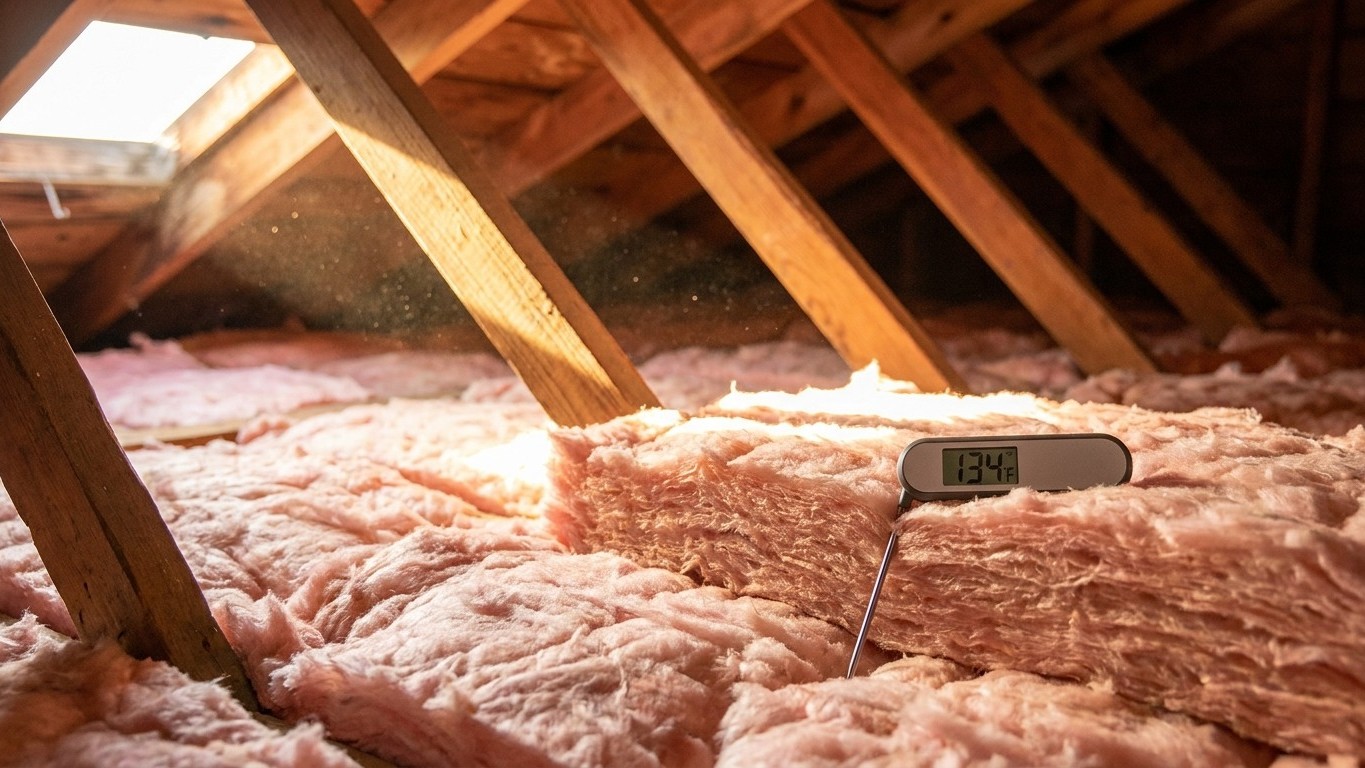
Regardless of how mild the summer is, the mechanism above a New Brunswick ceiling works the same way it does everywhere else. A roof deck under direct sun can run 40 to 60 degrees hotter than the outdoor air, and that heat radiates down into the attic space below it. Everything sitting under an uninsulated or under-insulated attic floor, including the ceiling drywall, stored boxes, and any ductwork routed through that space, sits inside that superheated air pocket. On the rare 85-degree afternoon this province does get, a hot attic is still the difference between a comfortable second floor and a stuffy one.
The point worth understanding is that attic insulation is not a seasonal product. It is a resistance to heat flow, full stop. In winter that flow runs upward and outward as furnace-warmed air tries to escape through the ceiling. In summer it runs downward and inward as attic heat tries to push into the living space. The same layer of insulation resists both directions equally. There is no separate “summer insulation” to buy; the fiberglass or cellulose already doing winter duty is the exact same material doing summer duty, which makes the attic the one upgrade that pays in both directions rather than trading one season’s comfort for another’s.
Recommended minimums for this climate zone
Natural Resources Canada publishes minimum insulation recommendations by climate zone in its “Keeping the Heat In” guide. For zone 6, the zone that covers the Moncton reference station, the recommended nominal values are:
| Assembly | RSI | R-value |
|---|---|---|
| Walls | 4.8 | R 27 |
| Basement walls | 4.2 | R 24 |
| Roof or ceiling | 10.6 | R 60 |
| Floor over unheated spaces | 7.1 | R 40 |
These are recommended minimums, not a code requirement, the actual building code enforced in a given municipality is provincial and municipal, and it can call for more than this table shows. They also belong specifically to zone 6 as measured at Moncton; a reader elsewhere in the province may sit in a colder zone and need higher values still.
What homes in New Brunswick cool with
Statistics Canada’s Canadian Social Survey on Quality of Life and Energy Consumption Behaviours found that 58.9% of households in the Atlantic region have air conditioning, compared with 68.3% across Canada as a whole. That figure covers the Atlantic region as one block in the survey, not New Brunswick alone, and it is a share of households surveyed, not a share of all houses standing, categories the survey lists as “not reported” or suppressed for small sample sizes are not the same thing as zero. A lower regional rate than the national average is consistent with the mild summer data above, though the source itself does not say whether that gap reflects climate, older housing stock, or something else entirely.
Where a household does run central air conditioning, the connection to insulation depends heavily on where the ductwork lives. In many homes the supply ducts run through the attic, which, as the previous section laid out, is the hottest space in the entire building on a warm day. Ceiling insulation above that duct run does nothing to protect the duct itself; a duct sitting in a 130-degree attic loses cooled air to that surrounding heat no matter how thick the attic floor insulation is. That is a separate job, handled by sealing and insulating the ducts directly rather than by adding more attic insulation. Readers dealing with attic ductwork should look at a dedicated duct insulation guide rather than assume ceiling work covers it.
Where cooling instead comes from a window unit or a ductless mini-split, attic insulation matters less directly and the room’s own envelope matters more: the windows, the wall insulation, and how tightly that one room is sealed off from the rest of the house. A room air conditioner guide is the more useful next stop for that situation, since the physics at play are about a single room holding cool air rather than a whole-house duct system losing it.
What the heat asks for that the cold does not
Two products exist specifically for hot-climate houses and have no real place in a cold-dominated one. The first is a radiant barrier: a reflective layer, usually foil-faced, installed under the roof deck to bounce radiant heat back out rather than absorb and conduct it inward. It carries no R-value, and it is not insulation in the conventional sense, it does a different job entirely. Radiant barriers earn their keep under a sun-loaded roof in a climate where attics regularly bake for weeks at a stretch. Given that this region records essentially zero days above 90°F at its reference station, a radiant barrier is not the tool this house needs; the money is better spent hitting the zone 6 attic insulation target already covered above.
The second is the direction water vapor travels through a wall assembly. In a warm, humid climate, the moisture load sits mostly on the outside of the house during summer, which is exactly why the model building code does not require an interior vapor retarder in the country’s warmest zones, trapping vapor on the inside would actually cause damage in that setup. A cold-climate zone like this one runs the opposite way for most of the year, with the moisture drive pointing outward from a heated interior toward cold exterior air. Getting that detail right is genuinely its own subject, with its own set of rules depending on wall assembly and interior humidity levels, so it deserves a dedicated look at this territory’s vapor barrier guide rather than a quick answer folded into a page about summer heat.
What the work is worth
The U.S. Environmental Protection Agency, through the ENERGY STAR program, states it plainly: “EPA estimates that homeowners can save an average of 15% on heating and cooling costs (or an average of 11% on total energy costs) by air sealing their homes and adding insulation in attics, floors over crawl spaces, and accessible basement rim joists.” Those two numbers travel together and mean different things : 15% is a share of combined heating and cooling costs specifically, while 11% is a share of total energy costs across the whole house. Neither figure applies to walls, windows, or doors; the estimate is scoped to attics, floors over crawl spaces, and accessible basement rim joists only.
Both figures come from energy modeling of a “typical” existing U.S. home, which makes them averages rather than a guarantee for any particular house. A well-sealed newer build in this province will see less benefit from the same work than a drafty older farmhouse with a bare attic floor. What the figure does confirm, though, is the exact argument this page is built around: the saving is reported as heating and cooling combined, not as a winter number that happens to carry a small summer bonus. For a region where summer barely cracks 90°F but winter runs cold and long for months, that combined framing is the honest way to read the payoff, most of it lands on the furnace side of the ledger, with the air conditioner side contributing whatever a modest cooling season allows.