
Yes, Insulation helps a North Dakota home stay cool, but the honest picture starts with how short that cooling season actually is. At the Fargo reference station, the average year brings just 11.7 days above 90°F. That’s not a heat wave season, it’s a handful of scattered afternoons, and it changes where the real payoff of Insulation lands.
The short answer for North Dakota

Insulation does keep heat out in summer here, and the same material does it in winter too. But North Dakota isn’t a state where cooling costs dominate the energy bill. With under a dozen days a year crossing 90°F at Fargo, the summer heat load is modest compared to states where triple-digit stretches run for weeks. This is a state built around winter, and the numbers back that up.
North Dakota’s 53 counties split across two IECC climate zones: 37 counties sit in zone 6A, and 16 counties sit in zone 7. Both zones sit on the cold side of the country’s climate divide, the side where the ENERGY STAR insulation tables call for the heaviest attic and floor levels in the book, precisely because winter heat loss, not summer heat gain, is the dominant load on the furnace and the wallet.
That doesn’t mean insulation is wasted effort in July. A well-insulated attic still blocks the sun-driven heat that builds up on the hot afternoons the state does get, and it does that job automatically, with no separate summer product needed. It just means the case for insulating a North Dakota house is made mostly on the winter side of the ledger, with the summer benefit riding along for free.
Compare that to a Gulf Coast county with 90-plus days above 90°F, where cooling can eat up more of the annual energy bill than heating does. Nothing in North Dakota’s climate data looks like that. The state’s summer is real, and worth planning for, but it is the smaller half of the story. A homeowner here who insulates for the long winter is already covering the smaller summer risk in the same project.
The zone split matters for one practical reason: it determines which row of the ENERGY STAR insulation table applies to a given address, and 6A and 7 don’t call for identical levels. A county-by-county answer isn’t something this page can hand out, since the zone assignment runs by county, not by broad regional guesswork. The ENERGY STAR zone map and the county-level IECC table are the places to confirm which of the two zones covers a specific property before buying material.
What happens above the ceiling
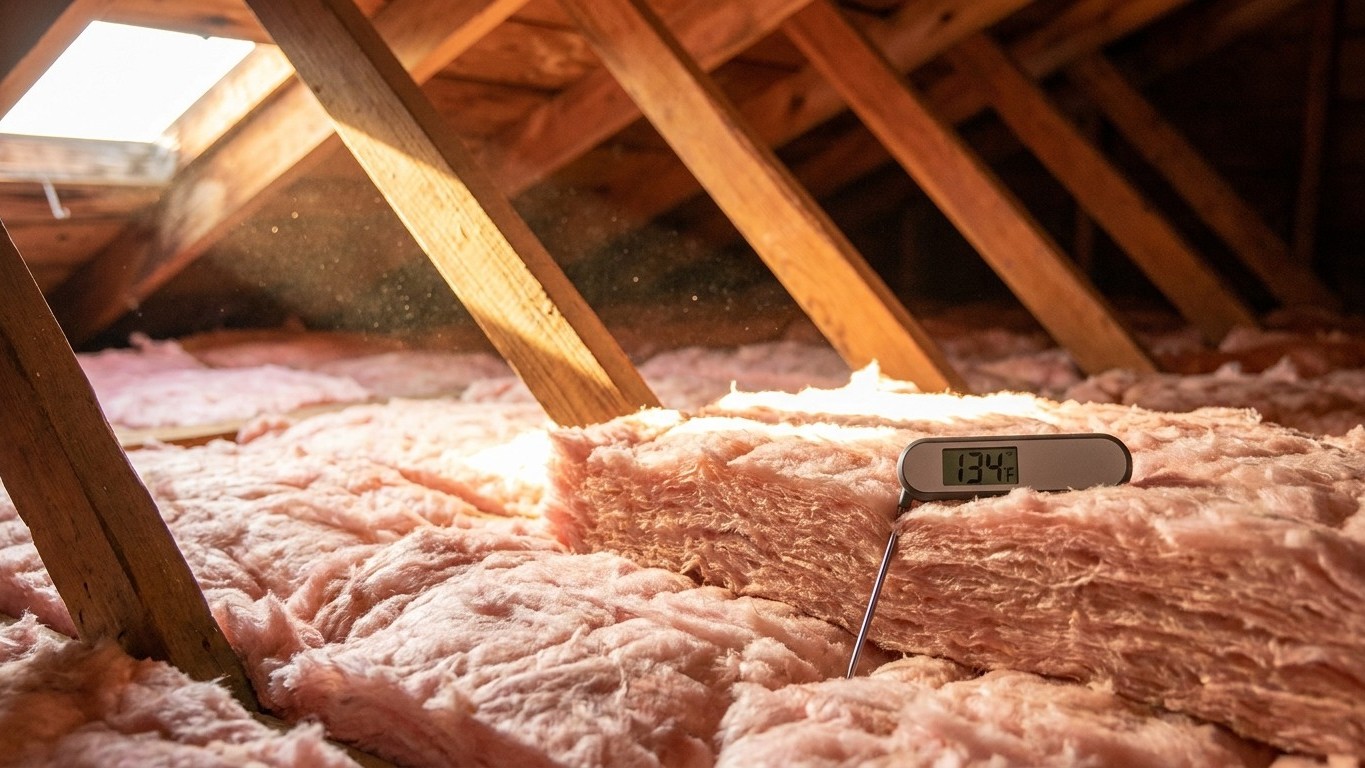
On a sunny summer afternoon, a dark asphalt shingle roof can push the air trapped underneath it well past the outdoor temperature, sometimes by 40 degrees or more. That superheated attic air sits directly above the ceiling drywall, above any ductwork routed through the space, and above anything stored up there. Heat moves from hot to cold, so all of that heat is pressing downward into the living space below, all day, every sunny day.
The insulation laid across that ceiling doesn’t care which direction the heat is trying to flow. It resists conducted heat moving through it, whether that heat is trying to escape a warm house into a cold January night or trying to invade a cool house from a blistering July attic. That’s the useful point for a state like North Dakota: this isn’t a winter product that happens to help in summer. It’s the same resistance, working the same way, just facing the other direction for a few months a year.
ENERGY STAR’s retrofit recommendations for existing wood-framed homes lay out three figures per climate zone: the attic level for a home starting with no insulation, the attic level for a home that already has 3 to 4 inches, and a separate floor level for space above unheated crawl spaces. The table below reproduces those rows for the two zones that cover North Dakota’s counties.
| Climate zone | Attic (uninsulated) | Attic (already has 3-4 in.) | Floor |
|---|---|---|---|
| Zones 6, 5 and 4C | R60 | R49 | R30 |
| Zones 7 and 8 | R60 | R49 | R38 |
North Dakota’s 37 zone 6A counties fall under the first row, and its 16 zone 7 counties fall under the second. Notice the attic numbers stay the same, R60 for an uninsulated attic or R49 for one that already has a few inches down, while the floor requirement climbs from R30 to R38 in the colder zone. These are retrofit levels for existing wood-framed constructions, not the code minimum required of new builds, and they’re the same figures a homeowner would use whether the goal is a warmer February or a cooler July afternoon. One improvement, two seasons covered.
What homes in North Dakota cool with
Air conditioning shows up in 93% of North Dakota households surveyed by the U.S. Energy Information Administration’s Residential Energy Consumption Survey. That’s a high number for a state with such a short hot season, and it says something about how uncomfortable even a handful of 90-degree days can feel in a climate not built around them. But the type of equipment behind that number matters as much as the number itself.
Of those households, 58% run a central air-conditioning system, while 37% rely on individual equipment, a ductless mini-split, a window unit, a wall unit, or a portable. That gap between “has air conditioning” and “has central air” is the whole story for a lot of homes here. A little over a third of households are cooling one room or a few rooms at a time rather than the whole house through a central system, and 62% of homes also lean on ceiling fans, likely to stretch the comfort of whichever cooling method they’ve got.
These figures describe what’s installed in the homes surveyed, not what anyone should install. They reflect what was affordable or practical when a given house was built or renovated, nothing more.
Here’s where the connection to insulation gets specific. In a house where central air runs through ductwork routed through the attic, that ductwork sits inside the hottest space in the entire building, the same superheated attic air described above. Ceiling insulation laid across the attic floor does nothing to protect ducts running through that space; sealing and insulating the ducts themselves is a separate project, covered in this site’s duct insulation guides. In a house cooling with a window unit or a mini-split instead, there’s no attic ductwork to worry about, and the insulation and air sealing of that specific room’s walls, ceiling, and windows is what determines how hard that unit has to work, a topic covered in the room air conditioner guides on this site.
What the heat asks for that the cold does not
Two items belong specifically to hot-climate homes, and neither one fits North Dakota’s short summer well.
A radiant barrier is a reflective material installed under the roof deck to bounce radiant heat back out before it ever gets absorbed into the attic space. It carries no R-value, it isn’t insulation, and it doesn’t slow conducted heat flow the way fiberglass or cellulose does. It earns its keep specifically in climates where the roof deck bakes under intense, sustained sun for months, driving attic temperatures far higher for far longer than a handful of scattered 90-degree days ever would. With just 11.7 days a year crossing that mark at the Fargo station, North Dakota doesn’t produce the kind of sustained radiant load that makes a barrier worth the cost here. This is a tool built for the long, brutal summers of the Southeast and Southwest, not for a state where winter dominates the energy calendar.
The second item runs in the opposite direction: moisture. In a warm, humid climate, water vapor pushes from the humid outdoor air toward the cooler, air-conditioned indoors, which is exactly why the model building code drops the requirement for an interior vapor retarder in the country’s warmest, most humid zones. North Dakota’s vapor dynamics work differently, shaped by long, dry, cold winters rather than muggy summers, and that’s a call this page shouldn’t try to settle in passing. The state’s own vapor barrier page on this site is the right place to work through which side of a wall assembly the vapor retarder belongs on here.
Skipping both of these for a North Dakota project isn’t cutting corners. Given the size of the state’s summer heat load, neither tool is doing much work that the attic insulation and ordinary air sealing aren’t already covering.
What the work is worth
ENERGY STAR puts a number on this kind of project: EPA estimates that homeowners can save an average of 15% on heating and cooling costs (or an average of 11% on total energy costs) by air sealing their homes and adding insulation in attics, floors over crawl spaces, and accessible basement rim joists. That’s the figure to anchor expectations to, and both percentages need to stay attached to what they’re measuring, 15% of the heating and cooling bill specifically, 11% of the whole energy bill, heating, cooling, and everything else running on electricity or gas in the house.
Notice what that estimate actually covers, and notice what it doesn’t. It’s built on energy modeling of a typical existing U.S. home, an average, not a projection for any one specific house, and certainly not a guarantee. It applies to work done in attics, in floors above crawl spaces, and on accessible basement rim joists, the same locations covered in the ENERGY STAR table above. It says nothing about wall insulation, window upgrades, or door replacements; those are separate projects with their own separate math.
The reason this figure matters for a page about summer heat in North Dakota is what it combines. It’s not a winter savings number that happens to keep working in July. It’s a single estimate built from heating and cooling together, which is exactly the point this page has been making from the start: the same attic and floor work that keeps a North Dakota furnace from running overtime in January is the same work reducing the load on the air conditioner during the state’s short run of 90-degree afternoons. One project, one estimate, both seasons.