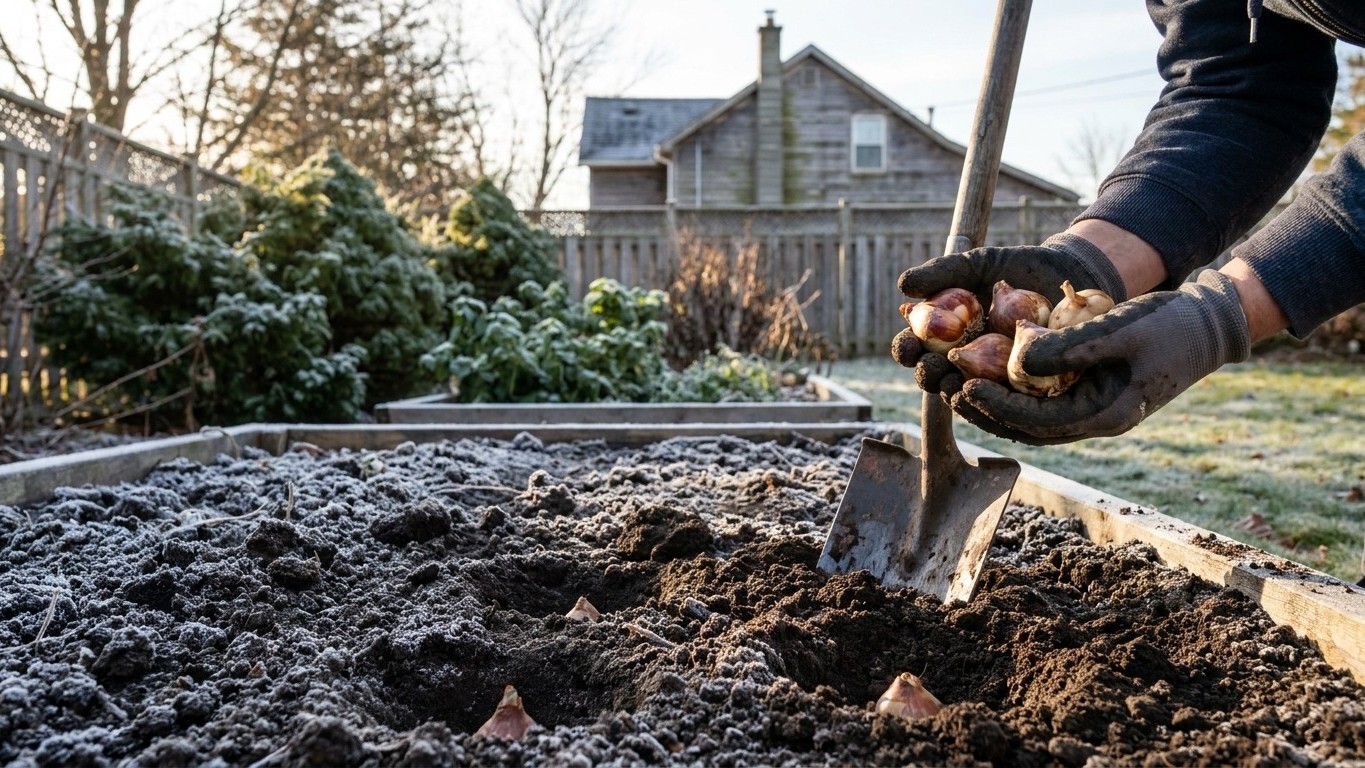

New Brunswick’s cold isn’t the obstacle for spring bulbs. It’s timing the planting date correctly and picking varieties that actually match a Canadian zone 5a climate. Moncton’s coldest month averages a nightly low of 6.9°F, more than enough to trigger bloom in tulips or daffodils. The real risk here is planting too early, too late, or choosing a bulb bred for a warmer province.
When to plant bulbs in New Brunswick

Spring bulbs go into the ground once the soil has cooled but before it locks up for winter, roughly six weeks before the ground freezes solid. In this province, that schedule anchors on the average first fall frost date for Moncton: October 2, according to Environment and Climate Change Canada’s 1981-2010 normals. That date marks the point where the soil starts its steady slide toward freezing, and it’s the reference gardeners across New Brunswick use to back-calculate a planting window.
In practice, that puts the workable stretch from early October through mid-November, with the best results landing in the back half of October, after the first frost has cooled the topsoil but well before the ground stiffens for good.
What happens at each end of the window
Plant too early, while soil is still warm from summer, and a bulb often pushes top growth before winter arrives. That green shoot gets caught by the first hard freeze and dies back, weakening or killing the bulb before it ever roots properly. Plant too late, after the ground has already gone hard, and the bulb sits in cold, barely-workable soil without enough time to grow roots before the freeze locks everything down. A bulb that goes in without rooting either comes up stunted the following spring or doesn’t come up at all.
None of this works as a fixed calendar date. October 2 is a mean, not a guarantee, which means in roughly half of all years the first frost lands later than that, and in the other half it lands earlier. A gardener who waits for a calendar date instead of watching the actual weather is gambling on the wrong half of that split. Soil thermometers are cheap, and checking soil temperature at planting depth beats trusting an average pulled from thirty years of data at one weather station.
Whether your winter is cold enough
Every spring bulb needs a stretch of real cold before it will flower. The standard figure across the classic bulbs, tulips, daffodils, hyacinths, is twelve to fourteen weeks with soil temperatures below about 45°F. Skip that requirement and the bulb still produces leaves, but no flower, or a flower bud so short it never clears the soil line. This number matters regardless of where you garden, because it’s the yardstick against which any bulb offered to you should be measured.
New Brunswick clears that bar without effort. The coldest month here averages a nightly low of 6.9°F, and that kind of cold doesn’t show up for a week and vanish. It settles in through November and holds well past the chilling requirement, which is also why Forcing Spring Bulbs Indoors in New Brunswick is a viable option for gardeners who want blooms before the outdoor season even starts.ll into March, meaning soil temperatures stay below 45°F for months at a stretch, several times longer than the minimum any classic spring bulb needs.
| Bulb | Weeks of cold below 45°F required | What New Brunswick delivers | Verdict |
|---|---|---|---|
| Tulips | 12-14 weeks | Sub-45°F soil from November into March | Clears comfortably |
| Daffodils | 12-14 weeks | Sub-45°F soil from November into March | Clears comfortably |
| Hyacinths | 12-14 weeks | Sub-45°F soil from November into March | Clears, but shelter from frost heaving |
| Crocus | 8-10 weeks | Requirement met by early winter | Clears easily, earliest bloom |
| Alliums | 8-10 weeks | Requirement met by early winter | Clears easily |
Because the margin is this wide, no one gardening in New Brunswick needs to pre-chill spring bulbs artificially. That’s worth explaining anyway, since it’s the fallback for warmer parts of the continent where winters don’t get cold enough on their own: twelve weeks in a refrigerator, kept away from ripening fruit because the ethylene gas that fruit gives off kills the flower bud sitting inside the bulb. Skip that step here. It solves a problem this province doesn’t have. A gardener who buys pre-chilled bulbs at a premium in a place with a winter like Moncton’s is paying for something the ground already does for free.
Which bulbs suit New Brunswick
Bulb packaging almost always prints a USDA hardiness range, a different scale entirely from the Canadian zone rating used above. Treat it as a rough guide to cold tolerance, not a direct match to New Brunswick’s zone 5a. With that caveat, these are the bulbs whose range comfortably covers this province and whose cold requirement it clears without issue:
- Daffodils / Narcissus — USDA zones 3-8
- Tulips — USDA zones 3-7
- Crocus — USDA zones 3-8
- Snowdrops (Galanthus) — USDA zones 3-7
- Alliums — USDA zones 3-8, depending on species
- Hyacinths — USDA zones 4-8, near the cold edge of their range
Ranunculus and anemone corms, rated for USDA zones 8-10, are the ones that disappoint most often here. Sold in the same bins as daffodils each fall, they put on a first-year display and then never come back, killed by a winter far past anything they evolved to survive. Freesia and ixia, rated zones 9-10, fare worse: left in the ground over winter, they rot outright in soil that freezes and thaws repeatedly. Hyacinths sit closer to the line than the others on this list. In an open, exposed bed they can heave out of the ground during freeze-thaw cycles and come up as leaves with no flower the following spring, while the same variety in a sheltered spot against a foundation or under a shrub often blooms reliably for years. A hardiness range is a description of averages, not a guarantee for any one yard.
What digs them up here
Squirrels and voles are selective, and the pattern isn’t random. Daffodils and anything in the onion family contain compounds that make them toxic or simply unpalatable, so they get left alone in the ground almost every time. Tulips and crocus have no such defense, and both rank among the most reliably dug-up bulbs in any yard where rodents are active.
- Usually taken: tulips, crocus
- Usually left alone: daffodils, alliums, snowdrops
The one measure that consistently works is a physical barrier: lay galvanized wire mesh flat over the planting bed right after planting, pinned down at the edges, and leave it in place until the ground freezes solid. By the time the mesh comes off, the bulbs are too deep and too well-rooted to interest a digging squirrel. Repellent sprays and granules sold for this purpose wash off with the first rain or heavy dew, and reapplying them every week through a New Brunswick fall isn’t a realistic routine for most gardeners.
Where to check for your own county
New Brunswick spans a meaningful stretch of latitude, and the figures above come from a single reference station, Moncton. A county in the province’s north or in higher elevation runs behind that schedule, sometimes by three weeks at either edge of the calendar, which is enough to turn a safe planting date into a bulb going into ground that’s already frozen, or into warm soil still weeks from its first frost.
For that local detail, Agriculture and Agri-Food Canada is a working, verified starting point. From there, a county-level extension or agricultural office can confirm frost timing and soil conditions specific to your part of the province, rather than the Moncton average used as this page’s anchor.