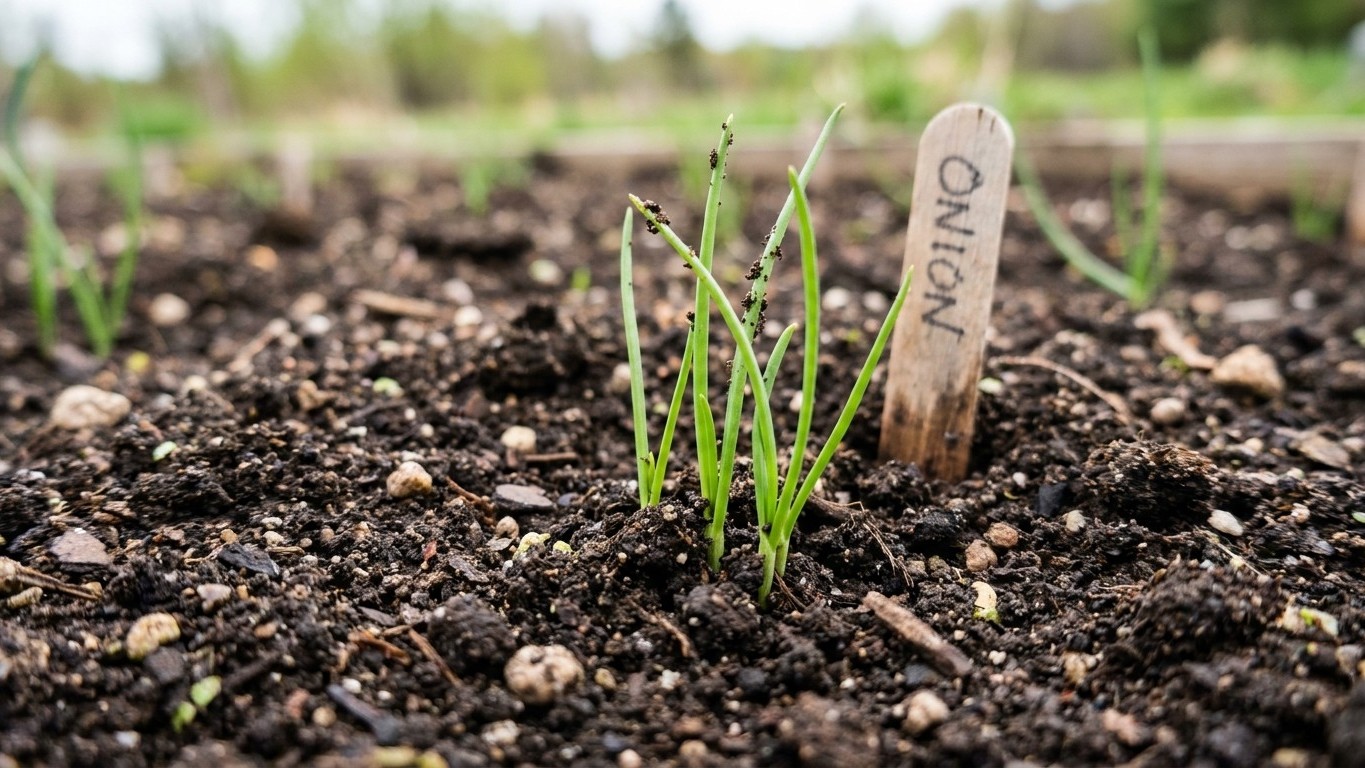

In New Brunswick, onions go in the ground in early-to-mid spring, as soon as the soil can be worked, not in autumn the way growers further south do it. The reference point for that advice is Moncton, at 46.11 degrees north, where the longest day of the year delivers 15 hours and 34 minutes of daylight. That single number determines almost everything about variety choice and timing here, because onions don’t bulb on a calendar. They bulb on day length.
The short answer for New Brunswick

Onions stop making leaves and start making a bulb once daylight reaches a certain threshold, and that threshold is fixed by genetics, not by the weather. Short-day types trigger around 12 hours of daylight. Long-day types wait until they see 14 to 16 hours. At 46.11°N, Moncton’s summer solstice supplies 15 hours 34 minutes of daylight, comfortably inside the long-day range. That makes New Brunswick long-day onion country, full stop.
This is also why the planting season looks nothing like it does in the Carolinas or Georgia. In mild-winter states, growers set onions out in autumn because the winter is soft enough for the plant to survive, and because the short-day varieties grown there trigger bulbing so early in the season that an autumn start still leaves enough time to size up before the 12-hour mark arrives. New Brunswick doesn’t get that option. Winters here freeze solid, so an autumn-planted onion simply dies. The whole strategy has to shift toward spring, and the goal becomes building as much leaf growth as possible before the long June days flip the plant’s switch to bulb-making.
Practically, that means starting seed indoors in late winter, or setting out transplants and sets as soon as the ground thaws and can be worked in early spring, usually April in most of the province. The earlier the plant gets going, the bigger it is when the switch flips in June, and the bigger the bulb it produces.
Fifteen of the onion varieties documented on this site have a published latitude range that covers 46.11°N, meaning they’re a realistic fit for New Brunswick gardens. That list includes Ailsa Craig, Barolo, Blush, Bridger, Frontier, New York Early, Patterson, Powell, Redwing, Rossa di Milano, Safrane, Talon, and Walla Walla Sweet, along with two intermediate-day types, Red Long of Florence and Red Long of Tropea, whose range also stretches this far north. All of them are long-day or intermediate-day onions built to wait for New Brunswick’s long summer daylight before bulbing.
What will not work here
Short-day onions are the mistake that shows up most often in northern gardens, and it isn’t a subtle one. A short-day variety triggers bulbing at roughly 12 hours of daylight, a threshold New Brunswick’s spring reaches early in the season, while the plant is still small. The result isn’t a failed crop exactly. It’s a crop of onions the size of golf balls, because the plant had barely gotten started when its genetics told it to stop growing leaves and start forming a bulb. This is a variety problem, not a feeding or watering problem, and no amount of fertilizer fixes it.
Eight documented short-day varieties fall into this category for New Brunswick, all published for latitudes well south of Moncton:
- Candy (intermediate-day, rated 33-40°N): too far north here, bulbs early and small
- Gabriella (short-day, rated 20-35°N): triggers bulbing far too early at this latitude
- Madalyn (short-day, rated 20-35°N): same undersized-bulb outcome
- Red Rock (short-day, rated 30-36°N): built for a much shorter summer day
- Red Sensation (short-day, rated 25-35°N): bulbs before the plant has size
- Texas Grano 1015Y (short-day, rated 25-35°N): a Deep South onion, not a Maritime one
- Vidora (short-day, rated 25-35°N): same early-trigger problem
- White Castle (short-day, rated 30-38°N): still south of the range this province needs
There’s a second, quieter version of this mistake that has nothing to do with variety: planting late. Gardeners sometimes assume that if they miss the ideal spring window, they can just plant a few weeks later and harvest a few weeks later too. Onions don’t work that way. Bulbing starts when day length hits the trigger, not when the plant feels ready, so a late-planted onion hits that June daylight threshold at whatever size it happens to be, small or large. The harvest date barely moves. The harvest size shrinks. Late planting doesn’t delay the crop, it downsizes it.
What changes across New Brunswick
Moncton isn’t the whole province, and a reader gardening in Saint John or up in the Restigouche Valley isn’t standing on the same latitude line. New Brunswick stretches from the Bay of Fundy coast in the south to the Quebec border in the north, and while that span isn’t large enough to shift anyone into a different day-length group, it’s enough to shift planting dates by a couple of weeks in either direction.
| Region | Position relative to Moncton | Practical effect on planting |
|---|---|---|
| Fundy coast (Saint John, Charlotte County) | Slightly south, moderated by the bay | Soil often workable a bit earlier in spring; frost risk tapers sooner |
| Reference city: Moncton | 46.11°N | 15 h 34 m of daylight on the longest day; baseline for this page |
| North and inland (Restigouche, Victoria County) | Slightly north, more continental | Later spring thaw; last frost date arrives later, pushing planting back |
The long-day requirement doesn’t change from one end of the province to the other. What changes is how soon the soil dries out and warms up enough to work, and how late a frost might still hit young transplants. A gardener near the Fundy shore may be planting onions a week or two before someone in the northern counties, even though both are growing the exact same long-day varieties suited to Moncton’s daylight numbers.
Checking this against your own garden
A provincial figure is a starting point, not a guarantee, and the closer a reader’s own property sits to Moncton, the more directly this planting window applies. Anyone gardening near the province’s edges, whether that’s the Fundy coast or the inland north, should treat the dates here as a rough anchor and confirm the specifics locally before committing seed or transplants to the ground.
- Look up your own latitude if you’re gardening well north or south of Moncton, since even a degree or two shifts your local day length curve
- Check your area’s average last spring frost date, since that’s what actually sets the earliest safe planting day, more than the calendar month does
- Contact your county’s agricultural extension office, or the New Brunswick Department of Agriculture, Aquaculture and Fisheries, for frost-date records specific to your area
- Watch your own soil, not the calendar: onions go in once the ground can be worked, which varies year to year with snowmelt and rainfall
- Confirm the day-length rating printed on any seed packet or catalogue listing before assuming it matches the long-day varieties suited to this province