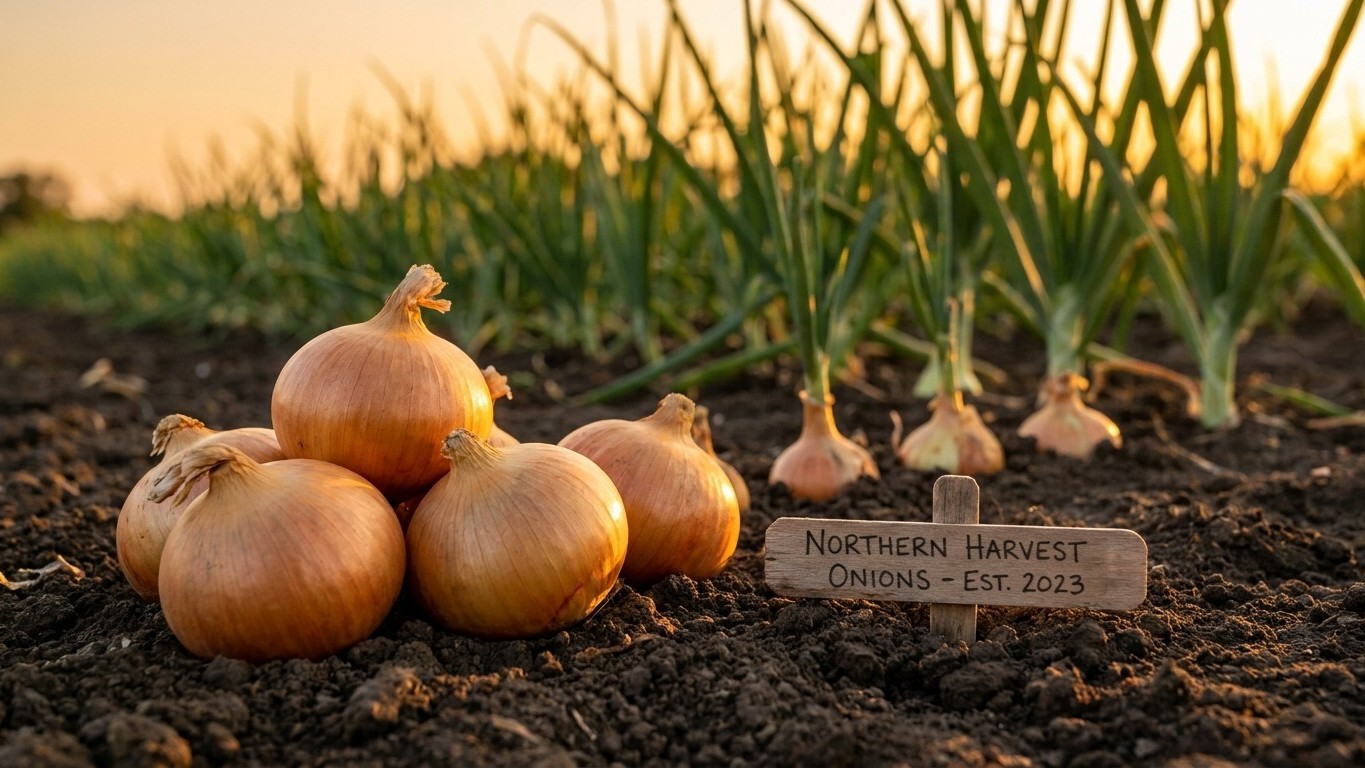

Onions bulb by the clock, not the thermometer, and Moncton’s clock reads 15 hours and 34 minutes of daylight on the longest day of the year. That single number decides which onion varieties will actually form a bulb in New Brunswick and which ones will sit in the ground making leaves until they rot. Here’s how to read it, and which varieties match it.
How long your longest day is

Moncton sits at 46.11 degrees north latitude, and on the June solstice it gets 15 hours and 34 minutes of daylight, according to a calculation based on Environment and Climate Change Canada’s station data and the standard sunset hour-angle formula. That’s the figure an onion plant actually reads. Onions don’t start swelling into a bulb because the soil warmed up or because you fed them a certain fertilizer. They start bulbing when the number of daylight hours crosses a threshold specific to the variety. Get the variety wrong for your latitude, and no amount of good soil or watering fixes it.
At 15 hours and 34 minutes, New Brunswick sits solidly in long-day territory. Long-day onions need somewhere between 14 and 16 hours of daylight before they’ll switch from leaf production to bulb production, and Moncton’s summer supplies that comfortably. Short-day onions, which trigger at around 12 hours according to Clemson Cooperative Extension’s Home & Garden Information Center, are ruled out here entirely: the day never gets short enough, relative to the plant’s needs, to hold them back, so they bulb while still small and never catch up in size. Intermediate-day types sit in a gray zone that depends on exactly which variety and exactly where in the province you garden. For a rundown of which cultivars actually fit this profile, see The Best Onion Varieties for New Brunswick.
A quick reference for the three groups and how they behave against a 15 h 34 summer day:
| Day-length group | Bulbing trigger | What happens at 46.11N |
|---|---|---|
| Short-day | about 12 hours | Bulbs too early, stays undersized |
| Intermediate-day | between the two thresholds | Case by case, often marginal |
| Long-day | 14 to 16 hours | Full growing season before bulbing, sizes up properly |
Keep in mind that 46.11 degrees is Moncton’s latitude, not the whole province’s. New Brunswick stretches from around the U.S. border up past the Chaleur region, and a gardener near the northern edge sits at a noticeably higher latitude, with an even longer solstice day, while someone near the southern boundary sits a bit lower. If you’re gardening well north or south of Moncton, it’s worth checking a full When to Plant Onions in New Brunswick your own latitude before assuming these numbers apply exactly to your yard. The gap is rarely dramatic, but it can be the difference between “this variety works” and “this variety is borderline.”
Which varieties bulb in New Brunswick
Fifteen of the twenty-eight onion varieties documented on this site have a published latitude range that fully covers 46.11 degrees north, meaning their catalogue data puts New Brunswick’s day length squarely inside their comfort zone. All of them are long-day or intermediate-day types, which lines up exactly with the daylight math above.
- Ailsa Craig (long-day, 38-60N)
- Barolo (long-day, 38-55N)
- Blush (long-day, 38-55N)
- Bridger (long-day, 35-50N)
- Frontier (long-day, 40-50N)
- New York Early (long-day, 38-50N)
- Patterson (long-day, 38-55N)
- Powell (long-day, 43-47N)
- Red Long of Florence (intermediate-day, 38-50N)
- Red Long of Tropea (intermediate-day, 35-48N)
- Redwing (long-day, 43-65N)
- Rossa di Milano (long-day, 38-50N)
- Safrane (long-day, 42-50N)
- Talon (long-day, 42-50N)
- Walla Walla Sweet (long-day, 35-55N)
Eight more varieties sit within about a degree and a half of one of their published bounds, which puts them in what’s really a continuum rather than a hard line: Cabernet, Calibra, Elsye, Expression, Monastrell, Red Carpet, Scout, and Sierra Blanca. These may bulb reasonably well in New Brunswick, but they’re at the edge of their documented range, so treat them as a gamble worth trying in a small trial row rather than a sure bet for your whole bed.
The varieties that won’t work here
This is the part worth reading twice if you’ve ever bought a bag of onion sets at a big-box garden center without checking the label closely. Five varieties documented on this site have published ranges that sit below New Brunswick’s latitude, meaning the province’s summer day length never reaches what they’re bred to expect.
- Candy (intermediate-day, 33-40N)
- Gabriella (short-day, 20-35N)
- Madalyn (short-day, 20-35N)
- Red Rock (short-day, 30-36N)
- White Castle (short-day, 30-38N)
Plant any of these in a New Brunswick garden and the sequence is predictable: strong, healthy-looking green tops all summer, a bulb that never really swells, and then, once the plant’s internal clock finally trips near the end of the season, a soft, watery onion that rots faster than it should in storage. It looks like a disease or a feeding problem. It isn’t. It’s a day-length mismatch, and no amount of extra fertilizer or better drainage corrects for the wrong latitude range on the seed packet.
When to plant onions in New Brunswick
Because New Brunswick’s day length calls for long-day and intermediate-day varieties, the planting calendar here looks different from what a gardener in Georgia or Texas would follow. Short-day growers plant in fall and let onions overwinter as small plants, because their local climate never gets cold enough to kill young onions and their short summer days trigger bulbing early. Long-day growers, including most of New Brunswick, need the opposite approach: get plants or sets in the ground as early in spring as the soil allows, so the plant has as many weeks as possible to build leaf mass before the long June days switch it over to bulb production. More leaves before the switch generally means a bigger bulb after it.
Moncton’s frost data gives a working frame for that spring window. The average last spring frost falls on May 23, and the average first fall frost lands on October 2, based on Environment and Climate Change Canada’s 1981-2010 climate normals for the Moncton station. Onion sets and transplants can generally go in a few weeks ahead of that last-frost average, since young onion plants tolerate a light frost far better than most vegetable seedlings, but exactly how many weeks depends on your soil and your specific site.
Two cautions matter here, and skipping them is where a lot of onion crops go wrong. First, May 23 is an average, not a guarantee: in roughly half of all years, the last frost actually falls after that date, so treating it as a hard safe date is a mistake that costs plants some years and costs nothing other years, purely by luck. Second, this figure comes from one station near Moncton, and a province isn’t one climate. Gardeners in higher-elevation or more northern parts of New Brunswick should expect both frost dates to run later in spring and earlier in fall than what Moncton reports, which shortens the growing window on both ends and makes early planting, and a fast-maturing long-day variety, more important, not less.
One more detail worth remembering when you’re comparing sources: Canadian climate normals cover 1981-2010, while a lot of U.S. extension data on this site is drawn from the 1991-2020 period. That’s not a contradiction, just a different reference window, and it’s part of why a New Brunswick planting date shouldn’t be lifted straight off a chart built for a Vermont or Maine county even though the latitudes look similar on a map.