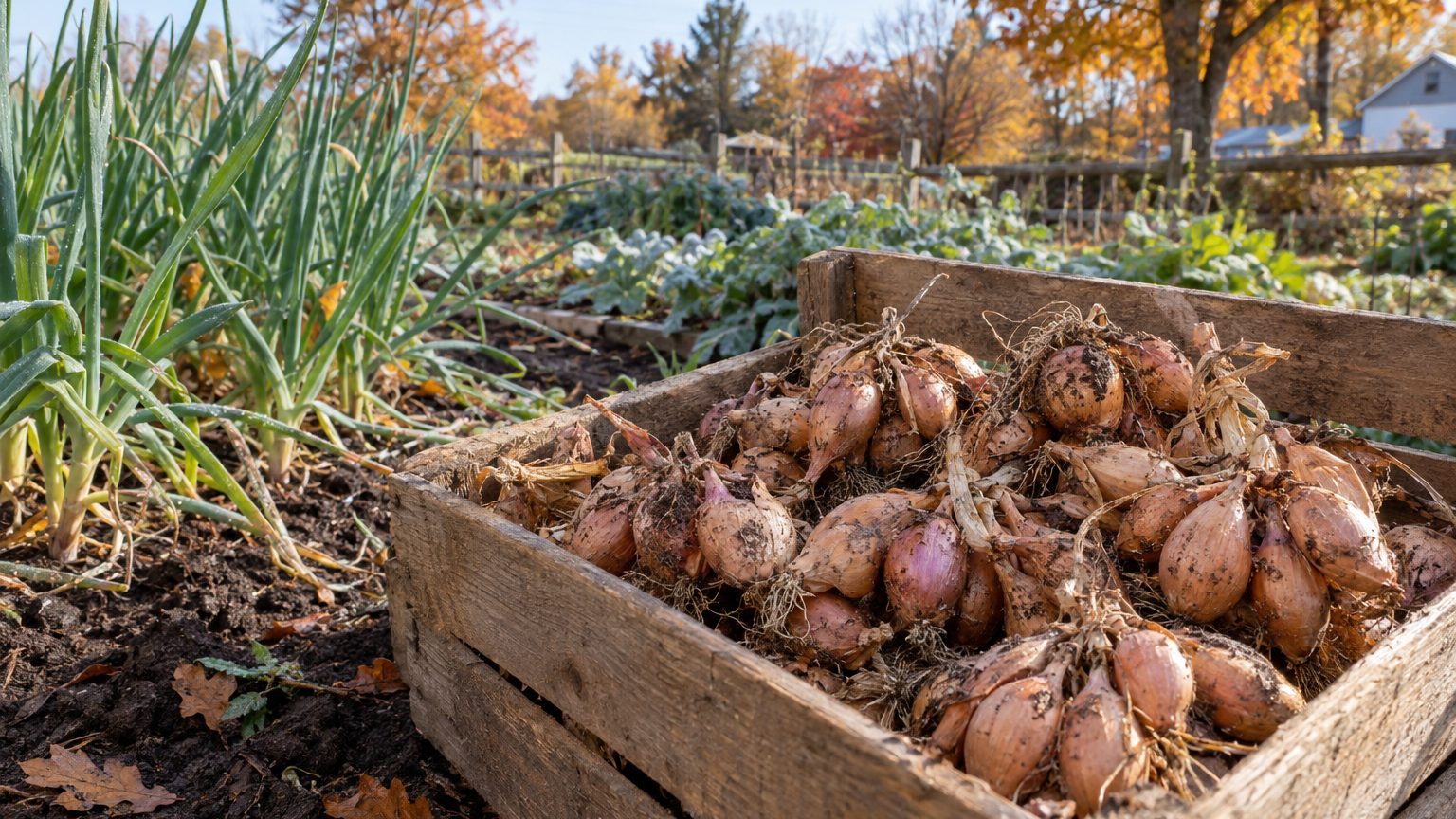

For New Brunswick, choose early- to mid-maturing shallots grown from bulbs (sets), and treat seed-grown types as a stretch goal. The season is long enough for a shallot, but not long enough to forgive a slow one. This page sorts varieties by type rather than by name, because the facts that decide the choice are the frost dates and the winter cold.
The short answer for New Brunswick
Plant bulb-grown, early- to mid-maturing shallots, the kind that size up and cure within a Maritime summer. Seed-grown shallots can work, but only if you start them indoors early and accept less margin. Anything sold as a long-season or heat-loving type belongs in a different province.
The numbers behind that call come from the Moncton station, the reference point this page uses. Environment and Climate Change Canada puts the average last spring frost at May 23 and the average first fall frost at October 2 (Canadian Climate Normals 1981-2010). Counting the days between them gives about 132. That is the stretch where tender crops can grow without a frost interrupting them. Shallots are hardier than that and can start earlier and finish earlier, but the 132 days tell you how much room a long-maturing variety would have. Not much.
Those two dates are averages, not guarantees. In one year out of two, the frost falls later than May 23 in spring, and in one year out of two the fall frost arrives before October 2. Think of each date as the middle of a window, never a safe date. A gardener who plants “after the last frost” on May 23 is gambling half the time. Shallots shrug off most spring frosts, which is part of why they suit this province.
Why bulb-planted types lead
A shallot planted as a bulb skips the slowest stage, which is growing a bulb from a seedling. It begins life already sized for a head start. In a season with roughly 132 frost-free days, that head start is the difference between a full-sized, well-cured crop and a pile of undersized bulbs. Bulb-planted shallots also multiply, so one planted bulb becomes a cluster. A small first purchase of planting stock can grow into a stock you keep replanting from year to year.
Where seed-grown shallots fit
True-seed shallots are cheaper per plant and avoid some of the disease that can ride along on bulbs. They are also slower. Sown outdoors in a province where the average last frost is late May, they would be racing the fall. Started indoors well ahead of the last frost and transplanted, they have a fair chance. If you try them, grow a few beside your bulb-planted rows and compare at harvest rather than betting the whole bed.
For planting timing, When to Plant Shallots in New Brunswick turns these dates into a working window. For the wider picture of the crop here, see Growing Shallots in New Brunswick.
What will not work here
The slowest shallots fail first. A variety bred for a warm, long summer wants more days than the Moncton figures give it, and it shows up as bulbs that stop sizing when the weather turns, necks that stay green and thick, and heads that never cure properly. With an average first fall frost of October 2, the plant has no spare weeks to make up for a cool June.
Late spring planting is the second failure, and it is a human one. If the ground stays cold and wet into May, there is a temptation to wait for the “safe” date of May 23. Waiting costs weeks of growth on a crop that needs every one. Shallots do not need a frost-free soil. They need soil that can be worked. Planting after a hard-won thaw, then losing a week to a frost, usually hurts less than starting late.
Winter is the third. The mean daily minimum of the coldest month at Moncton is -13.9 °C (6.9 °F, for readers comparing with the United States). That is an average of the nightly lows, not the record. Individual nights run colder, so fall-planted shallots left on bare ground are exposed to hard freezes and to the heaving that comes with repeated thaw and refreeze. A thick layer of straw or similar mulch is what separates a fall planting that wakes up in spring from one that gets pushed out of the soil. Mulch also needs pulling back in spring as shoots push through, or the bed stays cold and wet longer than it should.
Crowding is another quiet failure. This page does not have rainfall or humidity figures for the province, so it will not claim a number. But in any climate where leaves stay damp, shallots packed tightly together invite fungal problems and make curing harder. Give each bulb room, around 6 inches (15 cm) between plants is a common starting point, and stop watering as the tops begin to yellow and fall over so the bulbs can finish and dry.
The last failure is borrowing someone else’s dates. The Moncton figures describe one station in the southeast. A gardener in a northern or upland district who copies May 23 is working off a date that district may not reach for weeks. Variety choice in those places tilts even harder toward the earliest, quickest types.
What changes across New Brunswick
A province is not one garden. The hardiness figure this page has is zone 5a on the Canadian system, from Natural Resources Canada’s 1991-2020 normals, for the reference city of Moncton. That is the zone of one city, not of the province. The page does not hold the full spread for New Brunswick, so there is no single answer to give you, and it will not guess one.
Be careful with the label, too. The Canadian system is built on several climate variables, while the USDA system looks at one. Natural Resources Canada itself says the two do not convert simply: a single Canadian zone can overlap many USDA zones. So 5a here is a Canadian zone, and it should never be read as a USDA number or lined up against the US figures elsewhere on this site. Another note: the Canadian frost normals run 1981-2010, while the US frost figures on this site cover 1991-2020, so the two sets are not on the same footing.
What should a reader in the north or at altitude shift? Start with timing. Expect spring to arrive later and fall to arrive earlier than the Moncton dates suggest, which shrinks the growing season on both ends. Lean harder toward early-maturing, bulb-planted types, and be wary of seed-grown shallots. Mulch more heavily for fall plantings, since colder winters leave less margin. Near the coast, the effect is often milder, but this page does not have the figures to say by how much.
To find your own zone, use the Natural Resources Canada plant hardiness map and look up your municipality. Do not assume your zone from a neighbor’s or from this page. Zones can differ between towns that sit fifty miles apart.
Where to check this for your own county
A county recommendation beats a state one, and this page is the state one. It works from a single reference station and from averages. Someone who has trialed shallots in your district, in your soil and your frost pockets, knows things this page cannot.
The place to start is Agriculture and Agri-Food Canada. It is the federal department. The provincial department’s own site refused the automated check used to verify links, so the federal site is given instead because it demonstrably works. From there, look for your provincial agriculture contacts and any local growers’ resources.
When you get there, look for two things:
- A local planting calendar that gives sowing and planting windows for your district rather than for the province.
- Varieties that have been trialed near you, ideally with notes on maturity, storage and disease.
Compare what you find with the Moncton dates on this page. If a local calendar says to plant earlier or later, go with the local one. The same goes for a variety that a nearby grower or agricultural office has tested and recommends. This page is a starting point, and local trials are better evidence for your plot.
Checking this against your own garden
Your own observations outrank every date here, and three are worth watching.
Soil warmth by feel. In spring, push a hand into the bed. If the soil crumbles instead of clumping into cold mud, it is workable, and shallots can go in. A bed that stays cold and soggy long after your neighbors’ have dried tells you that your garden runs behind, and that you should favor the quickest types.
The first flush of male flowers. On nearby plants such as squash, the first male blooms signal that warmth has arrived. If they come late in your garden, your season is shorter than the averages suggest.
The first true leaves. Watch when seedlings, or the shoots from your planted bulbs, push their first real leaves. Slow, pale growth after a long wait points to a cold pocket, a shaded bed or heavy, wet soil. Fast, green growth tells you the spot is a good one.
Keep notes for a few years. After two or three seasons, your own dates will tell you more than the Moncton figures can.
Common questions
What is the best type of shallot for New Brunswick?
Bulb-planted, early- to mid-maturing shallots. They skip the slowest growth stage and fit a season with about 132 days between the average last spring frost (May 23) and the average first fall frost (October 2) at Moncton.
Can I grow shallots from seed in New Brunswick?
Yes, but with less margin. Start them indoors well ahead of the last frost and transplant them. Sowing outdoors in late spring leaves little time before fall.
Is May 23 a safe planting date?
No. It is the average last spring frost at Moncton, so in one year out of two the frost falls later. Treat it as the middle of a window. Shallots tolerate light frost, so you can often plant earlier once the soil is workable.
What hardiness zone is New Brunswick?
There is no single answer. Moncton is zone 5a on the Canadian system, but that is one city’s figure, and the Canadian system does not convert to USDA zones. Look up your municipality on the Natural Resources Canada map.