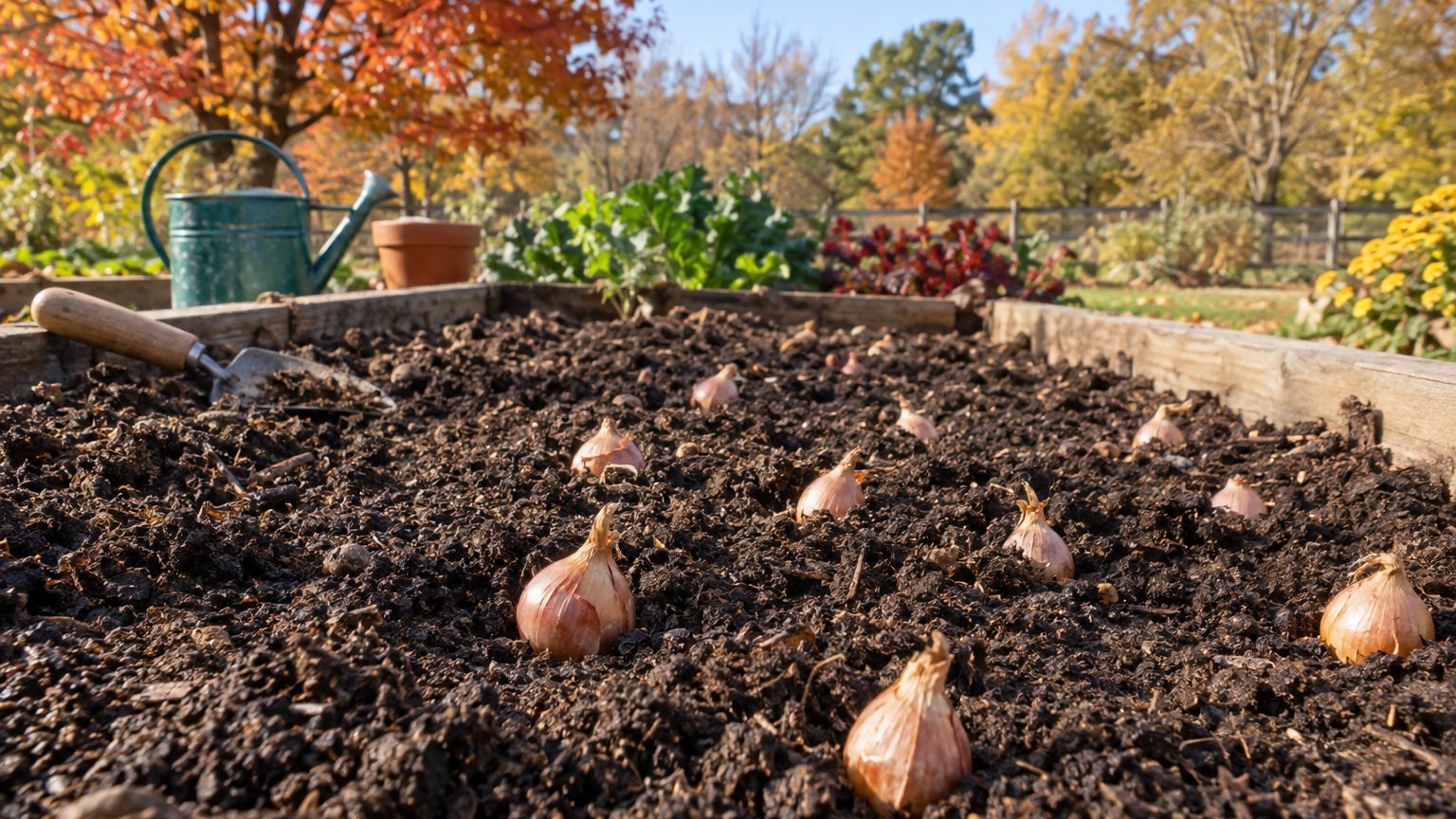

In New Mexico, shallots go in the ground in fall, a few weeks before the first hard freeze, or in early spring as soon as the soil can be worked. The only frost dates verified for this page come from the Albuquerque airport weather station, so they are a starting point. Elevation and your own county will move them.
The short answer for New Mexico
Plant shallots in fall, ahead of the first fall freeze, or in early spring, around the last spring freeze. At the Albuquerque reference station, NOAA’s 1991-2020 normals put the last spring frost at March 31 to April 12 and the first fall frost at October 29 to November 9.
Those dates are a probability, not a promise. They come from NOAA’s U.S. Climate Normals and describe the 30 to 70 percent band for a 32°F freeze. Before March 31, a freeze in spring is still more likely than not. After April 12, it is less likely than not, but still possible. The fall band works the same way in reverse.
| Event (Albuquerque reference station) | Date band | What it is a probability of |
|---|---|---|
| Last spring frost | March 31 to April 12 | 30-70% chance of a 32°F freeze |
| First fall frost | October 29 to November 9 | 30-70% chance of a 32°F freeze |
The fall window
Fall planting aims to give the cloves a few weeks to root before the ground gets cold. In practice that means planting in the weeks leading up to the October 29 to November 9 band. As of early October 2026, a garden at the reference station is right in that run-up. Gardens that freeze earlier should plant earlier.
The spring window
Spring planting starts when the soil is workable, which in the reference city lands near the March 31 to April 12 band. Shallots tolerate light frost once planted, so you don’t have to wait for the last freeze to pass. You do want them in early, because the season for sizing up bulbs is short.
One limit on all of this: the facts behind this page do not include a New Mexico extension calendar written specifically for shallots. The window above is built from frost dates, not copied from a shallot schedule. For the bigger picture, see Growing Shallots in New Mexico, and for what to plant, The Best Shallots to Grow in New Mexico.
What will not work here
Planting late in spring is the most common failure. Between the last spring frost band and the first fall frost band at the reference station lie roughly 200 to 223 days, by simple date arithmetic. That sounds generous. But a rural or higher garden often sees its last frost one to two weeks later and its first one one to two weeks earlier, which can trim two to four weeks off the total. A shallot planted in May has little cool weather left to build leaves before heat arrives, and leaf count sets bulb size. Expect small, disappointing bulbs.
Planting too early in fall fails too. If cloves go in during warm October weather, they can push a tall flush of green. At Albuquerque the mean daily minimum of the coldest month is 26.4°F, meaning nights below freezing are the norm in midwinter, not a rare event. Tall, soft tops take that cold worse than cloves that have only rooted. A couple of inches of straw or shredded leaves over the bed softens the swings, and it matters more as you move uphill.
Weekly watering is a quieter failure. Shallots have shallow roots, and New Mexico’s spring and early summer are dry. A single weekly soak can leave the top few inches parched for days while the bulbs are sizing. Lighter, more frequent watering during bulbing does better, then you ease off as the tops yellow and fall over. Overhead sprinkler schedules set for lawns tend to miss the mark either way.
Treating the airport dates as your dates is the last one. The Albuquerque figures come from a single station. The cautions attached to them are plain: suburban and rural gardens typically see the last spring frost later and the first fall frost earlier, often by one to two weeks, and more at elevation. A gardener in a cold-air pocket at the foot of a slope can plant by the reference date and lose the crop to a freeze the airport never recorded.
What changes across New Mexico
New Mexico is not one garden. The USDA Plant Hardiness Zone Map (2023, built on 1991-2020 normals) lists the state at 4b to 9a, a spread of more than four full zones. There is no single planting answer for that range. The map tracks only the average annual extreme minimum temperature, so it says nothing directly about heat, frost dates or season length, but it does show how much winter cold varies.
The practical shifts follow from that. At high elevation and in the north, winters are harsher, and the growing season starts later and ends sooner. Fall planting there should go in earlier, with heavier mulch, or you can lean on spring planting as soon as the ground thaws. In the warmer, lower parts of the state, fall frost arrives later, so fall planting can run later, while spring planting gets squeezed by early heat.
| Where you garden | Fall planting | Spring planting |
|---|---|---|
| North and high elevation | Earlier than the Albuquerque dates, with heavy mulch | Later start, but the best fallback if fall slips |
| Albuquerque-like conditions | The weeks before October 29 to November 9 | Around March 31 to April 12, soil workable |
| Warmer, lower areas | Can run later, since frost comes later | Go as early as the soil allows, before heat builds |
The table is directional, not a set of dates. This page has no frost data for those other areas, so it won’t invent any. To find your own zone, look up your location on the USDA Plant Hardiness Zone Map rather than guessing from a neighbor or a county seat 50 miles away.
Where to check this for your own county
The best next stop is New Mexico State University’s Cooperative Extension Service. It is the state’s land-grant extension system, with county offices staffed by people who watch local conditions year after year. Two things to look for there: the local planting calendar for your county, and the vegetable and allium varieties that have been trialled where you live.
That second item matters more than it sounds. A variety that does well in one valley can bolt or sulk at another elevation, and trial results from your county are far more useful than a catalog description written for the whole country. If the extension site has no shallot-specific guidance for you, a call or email to the county office will usually turn up onion or garlic timing, which runs close to shallots.
A county recommendation beats a state one, and this page is the state one. It rests on one reference station and a hardiness range that covers nearly half the zone scale. Use it to frame your plan. Where the county office says otherwise, go with the county office.
Checking this against your own garden
Your own observations outrank every date here. Three are worth tracking, and none needs equipment beyond your hands and eyes.
- Soil by feel. Push a hand or trowel several inches down. If it is cold and still crumbles instead of clumping into frozen chunks, the bed is workable for spring planting. Soil that warms and dries early in a bed against a south wall tells you that spot runs ahead of the rest of the yard.
- Your first frost. Note the morning you first see frost on a car windshield or on tender plants, and compare it to October 29 to November 9. If yours comes earlier, your fall planting window runs earlier too.
- The first green shoots. After planting, watch how soon the first leaves emerge. Quick emergence in fall means the soil held warmth and the tops may need mulch. Slow emergence in spring means a cold bed that will favor late-planted cloves less.
Write the dates down for a season or two. A simple notebook turns a state-level window into a calendar for your own garden.
Common questions
Is fall or spring better for shallots in New Mexico?
Fall planting gives roots a head start and usually yields larger bulbs where winters are mild enough. Spring works well where winters are harsh, such as at elevation. Both are reasonable options, and the right one depends on your local winter.
Can I plant shallots right now, in early October?
At the Albuquerque reference station, the first fall frost band is October 29 to November 9, so early October is in the run-up window. Higher or rural gardens may freeze sooner, so check your county before planting.
What do the frost dates on this page actually mean?
They are the 30 to 70 percent probability band for a 32°F freeze at the Albuquerque airport station, from NOAA’s 1991-2020 normals. They are not guarantees, and they are not statewide.
Does my hardiness zone tell me when to plant?
No. The USDA zone reflects only the average annual extreme minimum temperature. It helps judge winter survival, but frost dates, heat and season length decide the planting window. Use the zone map alongside your county’s frost information.