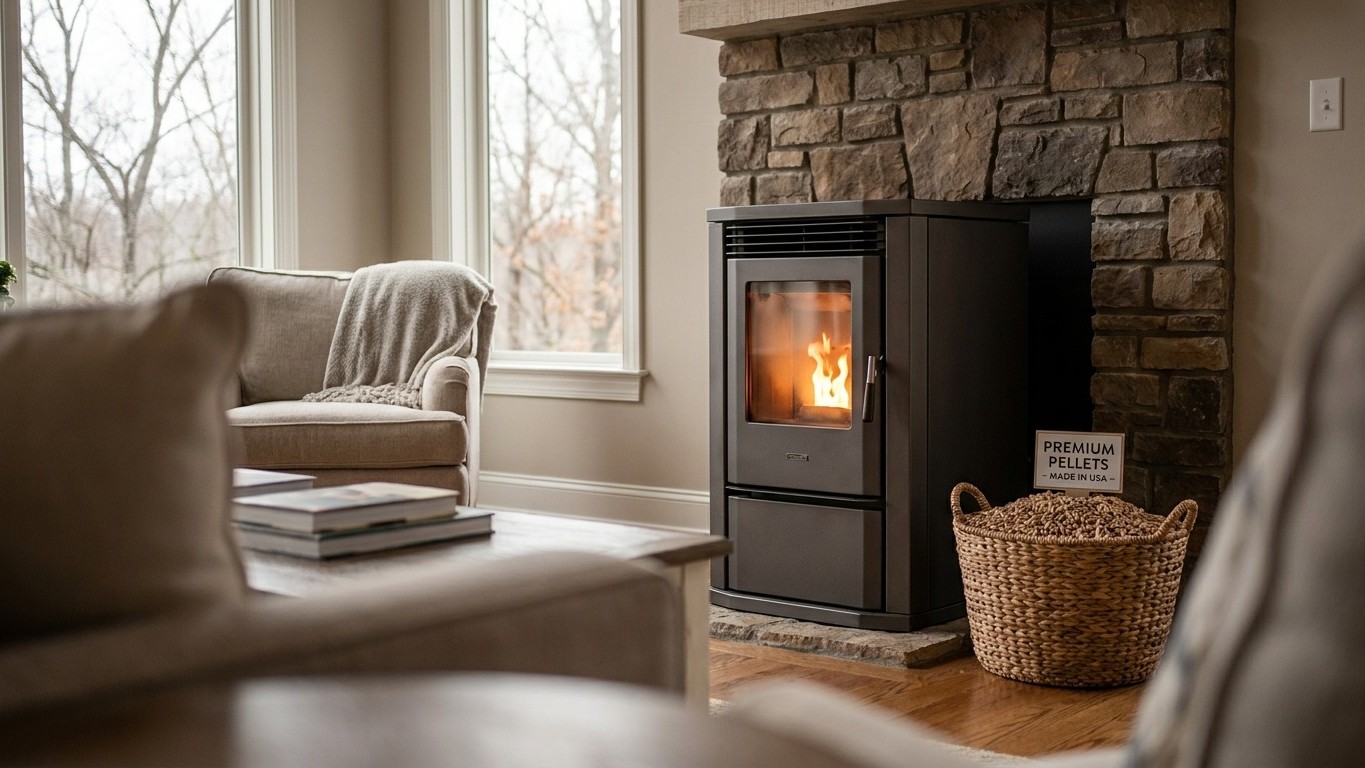

A New Hampshire winter isn’t mild, and it isn’t short either. For most households here, a pellet stove is doing real work from September through May, not just adding ambiance on a few cold nights. How many tons that takes depends heavily on the house, the setup, and how the stove is used, but the honest starting point is this: expect the season to run long, expect the stove to matter, and expect to track your own numbers rather than trust a generic estimate.
How hard the winter works here

The reference number for this state comes from Manchester AP, NH, where NOAA’s 1991-2020 Climate Normals put the annual heating degree day total at about 6,172 (base 65°F), against just 773 cooling degree days. That lopsided ratio tells you almost everything: this is a heating-dominated climate, and a pellet stove here is competing against a genuinely cold, genuinely long season rather than dressing up a few chilly evenings.
Degree days measure how far below 65°F the average daily temperature sits, added up across the year. Twice the degree days means roughly twice the fuel burned to hold the same indoor temperature in the same house. At 6,172, Manchester sits well above the national middle, closer to the cold end of the spectrum than the mild one. That’s the number that decides whether a stove works as a homeowner’s primary heat source or stays a supplement to a furnace or boiler.
Length matters separately from depth, and NH has both. Using the monthly normals from the same NOAA product, heating demand starts in September, the first month whose average temperature (64.3°F) dips below the 65°F threshold. It builds through fall, peaks hard in January at 1,221 degree days for that month alone, stays brutal through February (1,030) and March (884), and only lets up once the mean climbs back above 65°F in June. That’s roughly nine months of the year where the furnace, boiler, or stove has something real to do. December alone (1,042 degree days) outpaces what many southern states rack up over an entire winter.
A stove running under those numbers is not lifestyle heat. It’s carrying real load for the better part of three seasons, which is worth remembering before assuming last year’s bag count will repeat exactly, because a single cold snap in January can move the total more than people expect.
One caution worth repeating: Manchester is one station in one part of the state. The White Mountains and the Great North Woods run colder and longer than this figure suggests, sometimes by a wide margin. A homeowner in Coos County should treat 6,172 as a floor, not a forecast, and adjust expectations upward accordingly.
How many tons a winter takes here
There’s no published figure for “tons per winter in New Hampshire,” and any number presented that way should be treated with suspicion. What exists instead is a chain you can work through yourself, using the degree-day figure above as the input that actually drives consumption.
Start with the units. A standard bag of wood pellets weighs 40 pounds. Fifty bags make a ton. Consumption tracks the heat the house actually loses, which is exactly what those 6,172 annual heating degree days are measuring at the climate level, before the house’s own characteristics get involved.
Three things move the total from there, and they can shift it by a factor of two or more between two houses on the same New Hampshire street:
- How well the house holds heat. A tightly insulated newer build with modern windows loses far less heat per degree day than an older farmhouse with a leaky envelope, even sitting under the identical climate numbers above.
- Whether the stove is the only heat source or a supplement. A stove asked to carry the whole house through a 6,172-degree-day winter burns through pellets at a very different pace than one running alongside a furnace or boiler on the coldest days.
- The setting it runs at. A stove dialed up to hold a house at 72°F through January’s 1,221-degree-day peak consumes noticeably more than one held at 68°F, and that gap compounds over nine months of heating season.
Because none of these variables are fixed, no dealer, manufacturer, or state agency publishes a reliable tons-per-winter figure for New Hampshire, and two houses in the same town can genuinely differ by double. The only number worth trusting is the one a household generates itself: count the bags burned through a first full heating season, from the September start to the June tail-off, and use that as the baseline going forward. One measured season, tracked honestly, beats every estimate built from averages. For the fuller breakdown of how the math works nationally, see how many pellets a winter takes.
Buying and storing them in this climate
Timing matters more here than in milder states, precisely because the heating season starts early and runs long. Demand for pellets begins climbing as soon as September arrives and the monthly normal drops below 65°F, so buying ahead means buying before that window opens, ideally in spring or summer when supply is loosest and pricing tends to sit lowest. Wait until a regional cold snap hits in December or January, and shelves at local dealers can empty fast, with prices moving accordingly.
Storage is where New Hampshire’s specific weather pattern matters. Pellets are compressed sawdust held together by nothing but pressure and natural lignins, no glue involved, which means moisture is their single biggest enemy. A New England summer brings real humidity, and a garage or barn without good airflow can let bags absorb enough dampness to swell and crumble before the heating season even starts. New Hampshire’s wet winters compound the risk on the other end: a garage floor that sweats with meltwater and slush tracked in from the driveway is a poor place to stack pellets directly on concrete, since ground moisture wicks upward into paper packaging.
Elevated storage on pallets, a dry indoor space, and bags kept off any surface prone to condensation all matter more here than in a drier climate. For the full storage rules and how to judge pellet quality before buying, this site’s national storage and quality guides cover the details that apply regardless of state.
One more practical note: prices should always be compared per ton, not per bag or per pallet, since packaging and bulk deals vary between sellers and the ton figure is the only one that lines up across dealers.
What a winter outage means here
A pellet stove is not a wood stove, and the difference shows up the moment the power goes out. Feeding pellets from the hopper into the firebox and moving heated air into the room both depend on small electric motors and a control board. No power means no auger turning, no fan pushing warm air, and no fire, regardless of how many tons are sitting in the storage room.
Cross that limitation with the degree-day figure from earlier and the stakes become clear. In a state averaging 6,172 heating degree days a year, with January alone racking up 1,221 of them, an outage during the coldest stretch of winter isn’t an inconvenience. It’s a heating emergency, especially for a household where the pellet stove is the primary or sole heat source rather than a backup to something else.
What New Hampshire households actually fall back on during an outage lines up with how they heat in the first place. EIA’s Residential Energy Consumption Survey for the state shows 53% of homes running a furnace as their main heating equipment and 25% running a steam or hot-water boiler, with fuel oil or kerosene as the leading fuel at 40%, followed by natural gas at 28% and propane at 15%. Electricity as a main heating fuel sits at just 9%, and the survey doesn’t publish a reliable figure for central heat pumps in the state. That mix matters during an outage because most conventional furnaces and boilers, whether burning oil, gas, or propane, still rely on electric blowers or circulator pumps to distribute heat, meaning a whole-house power loss can knock out the backup system right alongside the pellet stove.
Sizing a generator or battery setup to cover that gap depends entirely on the specific appliance, so check the wattage rating on the stove’s own label rather than guessing, and see the national guide on power outages and pellet stoves for how to plan around it.