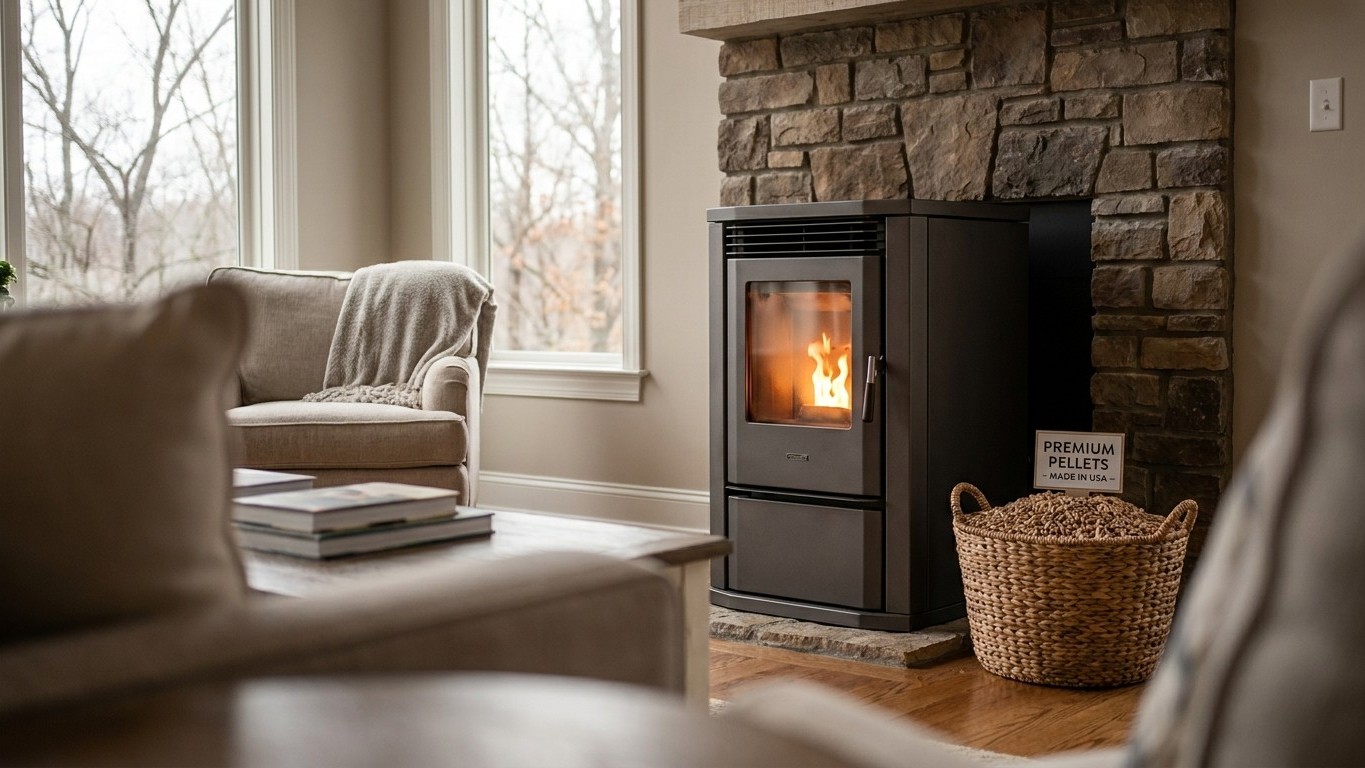

Milwaukee’s reference station logs about 6,450 heating degree days a year, one of the coldest tallies in the Midwest, spread across a heating season that runs roughly eight months. That combination means a pellet stove here isn’t background ambiance. It’s a fuel appliance doing real work, and the numbers below explain how much wood, how much storage space, and how much backup power that work actually requires.
How hard the winter works here

The number that matters is 6,450 heating degree days a year, measured at Milwaukee Mitchell AP under NOAA’s 1991-2020 Climate Normals. That figure adds up, for every day of the year, how far the average temperature fell below 65 F. It’s the closest thing to a fuel bill written in weather data, and at 6,450 it puts southeastern Wisconsin firmly in “this is a heating system” territory rather than “nice to have by the couch.”
But depth and length are two separate questions, and conflating them is how people under-buy pellets. Wisconsin’s heating season isn’t just cold, it’s long. Degree days start climbing in October, when the normal mean temperature drops to 53 F and crosses below the 65 F threshold NOAA uses for the count. The season doesn’t let up until June. That’s eight months where a stove could reasonably be running, not the four or five you’d see in a milder mid-Atlantic state with a similar degree-day total spread over a shorter window.
January carries the heaviest load, with 1,269 degree days on its own, basically a fifth of the annual total packed into one month. December (1,099) and February (1,061) aren’t far behind. November and March still register 737 and 886 respectively, which is why stoves in this climate tend to get lit in October and not fully shut down until well into spring. Compare that to July and August, which together barely crack 14 degree days combined. The season is a long ramp up, a brutal three-month peak, and a slower ramp down, not a short cold snap.
One caution worth repeating: this is a single-station figure, from Milwaukee Mitchell Airport. It’s a reasonable proxy for the southeastern part of the state, but Wisconsin runs from Lake Michigan up to the Northwoods and the Lake Superior shore, and those northern counties run measurably colder for measurably longer. A homeowner near Rhinelander or Ashland should treat 6,450 as a floor, not a ceiling, and expect their own season to demand more.
How many tons a winter takes here
Nobody can hand you a tons-per-winter number that fits your house, and any source that tries is guessing. What you can do is work the math yourself, using the same degree-day logic that drives the figure above.
Start with the units. A standard bag of pellets weighs 40 pounds. A ton is 2,000 pounds, so it takes 50 bags to make one ton. From there, consumption tracks heat demand, meaning it follows the same curve as the degree-day numbers: heavy in December and January, moderate in November and March, nearly nothing in summer. A stove running through Wisconsin’s eight-month season is burning through far more bags than the same stove would in a state with a shorter, milder stretch.
What actually decides your total, though, comes down to three variables specific to your house and your habits:
- How well the house holds heat. Insulation, air sealing, window quality, and even the layout (open floor plan versus closed-off rooms) change how much fuel it takes to hold a temperature.
- Whether the stove is the only heat source or a supplement. A stove backing up a furnace runs on a very different schedule than one carrying the whole load through a January cold snap.
- The setting it runs at. A stove left on a low, steady burn all winter consumes differently than one cycled hard during peak cold and throttled back overnight.
Given those variables, the only estimate worth trusting is the one you generate yourself. Count the bags you buy and burn during your first winter, note roughly how many heating degree days that winter produced compared to the 6,450 annual normal, and you’ve got a baseline specific to your house, not a statewide guess. Every published estimate is a starting point; one measured season on your own hearth beats all of them. For the general math behind bag-to-ton conversions and typical ranges by house size, the national page on how many pellets a winter takes walks through the calculation in more detail.
Buying and storing them in this climate
Timing matters more in Wisconsin than in states with a shorter heating window. Since demand starts climbing in October and doesn’t taper until spring, the smart buying window closes before October, not during it. Pellets are cheapest in the off-season, generally spring and summer, when demand is flat and suppliers are moving warehouse stock rather than scrambling to restock. Wait until the first hard cold snap hits and you’re competing with every other household in the region for the same pallets, often at higher prices and sometimes at empty shelves if a cold spell arrives early or lasts longer than forecast.
Storage is where Wisconsin’s climate creates its own set of problems. Pellets are compressed sawdust, held together by the natural lignin in the wood, no glue involved. That means they’re structurally dependent on staying dry. Introduce moisture and they swell, lose their bind, and crumble into sawdust again, useless in a hopper. Wisconsin summers run humid enough that an uninsulated garage or shed can trap moisture in the air even without a leak, and a concrete floor that sweats during a muggy July night is enough to wick dampness into the bottom layer of a pallet stored directly on it. Winters bring their own version of the same risk: snow tracked in, ice melt dripping off a vehicle, or a poorly sealed roof letting in wind-driven snow near a stack of bags.
The fix isn’t complicated, but it’s non-negotiable in this climate: keep pellets off the floor on a pallet or shelving, keep them away from exterior walls that sweat, and store them somewhere with airflow rather than sealed in a damp corner. None of that requires spending money on price or brand comparisons here, since local pricing varies too much by dealer and delivery distance to quote usefully. What’s worth comparing, wherever you buy, is the price per ton, the only figure that lets you compare a bulk delivery against bagged pallets on equal footing. For a fuller rundown on moisture protection, ventilation, and how to tell degraded pellets from good ones, see the national storage guide and the pellet quality page.
What a winter outage means here
A pellet stove isn’t a wood stove with a hopper bolted on. It runs on electricity, full stop. The auger that feeds pellets into the burn pot, the fan that pushes combustion air through, the blower that circulates heat into the room, all of it needs power. Cut the electricity and the stove goes cold no matter how full the hopper is. That’s the tradeoff for the convenience and steadier burn a pellet stove offers over splitting and stacking cordwood, and it’s worth knowing before, not during, an outage.
Cross that constraint with the degree-day figure above and the stakes shift depending on when the power goes out. An outage in July, sitting near the bottom of the annual degree-day curve, means an evening without ambiance and not much else. An outage in January, sitting at the top of the curve with 1,269 degree days on the books, means a house losing heat during the coldest stretch of the year, with pipes and comfort both on the line within hours, not days.
Wisconsin households mostly aren’t relying on the pellet stove alone when that happens. Federal survey data shows 78% of the state’s homes heat primarily with a furnace, and 71% run on natural gas as the main heating fuel, with another 8% on a steam or hot-water boiler and smaller shares on electricity (14%) or propane (10%). Estimates for central heat pumps and fuel oil or kerosene as primary systems were suppressed in the survey data for having too few responses to publish reliably, not because those systems are absent. What that mix tells you is that most Wisconsin homes running a pellet stove are doing it alongside a gas furnace, which means the furnace, not the stove, typically carries the home through an outage, provided the furnace’s own electrical components have power. That’s the layer worth checking before winter, not the size of a generator or battery. For guidance on backup planning and what actually needs power in a stove during a cold-weather outage, see the national power-cut page, and check your stove’s own appliance label for its specific electrical draw.