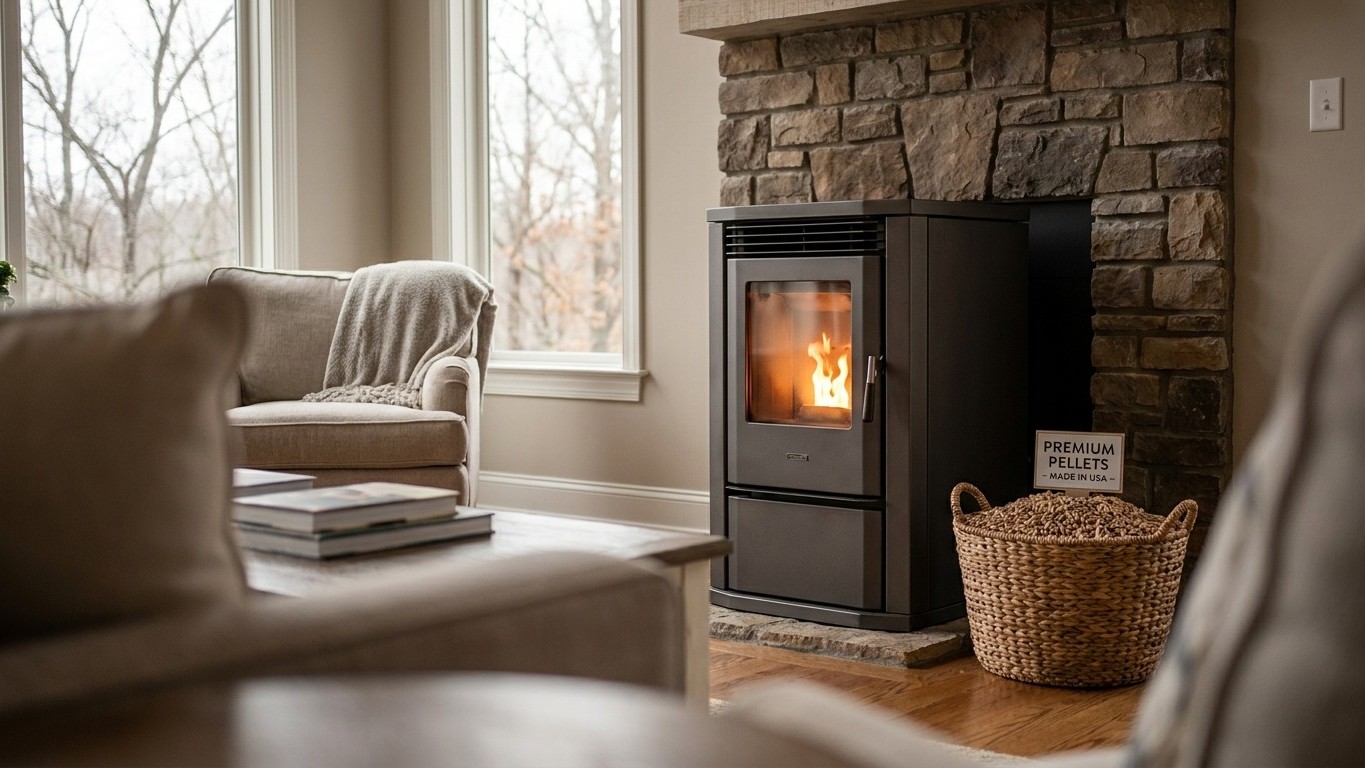

Heating with a pellet stove in Anchorage means feeding it through a season that, by the numbers, never fully lets up. This is not a climate where a stove sits in the corner for ambiance on the coldest nights. It’s a real heating load, likely several tons a winter, and the two things that decide how demanding it gets are the same two things that decide everything else here: how cold it gets, and how long the cold lasts.
How hard the winter works here

At Anchorage Intl AP, the reference station for the region, the National Oceanic and Atmospheric Administration counts about 9,979 heating degree days a year, against a base temperature of 65 F, alongside just 8 cooling degree days. That single number is the whole story of what a pellet stove has to do here. Heating degree days add up, for every day of the year, how far the average temperature fell short of 65 F. A house that needs 9,979 of them burns roughly twice the fuel of a house in a climate with 5,000, all else equal. That’s the yardstick for comparing Anchorage to anywhere else, and for judging whether a winter here is long, brutal, or both.
It’s both. The NOAA monthly data shows the mean temperature at this station stays below 65 F in every month of the year, including July, the warmest month, which still averages only 59.6 F. Demand peaks hard in January, with 1,493 degree days that month alone, then stays heavy through February (1,225) and March (1,215) before easing into a short, mild stretch from June through August. Even August, the calm before fall, still logs 236 degree days. That’s the difference between depth and length: a winter can be brutal and short, or mild and endless, and post the same yearly total. Anchorage’s is both deep and long, which is why a pellet stove doing real heating work here needs to be sized and fed like a primary system, not a backup plan.
None of this is a statewide constant. Anchorage sits on the coast, moderated somewhat by Cook Inlet, while interior towns like Fairbanks run far colder in January and Southeast communities like Juneau run milder and wetter. A household outside the Anchorage bowl, especially north or east into the Mat-Su Valley or up toward the interior, should check its own nearest station’s degree-day normal before assuming this figure applies. The gap between coastal and interior Alaska can be larger than the gap between two entirely different states.
How many tons a winter takes here
Nobody, including the stove manufacturer, can hand a household in Anchorage a tons-per-winter number that fits their house. What’s possible instead is a method for working it out. A bag of pellets weighs 40 pounds, a ton is 50 bags, and how many tons get burned follows directly from how much heat the house actually needs, which is exactly what that 9,979 degree-day figure above measures. More degree days, more fuel, for a given house, at a given setting.
What moves that number from one Anchorage household to the next is not the weather. It’s the house and how it’s run. Three variables do most of the work:
- How well the house holds heat. Insulation, air sealing, window quality, even how exposed the house is to wind off the inlet, all change how much heat has to be replaced.
- Whether the stove is the only heat source or a supplement. A stove carrying the whole load through a January with 1,493 degree days burns far more than one topping off a furnace or boiler on the coldest nights only.
- The setting it runs at. A stove left on a low or moderate burn to hold a steady background temperature uses noticeably less fuel than one run high to push the house warmer, and the difference compounds over a season this long.
Given a factor-of-two swing between two houses on the same street, the only number worth trusting is the one a household measures itself. Buy in manageable batches the first winter, keep a simple tally of bags burned by month, and use that tally as the baseline for every winter after. One measured season in an actual Anchorage house beats any estimate built from national averages or a neighbor’s guess. For the mechanics of that math applied more broadly, see the national page on how many pellets a winter takes.
Buying and storing them in this climate
Because the heating season here never fully closes, there’s no obvious “before winter” window the way there is in a climate with a clean spring-to-fall break. The closest thing to a shoulder season on the degree-day chart is June through August, when demand statewide drops and dealers are least likely to be selling into a supply crunch. Buying in that window, well ahead of the September degree-day climb back to 471 and the sharp jump to 888 in October, means avoiding the scramble that hits every cold-climate market during the first real cold snap of fall, when shelves empty and pellets that were sitting at their lowest price a few weeks earlier suddenly aren’t available at any price.
Storage matters as much as timing in this climate. Pellets are compressed sawdust, held together by the natural lignin in the wood rather than any added glue, which means they have no tolerance for moisture. Anchorage’s climate brings damp, heavy snow and a coastal humidity that a lot of buyers underestimate compared to interior Alaska’s drier cold. A garage floor that sweats with temperature swings, a shed with a dirt floor, or bags stacked directly against a concrete wall can all wick in enough moisture to swell the pellets and break them down into sawdust before they ever reach the hopper. Pallet storage off the floor, a dry interior space, and bags kept sealed until use matter more here than in a drier climate. For the full storage and quality guidance that applies regardless of location, see the national storage page and the pellet quality page. When comparing suppliers, compare by price per ton. It’s the only figure that lines up across bag sizes and packaging.
What a winter outage means here
A pellet stove runs on electricity as much as it runs on pellets. An auger has to turn to feed fuel into the burn pot, and a fan has to move the air, and both of those depend on a wall outlet working. A wood stove will keep burning through a blackout. A pellet stove, cut off from power, goes cold within the hour, no matter how full the hopper is.
Set against a 9,979 degree-day winter, that’s not a minor inconvenience. An outage during the January peak, when the region is racking up nearly 1,500 degree days in a single month, is a heating emergency for any household leaning on the stove as a primary source. The same outage in July, sitting at 174 degree days, is an evening without a fire and not much more.
What most households in the state actually fall back on shapes how serious that gap is. Federal survey data for Alaska shows furnaces as the main heating equipment in 37% of homes and steam or hot-water boilers in another 36%, with natural gas as the leading heating fuel at 57% and fuel oil or kerosene at 24%. Electricity alone is the main heat source in just 13% of households, and the state-level estimates for central heat pumps and propane were too small a sample to publish. That mix means a lot of Anchorage-area homes have a furnace or boiler running on gas or oil as the actual backbone of their heat, with the pellet stove as a supplement, which softens the risk somewhat. A household where the pellet stove carries the full load doesn’t have that cushion. Either way, don’t guess at a generator size or battery capacity from a rule of thumb. Check the stove’s own electrical draw on its rating label, and see the national guide to pellet stoves and power outages for how to plan around it.