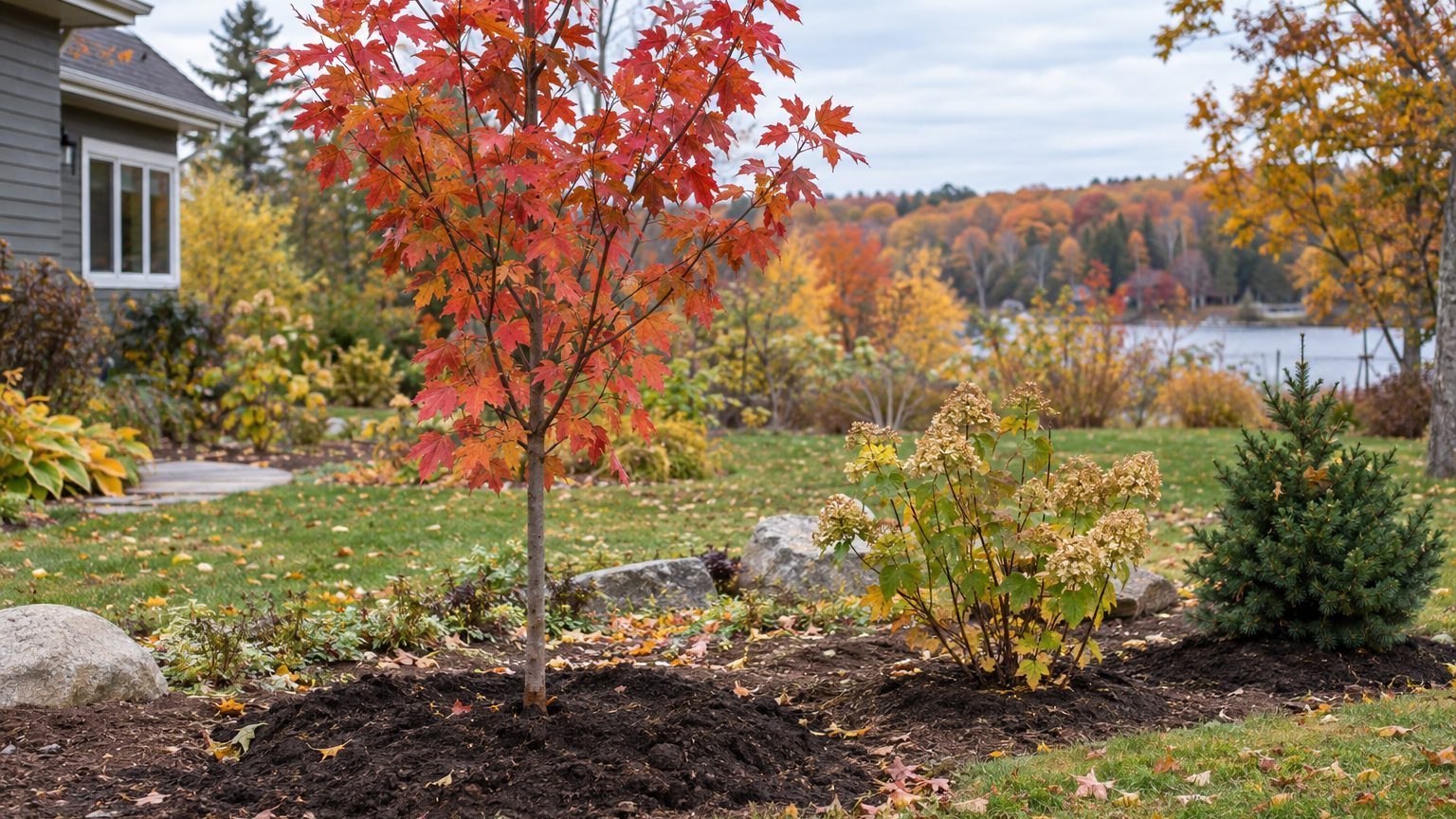

In Vermont, the safe deadline for planting trees and shrubs in fall is six weeks before the first fall frost. For Burlington, that works out to August 22 to September 1. Plants can go in later, because roots keep working until the ground freezes, but every week past that window thins your margin for error. The colder Green Mountains and the Northeast Kingdom reach their deadline sooner. What follows covers how the dates work, what tolerates a late start, and how to protect the plant once it’s in.
The deadline in Vermont
Air temperature gets the attention, but roots answer to the soil. They keep growing as long as the ground is workable and above freezing, and in Vermont that stretches weeks beyond the first frosty night. A shrub planted in early fall is still pushing out fine roots after its neighbors have dropped their leaves. That quiet underground work is what carries it through winter and into the first spring.
Counting back from the first frost
Cornell Cooperative Extension puts the rule this way: “Fall is an excellent time for transplanting, provided you get them to their new home at least 6 weeks before the ground freezes, allowing them time to establish roots before winter dormancy.” That comes from the Orleans County extension office’s fall gardening page. The clock starts at frozen ground, which is hard to predict, so a calendar anchor helps.
The anchor here is the first fall frost. NOAA’s NCEI 1991-2020 Climate Normals for the Burlington station (USW00014742) put the first 32°F freeze between October 3 and October 13, using the 30-70% probability band. Count back six weeks and you get a conservative target: plant between August 22 and September 1, or earlier. If you want the frost dates for your own town, the guide to first and last frost dates in Vermont breaks them down.
Why the real limit falls later
Soil holds summer heat long after the air cools off, so the ground freezes some time after that first frost. The August 22 to September 1 window is therefore a safe target, not a cliff edge. A tree set out a bit past it still has some weeks of root growth, but the cushion shrinks with each week. Treat the window as the date you aim for and the weeks after it as borrowed time.
Burlington is the mild corner
Burlington sits on Lake Champlain, the mildest corner of the state. Gardeners in the Green Mountains and the Northeast Kingdom get substantially shorter seasons, so the first frost arrives earlier there and the deadline moves earlier with it. If you garden at elevation or well north of Lake Champlain, use the Burlington window as the latest possible date, not the middle of it.
Cold is not in question anywhere in Vermont. Burlington’s coldest-month mean daily minimum is 12.9°F (NOAA NCEI 1991-2020 normals), so the ground freezes and the deadline applies statewide. The USDA Plant Hardiness Zone Map 2023 runs from 3b to 5b across the state, built on the average annual extreme minimum temperature. Look up your own address rather than assuming a zone. Gardeners curious how the same arithmetic plays out in another cold state can compare it with how late you can plant trees and shrubs in fall in Minnesota.
What to plant late, and what to wait on
Not every plant handles a late start equally. A container-grown shrub arrives with its root system intact, so it has little to recover from. A balled-and-burlapped tree has lost part of its roots at digging, but it carries a good chunk of soil and tends to settle in well if it is watered. Both do best when the species is fully hardy where you live. Fall planting works because the plant is dormant on top and busy underneath. Anything that struggles with winter itself has no business being a late-season gamble.
The Burlington figure helps here. A coldest-month mean daily minimum of 12.9°F is an average of the cold nights, not the worst one. The USDA zone number is based on the average annual extreme minimum, which is colder than that monthly average. A plant rated for your zone has been tested against the cold you will actually get, not just the typical January night. Plant only what is fully hardy for your own USDA zone in fall, and hold anything borderline until spring.
Evergreens need separate thought. Pines, spruces, arborvitae, rhododendrons and boxwood keep their foliage all winter and keep losing water through it. Cold soil can’t deliver much to replace that loss, so a freshly planted evergreen with a small root system can dry out from the top down. Deciduous trees and shrubs drop their leaves and shut that tap, which is why they tolerate a late start better.
| Plant type | Late-fall outlook | Reason |
|---|---|---|
| Hardy container-grown trees and shrubs | Good | Roots arrive intact and settle in quickly |
| Hardy balled-and-burlapped trees | Good, with steady watering | Some roots were cut at digging, but soil stays attached |
| Deciduous plants that shed their leaves | Good | No foliage to lose water through in winter |
| Borderline-hardy plants for your zone | Wait for spring | Winter cold is the test, and a young root system is a weak defense |
| Evergreens, needled or broadleaf | Risky, plant early in the window or wait | They lose water all winter while roots sit in cold soil |
| Bare-root stock | Spring is the usual season | No soil protecting the roots |
If an evergreen has to go in during fall, aim for the early end of the window and pick a spot sheltered from the wind. A south-facing wall or open lawn with winter sun and wind beating on it is the harshest exposure. The wider approach to siting, digging and aftercare is covered in planting and caring for trees, shrubs and perennials.
Watering and mulch until the ground freezes
A tree planted in fall has one job before winter, and it isn’t growing taller. It is anchoring itself and spreading roots into native soil. Top growth in a newly planted tree is minimal or slow, and whatever energy the plant has goes underground. That is why the first winter is about roots, not growth. Skip heavy pruning and anything that coaxes a flush of tender new shoots. Your help is moisture and insulation.
Water until freeze-up
Leaf drop is not a signal to put the hose away. Roots keep drinking until the ground locks up, and a new planting has a small root ball that dries faster than the surrounding soil. Give it a slow, deep soak, so water moves through the whole root ball and into the soil around it, rather than a quick splash that wets only the surface. Check the soil at root depth before you water again. If a dry spell hits in October, water more often than the calendar would suggest. The last good soak just before the ground freezes is the one that counts most.
Mulch in a ring, not a volcano
Mulch evens out soil moisture and temperature, which is just what a new root system wants. NC State Extension’s Gardener Handbook (chapter 11, Woody Ornamentals) describes it two ways. On weeds: “A 2-inch to 3-inch layer of mulch suppresses most annual weed seeds and makes it easy to hand-pull any that do germinate.” On trees: “Provide a 3-inch layer of mulch to reduce water loss and maintain uniform soil moisture and temperature around roots.” Two purposes, one depth. Keep the layer within that 2-inch to 3-inch range, spread in a wide ring and pulled back from the trunk.
The ring matters as much as the depth. Piling mulch against the trunk in a cone, the so-called volcano, holds moisture against the bark, invites rot and gives mice and voles a sheltered place to nest and chew. Leave a gap of bare soil around the trunk and spread the mulch outward over the root zone. More is not better here. The range above is the whole instruction, and the guide to mulching without killing the plant goes through the common mistakes in more detail.
What goes wrong
The most common failure is simply planting too late for the climate. A tree that goes in after the soil has begun to stiffen has had no time to anchor. The safe window of August 22 to September 1 exists to prevent exactly this, and gardeners in the colder Northeast Kingdom hit the problem earlier than the Burlington dates suggest. A late planting is not doomed, but it needs extra attention to watering and mulch, and it gets no second chance in a hard winter.
Winter burn is the next one. It shows up in late winter or early spring as brown, scorched needles or leaves on evergreens, the result of water leaving foliage faster than frozen roots can supply it. Sun and wind speed the loss. Planting evergreens early, watering them well before freeze-up and siting them out of the harshest wind all reduce the risk.
Then there is heaving. Vermont soil freezes and thaws repeatedly through late fall and early spring, and a shallow or loosely set root ball can be pushed upward a little with each cycle, exposing roots to air. A steady mulch ring cushions those swings, and you should check new plantings after thaws and press the soil back if a root ball has lifted.
A dry fall is the quiet culprit. Sunny weeks without rain can leave a new root ball parched just as the ground is about to lock up, and a plant that enters winter thirsty rarely recovers. If you have missed the window, plant only a hardy deciduous tree or shrub, or hold off until spring after the ground thaws. A plant waiting a few months costs far less than one lost over the winter.
Common questions
Can I still plant in October in Vermont?
It is past the safe window, but not necessarily too late. In Burlington the first 32°F freeze falls between October 3 and October 13 (NOAA NCEI normals), and the ground freezes some time after that. A fully hardy container-grown deciduous plant, watered through any dry spells and mulched, has a fair chance. At higher elevations or in the Northeast Kingdom, the odds drop, because the ground freezes earlier.
Is the first frost the planting deadline?
No. Cornell’s rule counts six weeks back from when the ground freezes, and the ground freezes later than the first frost of the air. Our safe date counts six weeks before the first fall frost, which comes out as August 22 to September 1 for Burlington. That is a conservative target, and the real limit usually falls later.
Do the Burlington dates apply across the whole state?
They apply at the mild end. Burlington benefits from Lake Champlain, while the Green Mountains and the Northeast Kingdom have substantially shorter seasons and an earlier first frost, so their planting deadlines come earlier. For a closer fit, check the frost dates for your own town and the Vermont guides for timing on other garden jobs.
Is spring planting better than fall?
Cornell calls fall “an excellent time” for transplanting, so fall is a good choice when you can hit the window and the plant is fully hardy. Spring suits borderline plants, evergreens and bare-root stock, and any planting that slipped past the window. A spring planting does not need to survive a first winter in the ground, but it will need more watering in its first summer.