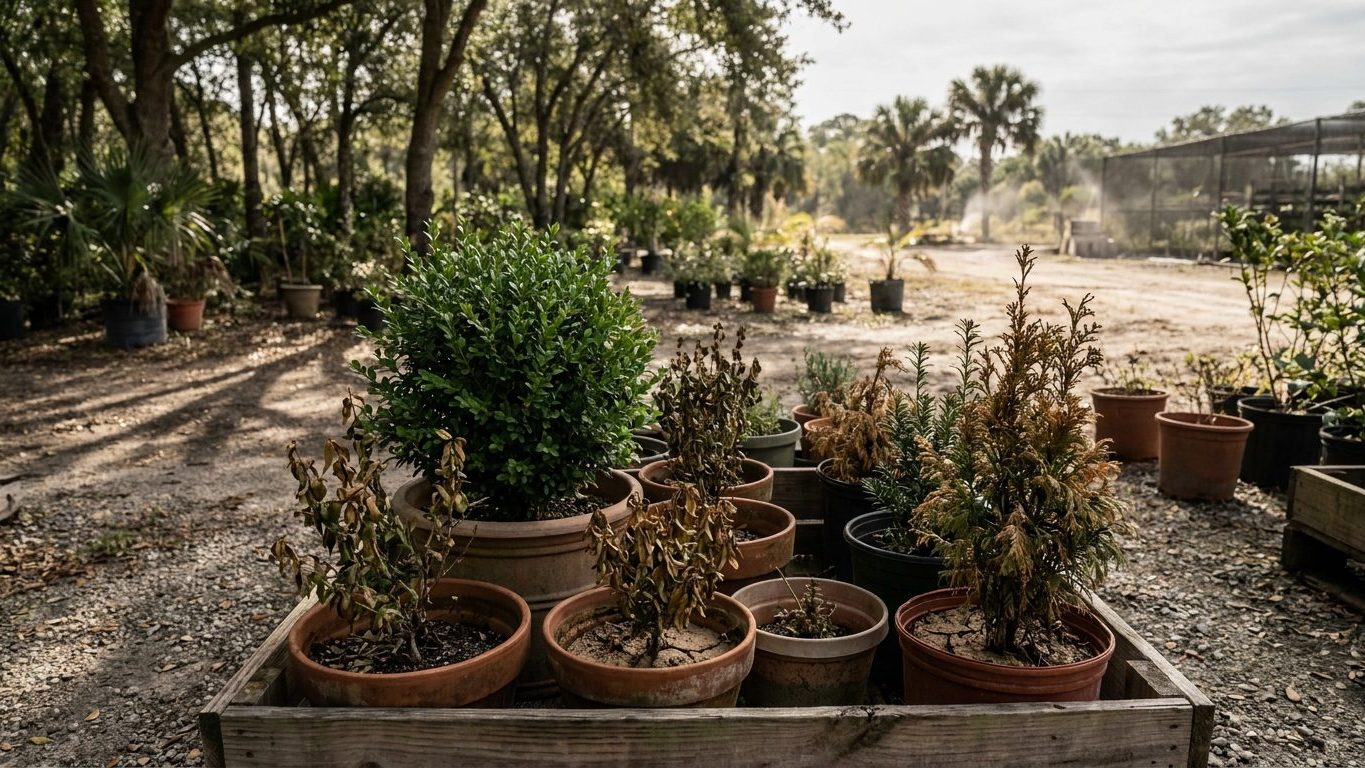

New Hampshire spans USDA zones 3b to 6a (USDA system, 2023 map), and that spread decides which hedge you can plant. Of the 12 hedge species documented on this site, six survive the whole state and six survive only in part of it. None fail everywhere. The six partial ones all drop out in zone 3b, and two of them need zone 6a. Pick from the wrong bucket and you find out the first hard winter. For the broader picture, start with Hedges.
What actually holds in New Hampshire
The six that need a warmer zone
Start with what will not make it, because that is the list nobody hands you at the nursery. Boxwood, yew, inkberry holly, privet, cherry laurel and Leyland cypress are each hardy in only part of the state. Hardiness ranges come from the NC State Extension Gardener Plant Toolbox, checked against New Hampshire’s own 3b-6a range.
| Plant | Survives in zones | Regrows from old wood? |
|---|---|---|
| Boxwood (Buxus sempervirens) | 5a, 5b, 6a | Yes |
| Yew (Taxus x media) | 4a through 6a | Yes |
| Inkberry holly (Ilex glabra) | 4a through 6a | Yes |
| Privet (Ligustrum vulgare) | 4a through 6a | Yes |
| Cherry laurel (Prunus laurocerasus) | 6a only | Yes |
| Leyland cypress (x Hesperotropsis leylandii) | 6a only | No |
Read the zone column as a floor. Boxwood needs 5a or milder, so it is out in 3b, 4a and 4b. Cherry laurel and Leyland cypress sit at the very edge of the state’s range and should be treated as long shots outside 6a.
The six that hold statewide
These survive from 3b through 6a: American hornbeam, winterberry holly (which loses its leaves in winter), eastern red cedar, arborvitae, eastern hemlock and arrowwood viburnum. If you garden somewhere cold, or you don’t know your zone, this is your shopping list.
“Holds” here means survives, and nothing more. A USDA zone is built on one variable, the average annual extreme minimum temperature. It says nothing about wind, snow load or how a plant looks in April, so a plant can be listed as hardy and still come through a bad winter looking rough. Treat the ranges as a survival filter, then judge the site.
Your own zone is a lookup, not a guess. Enter your ZIP code on the USDA map and note the half-zone. New Hampshire’s colder, higher ground can sit a full zone or two away from the mild end, so a neighbor’s boxwood two valleys over tells you little. The same 12 species sort differently elsewhere, as the lists for Hedge Plants for Wisconsin: What Holds, and What Only Looks Hardy and Hedge Plants for Arkansas: What Holds, and What Only Looks Hardy show.
The hedges you can never cut back down
Three of the 12 species cannot regrow from old wood: Leyland cypress, eastern red cedar and arborvitae. Cut into the bare interior and the branch stays bare. Size is a decision you make at planting, not something you correct later with a hard cut.
Arborvitae, red cedar and Leyland cypress
Arborvitae (Thuja occidentalis) grows 6 to 9 inches a year and reaches 4 to 15 feet as a hedge. It cannot regrow from old wood. Prune in late winter before growth starts, or in midsummer, and keep the cuts on green growth. It holds statewide, which is why it fills so many New Hampshire property lines.
Eastern red cedar (Juniperus virginiana) adds 12 to 24 inches a year and makes an 8 to 20 foot screen. It also cannot regrow from old wood, so light cuts only, in late winter. Fast growth plus no rescue pruning means you plan the width from the start.
Leyland cypress is the riskiest of the three. It grows 3 to 4 feet a year toward 15 to 25 feet, it is hardy only in zone 6a, and it cannot regrow from old wood. A tall plant with one narrow zone and no second chance is a poor bet for most yards. Prune it late spring to midsummer, if you plant it at all.
The ones that forgive you
The other nine regrow from old wood. Yew, boxwood, inkberry, privet, cherry laurel, hornbeam, winterberry, hemlock and arrowwood can all be cut hard and come back, which makes them the safer choice if you might neglect the hedge for a few years. Eastern hemlock (Tsuga canadensis) is the standout among tall evergreens. It reaches 10 to 20 feet, grows 12 to 24 inches a year and regrows from old wood, though the guidance is still light cuts in late spring.
Matching the plant to the job
A hedge that survives can still be the wrong hedge. Height, growth rate and pruning schedule decide whether you own a hedge or a weekend project.
Tall privacy screens
For a screen that works in every zone, the choices are hemlock (10 to 20 feet), red cedar (8 to 20 feet) and arborvitae (4 to 15 feet). Of those three, only hemlock regrows from old wood. Leyland cypress reaches 15 to 25 feet, but only in 6a. If you want a tall screen and the freedom to correct mistakes, hemlock is the statewide answer on paper.
Low, formal hedges
Boxwood is the classic: 2 to 6 feet as a hedge, 3 to 6 inches of growth a year, pruned in late spring after the last frost. It needs zone 5a or milder. Yew (3 to 8 feet, 6 to 12 inches a year) works from 4a up and is pruned in late spring after new growth hardens. Inkberry holly, an evergreen, runs 5 to 15 feet at 6 to 12 inches a year and is pruned in late winter while dormant. In 3b, arborvitae is the low evergreen option that still holds.
Softer, deciduous and fast
Arrowwood viburnum (6 to 10 feet, 12 to 24 inches a year) is pruned right after flowering. American hornbeam (6 to 15 feet, about 12 inches a year) gets its cut in midsummer after the first flush. Winterberry holly (5 to 15 feet, 6 to 12 inches a year) is pruned in late winter, and it drops its leaves. Privet moves fastest of the partial-hardy group at 2 to 3 feet a year, reaches 4 to 12 feet, and wants pruning twice a season, spring and midsummer. That is real upkeep.
The ground you are planting into
The soil USDA lists as representative of New Hampshire is the Marlow series, a Spodosol: sandy, acid, strongly leached ground that typically develops under conifers. USDA NRCS records its surface horizon at a pH of about 3.5, which is strongly acid. It is 57 percent sand, 5 percent clay and 38 percent silt, and it drains well.
The listed organic matter, about 85 percent, is not a number your bed will match. That figure describes a natural forest-litter layer on the mapped surface. A cultivated bed will not have it, and neither will a yard where a builder scraped, filled or regraded the lot. The figures come from surface values across 215 mapped components, queried in August 2026, and they describe the state’s representative soil, not your yard.
What the Marlow series does tell you is what the ground here tends to do: run acid and shed water quickly. River bottoms, hill country and filled ground can differ completely. Before buying a single plant, get your own pH and texture from a soil test. UNH Extension at extension.unh.edu is the place to ask about testing and your county’s conditions.
On timing, the reference weather station in NOAA NCEI’s 1991-2020 normals shows the last spring frost between April 16 and April 27 and the first fall frost between October 13 and October 26. Suburban and rural gardens usually see later spring frosts and earlier fall ones, often by one to two weeks, and more at elevation. Check your own county. Every pruning window listed for these plants falls between late winter and midsummer, so late September is a month for planning and site prep, not for shears.
Common questions
What is the hardiest hedge for the coldest parts of New Hampshire?
Six species hold across the whole 3b-6a range. Evergreens: arborvitae, eastern hemlock and eastern red cedar. Deciduous: winterberry holly, arrowwood viburnum and American hornbeam.
Can I grow boxwood in New Hampshire?
Only in zones 5a, 5b and 6a. It is not hardy in 3b, 4a or 4b, so look up your half-zone on the USDA map before you buy.
Can I fix an overgrown arborvitae by cutting it back hard?
No. Arborvitae, eastern red cedar and Leyland cypress do not regrow from old wood, so cutting into bare interior leaves permanent gaps. Trim only green growth, in late winter before growth starts or in midsummer for arborvitae. If it has outgrown the space, replacement is usually the real fix.
Is Leyland cypress worth trying in New Hampshire?
Only in a zone 6a spot. It grows 3 to 4 feet a year toward 15 to 25 feet, and it can never be cut back to size later. Outside 6a, choose one of the six statewide species instead.