
Matching a pepper variety to New Hampshire’s growing season starts with two numbers you can act on: your county’s last frost date and your soil temperature. Sweet peppers and hot peppers both need a long, steady warm stretch to set fruit, and in this state that stretch is bounded on both ends by heat and cold extremes that no seed packet accounts for. Get the transplant timing right, and most varieties sold for northern gardens will ripen before fall frost.
The short answer

The hot end
Manchester’s reference station averages 10.9 days a year at or above 90 F, based on NOAA NCEI Climate Normals covering 1991-2020. That is not a heat wave you get once and forget. It is close to two full weeks scattered across a typical summer, usually clustered in July and August, right when pepper plants are flowering and trying to set their first fruit. Heat at that level does not usually kill a pepper plant, but it can stall it. Flowers drop instead of setting fruit when daytime temperatures push past that 90 F line for several days running, especially if the plant is also under drought stress. A gardener who sees a run of blossoms fall off in mid-July, with no fruit forming behind them, is usually watching this exact mechanism play out.
The cool end
Fruit set fails just as hard at the other end. Nights that drop below 55 F interrupt pollen viability the same way excess heat does, and a pepper plant sitting through a stretch of cool nights will drop blossoms even in perfectly pleasant daytime weather. This is where the numbers get trickier for New Hampshire gardeners, because summer night minimums are not tracked here the way daytime heat is. This site carries the count of hot days for this territory, but it does not carry a figure for how cold your nights typically run in June or in a wet August. Elevation, valley placement, and distance from the coast all shift that number in ways a state-level average cannot capture. The practical move is to watch your own thermometer through the growing season rather than assume a number based on where you sit on the map. A garden at 1,200 feet in the Monadnock region will see cooler nights than one along the Merrimack River valley, even though both fall under the same statewide heat statistics.
When to start seed here
Pepper transplants need 8 to 10 weeks of indoor growing before they go in the ground, according to Utah State University Extension guidance on growing peppers. That window, combined with your local frost date and soil temperature, is what actually decides your seed-starting date, not the calendar month printed on a seed rack. Here is how to build the math for your own address.
- Find your last spring frost date. The Manchester airport station shows a 30 to 70 percent probability band for the last 32 F freeze running from April 16 to April 27, per NOAA NCEI’s 1991-2020 climate normals. That is the reference-city figure, not a guarantee for every yard in the state. Suburban and rural gardens, and anywhere with meaningful elevation, commonly see frost linger one to two weeks past what the airport station records. Check your own county’s extension data or your own frost log before locking in a date.
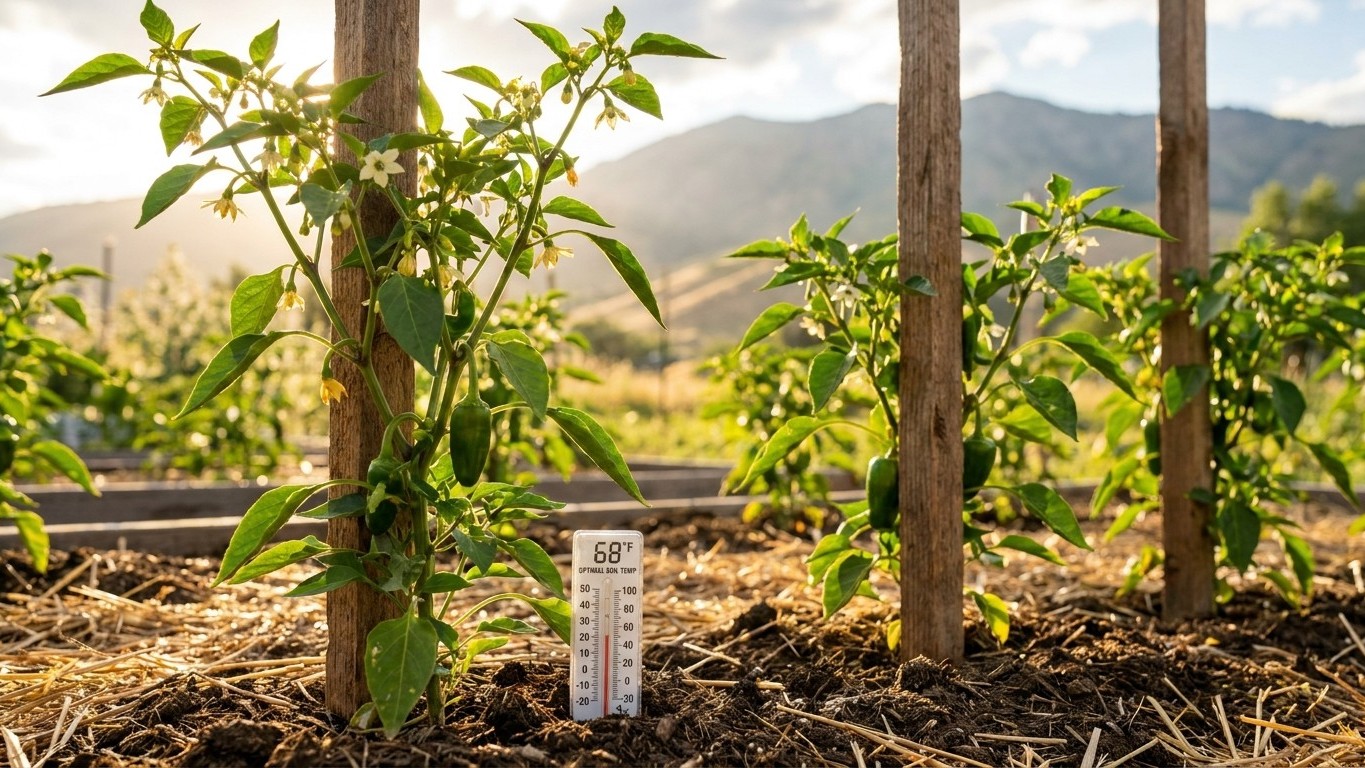
- Add the soil temperature requirement. Peppers should not go into the ground until soil temperature reaches 60 F, regardless of what the calendar says about frost. A frost-free date that arrives during a cold, wet spring does not mean the soil is ready. A simple soil thermometer pushed a few inches into a garden bed on a sunny morning will tell you more than any regional average.
- Set your transplant date as the later of the two. If your local frost typically clears by late April but your soil is slow to warm in a shaded or heavy-clay bed, the soil reading wins. Peppers set out into cool soil sit and sulk for weeks even if the air temperature looks fine.
- Count back 8 to 10 weeks from that transplant date. This is your indoor seed-starting date. If your working transplant date lands in the third week of May, for instance, an 8-week count-back puts seed-starting in the second half of March, and a 10-week count-back moves it into the second week of March.
- Build in a buffer for a slow spring. Because the actual transplant date depends on soil warming as much as frost clearing, a seed-starting date on the earlier end of the 8-to-10-week window gives more flexibility if the ground stays cold longer than expected.
Redo this arithmetic every season using your own observed frost and soil data rather than a fixed date. A count-back built once on an average year will eventually mismatch a spring that runs early or late, and pepper transplants that go out too soon into cold soil rarely catch up to ones started correctly a week or two later.
What goes wrong here
Three failure patterns tied directly to this climate
- Blossom drop during a hot spell. When daytime highs push into the 90s across several of those 10.9 annual days, flowers abort instead of setting fruit. There is no fix for the heat itself, but light afternoon shade cloth over the plants during the worst stretch, along with consistent deep watering so the plant is not also fighting drought stress, keeps the damage to a minimum. New flowers set normally again once temperatures ease.
- Blossom drop during a cool night stretch. A run of nights under 55 F, whenever it happens in your particular yard, produces the same dropped-flower symptom as heat stress, which is why watching your own nighttime lows matters more than trusting a regional average. Row cover pulled over plants in the evening during an unseasonably cool early-summer stretch can buy back a few degrees and protect the flowers already forming.
- Sunscald on exposed fruit. Strong sun combined with heat load can scorch pepper fruit left unshaded by foliage, especially on plants that have lost leaves to disease or pruning. Leaving the natural leaf canopy intact, rather than trimming heavily for airflow, protects developing fruit from direct sun exposure during the hottest weeks.
- Blossom-end rot on developing fruit. Irregular watering, wet spells followed by dry stretches, interferes with calcium uptake and shows up as a dark, sunken patch on the bottom of the fruit. Even, consistent soil moisture through a mulched bed prevents the swings that trigger it far more reliably than any fertilizer applied after the symptom appears.
Common questions
Do all pepper varieties fail at the same heat and cold thresholds?
The fruit-set thresholds, nights below 55 F and days above 90 F, apply broadly to peppers as a crop rather than to one variety over another. Published guidance from Utah State University Extension does not attach a heat rating or a specific day count to individual variety names, so treat all pepper varieties as subject to the same two-sided fruit-set limits until your own observation shows otherwise.
Can I just transplant earlier to dodge the hot days in August?
Transplanting earlier does not move your plant past the hot stretch, since those 10.9 annual days above 90 F land wherever the weather puts them, regardless of your setout date. What earlier transplanting can do, if soil temperature genuinely allows it, is give the plant more time to set an early flush of fruit before any heat spell arrives. Never transplant before soil reaches 60 F just to gain a head start; cold soil stalls plants worse than a late start does.
Is there a hard-freeze date I should plan around instead of the frost date?
This page carries only the 32 F frost probability window published by NOAA NCEI for the Manchester reference station, April 16 to April 27. No separate hard-freeze threshold is published here, so do not substitute a different number from memory or from another source. Track your own local conditions if you want a second data point beyond this frost window.
How do I know if my nights are staying above 55 F without special equipment?
A basic outdoor min-max thermometer, left in the garden bed area overnight, gives you a direct reading of your own low temperature, which is the only reliable way to check this threshold since summer night minimums are not tracked at the state level here. Checking it through the first few weeks after transplanting tells you quickly whether cool nights are a factor worth managing with row cover.