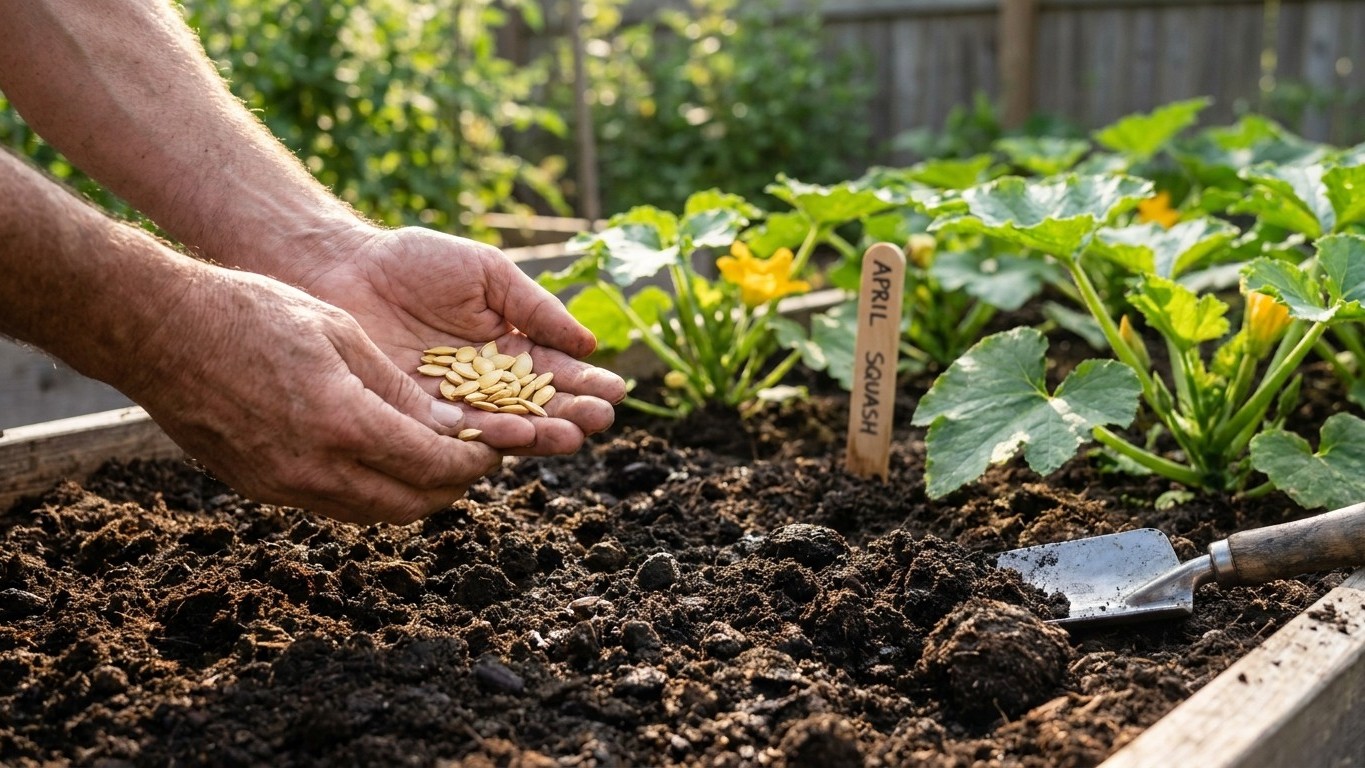

Summer squash goes into New Hampshire gardens once the soil has warmed past 60°F, generally from the third week of May through mid-June, depending on how far a county sits from the coast. That window comes straight from the frost dates for the state’s reference weather station, and it shifts earlier or later depending on where you actually garden.
The short answer for New Hampshire
The reference station used for New Hampshire’s official climate normals, at Manchester, records a last spring frost anywhere between April 16 and April 27, and a first fall frost between October 13 and October 26. Those two figures are not fixed dates. They’re a probability band: the 30 to 70 percent chance of a 32°F freeze, based on three decades of NOAA data. In practice that means there’s still a real chance of frost into late April at that station, and gardens outside the immediate airport area tend to run later in spring and earlier in fall by one to two weeks, sometimes more if you’re at elevation.
Summer squash won’t tolerate frost at any stage, and its seeds barely germinate in cold soil. Direct seeding before soil temperature clears 60°F wastes seed and invites rot. Given the frost window above, and the fact that suburban and rural sites typically run behind the station’s dates, the safer planting stretch for most of the state falls between the last week of May and the second week of June, whether you’re direct seeding or setting out transplants started indoors three to four weeks earlier.
Work backward from the fall side too. Summer squash matures in roughly 50 to 65 days depending on variety. Counting back from an October first frost that could arrive as early as October 13 at the reference station, and possibly a week or so sooner away from it, the last realistic sowing date for a full harvest sits in the first half of July for quicker varieties, earlier for anything on the slower end. That leaves comfortable room for one, sometimes two, plantings if you want a continuous supply rather than a single glut in August.
What will not work here
Two numbers from the state’s climate record explain most of the summer squash failures reported in New Hampshire gardens, and neither is about frost.
Heat load without a watering plan
The state averages 10.9 days a year at or above 90°F. That’s not a lot compared to states farther south, but it’s enough to stress squash plants that are watered on a fixed weekly schedule rather than by actual soil moisture. July, the driest summer month at just 3.3 inches of rain, is exactly when those hot spells tend to cluster. A gardener who waters every Sunday and skips the rest of the week will watch blossoms drop and fruit stop setting the moment a heat run coincides with a dry stretch. Squash roots sit shallow, and a single 90°F day on parched soil does more damage than a week of mild weather ever would.
Season length defeats the slowest varieties in the coldest counties
New Hampshire’s hardiness zone range runs from 3b to 6a, and that spread alone tells you the growing season is not the same length everywhere. In the zone 3b stretches of the North Country, a frost-free window that’s already tight at the reference station shrinks further. A summer squash variety bred for 65 days to maturity, planted even at the earliest safe date, can run into a September or early-October frost before it produces a full harvest. That’s a variety mismatch, not a gardening mistake, and it’s one of the most common reasons northern New Hampshire gardeners report disappointing yields from seed packets that work fine in the Merrimack Valley.
Tight spacing compounds both problems. Squash planted too close traps humidity around the leaves after any of the summer’s rain events, whether that’s a June downpour (the wettest month at 4.04 inches) or a July thunderstorm that dumps its inch in twenty minutes and mostly runs off rather than soaking in. Poor airflow plus surface moisture that lingers is a reliable recipe for powdery mildew by late summer.
What changes across New Hampshire
A hardiness zone range of 3b to 6a is a wide spread for a state this size, and it means there is no single planting date that fits Portsmouth and Pittsburg equally well. The zone 6a areas, generally closer to the coast and the southern tier where the reference station sits, get the longer frost-free season and can push both the spring planting date earlier and the fall harvest later than the state’s own average would suggest. The zone 3b pockets, concentrated in the higher elevations of the White Mountains and the far north, are working with a season that can be a full month shorter on each end.
That gap matters more for summer squash than for many other garden crops, because the plant offers almost no flexibility on cold tolerance. A gardener in a warmer pocket of the state might comfortably direct-seed in late May and still get two plantings in before frost. A gardener at elevation, or in a low-lying frost pocket where cold air pools overnight, may need to wait until early June for the first planting and choose only the fastest-maturing varieties to guarantee a harvest before the season closes.
Elevation itself is worth watching independent of latitude. Two towns at the same zone number can still behave differently if one sits in a valley that traps cold air and the other sits on a slope that drains it away. None of this is something a state-level page can resolve for an individual reader. The right move is to look up your own location on the USDA Plant Hardiness Zone Map rather than assume the state’s midpoint applies to your yard.
Where to check this for your own county
Everything above describes New Hampshire as a whole, built from one reference station’s data and a statewide hardiness range. That’s useful for a general sense of timing, but it is not a substitute for a county-level recommendation, and it was never meant to be.
The University of New Hampshire Cooperative Extension, at extension.unh.edu, is the state’s land-grant extension service and the right next stop for anyone who wants a planting date sharpened to their own county rather than the state average. Two things are worth looking for once you’re there: a local planting calendar that accounts for your specific region’s frost dates rather than the single reference station cited here, and any variety trial results the extension has published for summer squash performance in New Hampshire conditions. Extension offices often track which varieties held up best against the state’s actual mix of short seasons, humid summers and occasional heat spikes, which is exactly the kind of ground-level detail a statewide article can’t provide.
A county recommendation will always outrank a state one, for the simple reason that it’s built on data closer to your actual soil and microclimate. This page is deliberately the state-level view, useful for understanding the overall pattern and the reasoning behind it, but the extension office is where that pattern gets corrected for your particular ten acres or quarter-acre lot.
The Moon calendar is a separate, older custom: see when to plant zucchini by the moon, written as tradition rather than fact.
Checking this against your own garden
Every date in this article is a regional average built from thirty years of weather records at one station. Your own garden will tell you something more precise, and it costs nothing to check.
Start with the soil itself. Push a finger a couple of inches down in the bed where you plan to plant. If it still feels cold and damp rather than merely cool, the soil hasn’t reached the range squash seeds need to germinate reliably, regardless of what the calendar says. Second, watch for the first flush of male flowers on plants already in the ground nearby, whether yours or a neighbor’s. Male flowers typically show up before the females that actually set fruit, and their appearance is a decent signal that the plant has settled into active growth rather than just surviving. Third, look at the first true leaves on any seedlings you’ve started. If they’re slow to unfurl and pale rather than a healthy green, that often points to a microclimate running cooler or shadier than the general county pattern would suggest, whether from a hedge line, a north-facing slope or simply a spot that gets less afternoon sun than you assumed.
None of these three checks require anything beyond your own hands and eyes, and together they’ll tell you more about your particular patch of ground than any regional planting date ever could.