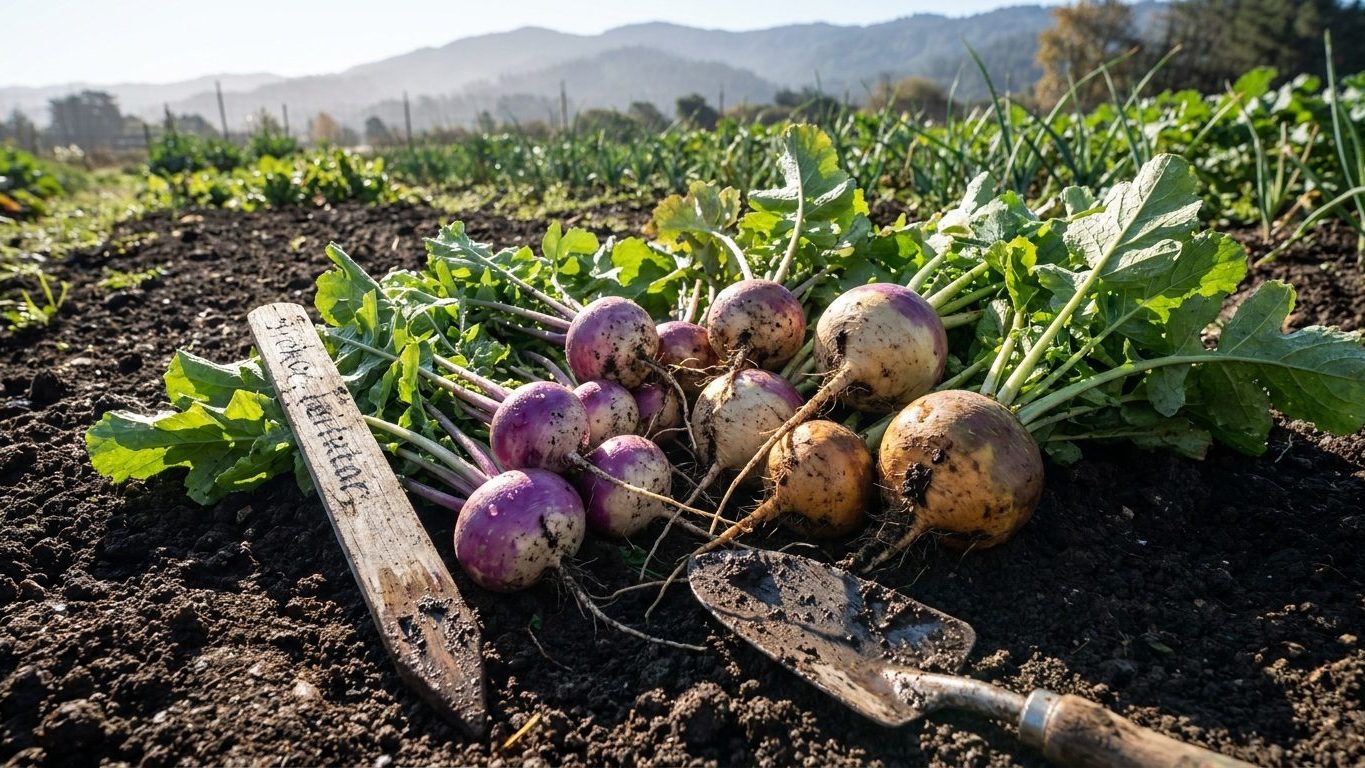

Turnips do well almost anywhere in New Jersey, but the variety that works depends on whether you’re planting for a quick spring bunch or a fall storage crop. Fast 40- to 50-day turnips suit both seasons here; rutabaga only really works as a fall crop, sown in early-to-mid summer for a cool finish before hard frost.
The short answer for New Jersey
New Jersey’s growing season, bookended by a last spring frost of March 29 to April 6 and a first fall frost of November 4 to November 16 at the Newark reference station, gives you roughly seven months of frost-free ground. That’s enough for two turnip crops and exactly one rutabaga crop, planted in the right window.
For turnips, lean on the fast, small-rooted types built for 40 to 50 days: Japanese salad turnips (Hakurei-type), Purple Top White Globe, and Tokyo Cross all finish quickly enough to dodge the worst of the summer heat if you sow them in early spring or, better, in late summer for a fall harvest. Skip the slower storage-style turnips for a spring planting; they run into July heat before they’re done and turn woody and bitter.
Rutabaga is a different animal. American Purple Top rutabaga needs 90 to 100 days of cool, even growth, and it does not tolerate a hot, muggy New Jersey July the way a fast turnip can shrug it off. The only reliable move is sowing by early July so the roots bulk up in September and October and finish just as nights cool toward that November frost window.
Turnip and rutabaga at a glance
| Crop | Days to maturity | Best NJ sowing window | Typical use |
|---|---|---|---|
| Salad/baby turnips (Hakurei-type) | 40-50 | Late March-April; again mid-August | Fresh eating, roasted, raw |
| Purple Top White Globe turnip | 50-60 | Mid-August for fall crop | Storage, boiling, mashing |
| American Purple Top rutabaga | 90-100 | Late June-early July | Winter storage, roasting |
The pattern holds across the state: fast turnips are flexible, rutabaga is a one-shot fall crop that has to be timed backward from frost, not forward from spring.
What will not work here

The single biggest mistake in New Jersey gardens is sowing rutabaga in spring instead of early summer. A spring-sown rutabaga hits its stride right as June and July humidity and heat set in, and the plant bolts or stalls instead of bulking a root. Push the sowing date past mid-July and you run out of runway before the first fall frost, leaving small, fibrous roots that never finish.
Slow storage turnips planted in spring have the same problem in miniature. They need 50 to 60 days, which sounds fine against an April 6 frost date, but that math only works if June stays mild. In practice, New Jersey summers push into the 80s and 90s well before those turnips are ready, and the roots go pithy and hot-tasting under that stress. That’s a variety choice failing against a climate fact, not a fluke.
Humidity does its own damage. New Jersey summers run wet as well as warm, and turnips or rutabaga planted at tight spacing in that kind of air are far more prone to downy mildew and clubroot than the same plants given room to dry out between waterings. Crowded rows also trap flea beetles, which shred young turnip leaves fast enough to stunt a whole planting before it gets going.
Cold is a smaller risk than heat here, but it isn’t zero. The coldest month at the Newark reference station averages a daily minimum of 25.5°F, which most mature Turnips and Rutabaga can sit through under a layer of mulch or soil. What they can’t handle is an unmulched hard freeze arriving early, before the roots have had a chance to size up and toughen their skins. A root pulled too green into a sudden cold snap tends to split or turn glassy in storage, which is really a timing failure dressed up as a weather problem.
What changes across New Jersey
New Jersey is not one garden, and its USDA hardiness range says so plainly: the state spans zone 6a to zone 7b, a two-zone spread that covers a real difference in growing conditions from the northwest hills down to the coastal south. That’s not a small gap. It’s the difference between a garden that sees its first fall frost in early October and one that doesn’t see a frost until well into November.
Gardeners in the higher, colder northwest counties, closer to zone 6a, should plan on both an earlier spring thaw delay and an earlier fall cutoff than the Newark station’s November 4 to November 16 window suggests. That pushes the rutabaga sowing date earlier too, since a shorter fall means less time to bulk roots before frost shuts things down. A gardener there sowing rutabaga on the same July calendar date as someone near the shore is working with noticeably less cushion.
Toward the coast and the milder south, closer to zone 7b, the season stretches longer in both directions. Those gardeners can often push a fall turnip sowing later into August and still beat frost comfortably, and their rutabaga has more slack if a wet spell delays germination.
None of this tells you which zone your own yard sits in, and elevation, tree cover, and distance from the coast all shift things further at a very local scale. The USDA Plant Hardiness Zone Map is the tool built for that question, and it’s worth five minutes to look up your own address rather than assume the state average applies to your specific plot.
Where to check this for your own county
Everything above is a state-level pattern, built from one reference weather station and one statewide hardiness range. Your county is not that station. The Rutgers New Jersey Agricultural Experiment Station runs the state’s Cooperative Extension system, and its county offices are where the state-level answer gets corrected into a local one.
Start at njaes.rutgers.edu and look specifically for two things: a county-level vegetable planting calendar, and any variety trial results for turnips or rutabaga run through that office. Extension programs regularly test root crop varieties in local soil and local weather, and their published results reflect a specific county’s frost dates and disease pressure rather than a statewide range.
A county recommendation beats a state one every time, because it accounts for the microclimate details this article can’t: whether your county tends toward heavier clay that drains slowly and delays spring sowing, whether local flea beetle pressure runs high enough to warrant row cover, and whether the local frost pattern tracks closer to the earlier or later end of that November window.
This page is deliberately the state-level layer, built to explain the mechanism, the season length, and the tradeoffs between fast turnips and slow rutabaga. Treat it as the framework, and treat your county extension office as the source that fills in the exact dates for your own address.
Checking this against your own garden
No frost date on this page beats what your own soil and plants are telling you, and three simple checks will tell you more than any calendar. First, feel the soil before sowing: turnip seed germinates poorly in cold, sticky mud, and if a handful crumbles apart instead of forming a wet ball, the ground has warmed enough for spring sowing to succeed.
Second, watch for the first true leaves, the second set that appears after the small rounded seed leaves. If they show up within about a week of germination and look clean, without shot holes, your plants are moving at a healthy pace and flea beetle pressure is manageable. If those leaves are slow to appear or riddled with holes, that’s a sign this particular bed runs cooler or buggier than the neighborhood average, and it’s worth adjusting your next sowing date earlier or later accordingly.
Third, for rutabaga specifically, watch the shoulders of the root as fall progresses: once they start pushing up and out of the soil surface and the leaves begin to yellow at the edges, the root has finished bulking and is ready to pull, regardless of what the calendar says. A root that pushes up early, well ahead of your expected date, means your particular spot is running warmer than the county average, and next year’s sowing can shift a little later. One that lags means the opposite, and an earlier sowing date next year buys back the time.