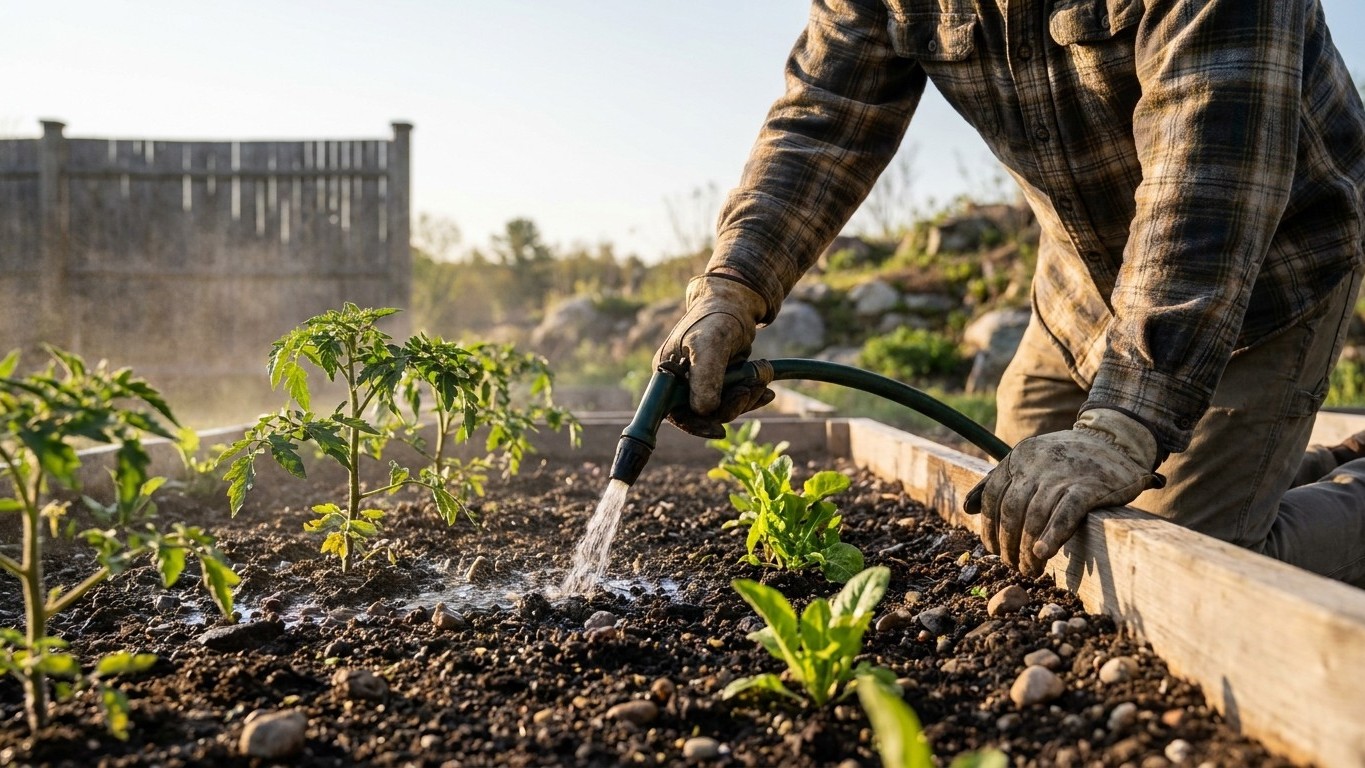

New Hampshire gardens don’t struggle from lack of rain the way a desert climate does, but the heat spikes and soil type on any given property decide whether a hose is optional or mandatory. The short answer: give beds about an inch of water a week, water deeply in the morning at the soil rather than the leaves, and check your water district before you set a schedule, because restrictions vary by town and can appear with little warning during a dry stretch. For a closer look at adjusting your routine when the rain stops altogether, see Watering Through a Dry Spell in New Hampshire.
What the climate asks of you

The single figure that tells you the most about a New Hampshire summer isn’t rainfall, it’s heat. At the Manchester reference station, NOAA’s 1991-2020 Climate Normals put the average at 10.9 days a year reaching 90F or higher. That’s not a lot of days compared to the mid-Atlantic or the South, but it’s enough heat stress to push shallow-rooted plants and container gardens into wilting fast, especially during the stretch when those 90-degree days cluster in July.
What the reference station data does not hand you, town by town, is a precise inch-count for June, July and August rainfall or a soil texture reading for your particular yard. New Hampshire’s terrain runs from sandy outwash along the Merrimack Valley to heavier loam and clay pockets in the Connecticut River lowlands and up into rocky, thin soils at elevation in the White Mountains foothills. That range matters more here than a single statewide rainfall average would, because the same storm that soaks a sandy lot in Concord and drains through by afternoon can leave a clay-heavy yard in the Monadnock region holding water for days. Rather than guess at a number for your soil, dig a spade six inches down after a rain and look: fast-draining, gritty, pale soil is sand: dense, ribbon-like, sticky soil when wet is clay. If you’re gardening in pots rather than in-ground beds, that same soil variability is exactly why container plants need their own approach; see Watering Pots and Containers in New Hampshire for specifics.
Why the growing season length matters too
Frost dates set the boundaries of the watering season as much as heat does. At the Manchester station, the last spring frost falls in the window of April 16 to April 27, and the first fall frost arrives between October 13 and October 26. Suburban and rural properties tend to see that spring frost linger later and the fall frost arrive earlier than the airport reading, often by one to two weeks, and more at elevation. That compresses the real watering season in higher, colder pockets of the state, meaning the same total rainfall gets spread over fewer usable weeks. The USDA Hardiness Zones for New Hampshire span 3b to 6a, a wide range for one small state, and it’s worth checking your own county’s zone and frost window with the UNH Cooperative Extension before you lock in a watering calendar built around a statewide average that won’t match your yard.
How much, how often
The rule gardeners repeat for a reason: water deep and infrequently, not shallow and daily. A quick daily sprinkle wets only the top inch or two of soil, and roots follow the water, staying near the surface where they dry out and bake the moment a hot afternoon hits. A deep soak pushes moisture down six inches or more, which trains roots to grow downward into cooler, more stable soil that holds moisture longer between waterings.
The way to know it’s time to water isn’t a calendar, it’s your soil. Push a finger or a trowel two inches down near the base of the plant. If it’s dry at that depth, water. If it’s still damp, wait a day and check again. This single habit prevents both the underwatering that stresses a garden and the overwatering that rots roots, and it adjusts automatically for whatever soil you actually have, rather than a generic schedule.
Soil texture changes the frequency more than anything else. Sandy soil, common in the Merrimack Valley and other outwash areas, drains fast and holds little water in reserve, so it asks for shorter, more frequent soakings, sometimes every second or third day during a hot stretch. Heavy clay, found in pockets around the Connecticut River lowlands, holds a week’s worth of water in reserve but drowns roots of it’s watered again before that reserve has drained, and it should never be worked or soaked while it’s already wet, since compacted wet clay loses structure for a season. With only 10.9 days a year reaching 90F, most New Hampshire gardens aren’t fighting extreme, sustained heat, but a run of those hot days in July can still dry out a sandy bed within 48 hours.
Here’s a sequence that works across most New Hampshire soils:
- Check soil moisture two inches down at the plant’s base before watering, every time, rather than on a fixed schedule.
- Water early morning, before 9 a.m. if possible, so moisture soaks in before the heat of the day pulls it back out through evaporation.
- Aim the water at the soil, not the foliage, using a soaker hose, drip line, or the base of a watering can nozzle, to avoid fungal disease on wet leaves overnight.
- Deliver roughly one inch of water per week, combined rainfall and irrigation, split into one or two deep sessions rather than daily light ones.
- Adjust the interval to your soil: shorten it to every two to three days on sandy ground, stretch it toward the full week on heavier clay once it has visibly dried at depth.
Restrictions and rules
Watering restrictions in New Hampshire are set locally, not by a single statewide law, and they show up most often during dry summer stretches when a town’s water system or a private well aquifer comes under stress. Rules can range from voluntary requests to cut back, to odd-even day schedules by street address, to outright bans on daytime watering or outdoor use during a declared drought stage. Because these restrictions change from one season to the next and from one water district to the next, the only reliable way to know what applies to your address is to contact your local water utility or town office directly before setting an automatic timer or irrigation schedule.
Private well owners aren’t automatically exempt from local guidance either. Some New Hampshire towns issue drought advisories that apply to well users as well as municipal water customers, especially in years when groundwater levels drop statewide, since a neighborhood of wells draws from the same shared aquifer even without a municipal meter involved.
Given how few 90-degree days the state averages in a typical year, sustained drought stress isn’t the norm here the way it is in warmer states, but dry spells still happen, and they concentrate demand on the same weeks that heat stress hits gardens hardest. That overlap is exactly when a town is most likely to introduce a temporary restriction. Checking with your water district before, rather than after, a dry stretch sets in is the more useful habit, and the UNH Cooperative Extension tracks regional conditions and can point you to the right local contact if you’re not sure which office manages your water supply.
Using less
Cutting water use in a New Hampshire garden isn’t about watering less overall, it’s about losing less of what you already put down. A handful of techniques do most of the work, and they stack, so combining two or three compounds the savings rather than adding them one by one.
- Mulch, two to three inches deep, around beds and shrubs. It slows evaporation from the soil surface dramatically, which matters most on sandy ground that already drains fast, and it also suppresses weeds that would otherwise compete for the same water.
- Drip irrigation or soaker hoses deliver water straight to the root zone instead of spraying it into the air, where wind and heat can carry off a real share of a sprinkler’s output before it ever reaches soil.
- Group plants by water need rather than scattering thirsty annuals among drought-tolerant perennials. A bed where every plant wants the same amount avoids the common trap of overwatering the whole area just to satisfy the neediest one.
- Work organic matter into the soil, compost especially, which helps sandy soil hold moisture longer between waterings and helps heavy clay drain more evenly so it doesn’t stay waterlogged after a storm.
- Rain barrels where local rules allow them capture roof runoff for later use. As a rule of thumb, an inch of rain falling on a thousand square feet of roof works out to roughly 600 gallons of runoff, so even a single storm can fill a barrel fast. Because New Hampshire’s month-to-month summer rainfall isn’t part of the verified figures here, the practical approach is to track your own roof’s runoff after a few storms and size your storage, or number of barrels, to what your driest stretch actually demands rather than to a statewide guess.
None of these replace checking the soil before you water, they just make each watering session go further, which matters most in the years when a town does introduce restrictions and every gallon has to count.
Common questions
How often should I water a vegetable garden in New Hampshire?
Aim for about one inch of water a week total, from rain and irrigation combined, split into one or two deep sessions rather than daily light watering. Adjust the interval based on your soil: sandy ground may need a check every two to three days, while clay can often stretch closer to the full week.
Do I need to water more during a New Hampshire heat wave?
Yes. With the state averaging 10.9 days a year at 90F or above, most gardens aren’t built for sustained heat stress, so a run of hot days can dry sandy soil out within 48 hours. Check soil moisture at two inches deep daily during any stretch of 90-degree weather, rather than sticking to your normal-week schedule.
Are there statewide watering restrictions in New Hampshire?
No single statewide rule applies. Restrictions are set locally by individual towns and water districts, usually during dry stretches, and they can include odd-even day schedules or daytime bans. Contact your local water utility or town office for the rule that applies at your address.
When does the New Hampshire growing season actually start and end?
At the Manchester reference station, the last spring frost typically falls between April 16 and April 27, and the first fall frost between October 13 and October 26. Suburban and rural gardens, and especially those at higher elevation, often see frost arrive one to two weeks earlier in fall and linger later in spring, so check your own county’s frost window with UNH Cooperative Extension rather than relying on the airport figures alone.