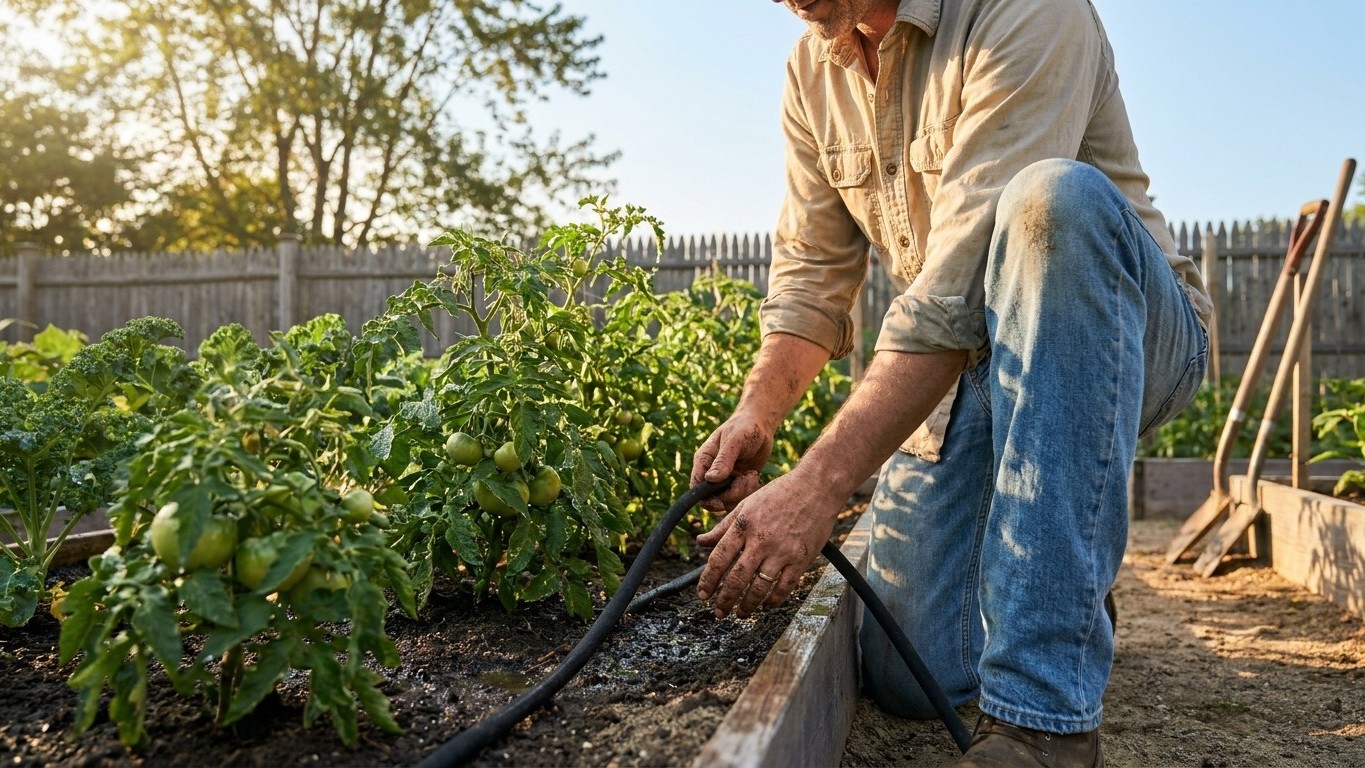

Most gardens in New Hampshire need supplemental watering by mid-July, even though the state gets a respectable 10.7 inches of rain across the whole summer. The gap isn’t in total rainfall, it’s in timing, heat load, and how fast a given soil lets that water go.
What changes here

July, the driest summer month at the reference station, averages 3.3 inches of rain. The same station logs 10.9 days a year at or above 90F. Put those two numbers together and you get the real story: the rain is there on paper, but it doesn’t always fall when the heat is pulling moisture out of the soil fastest.
Do the arithmetic and it gets concrete. A vegetable bed or a young shrub wants roughly an inch of water a week. July has about 4.4 weeks in it, so 3.3 inches spread evenly would give a garden about 0.74 inches a week from the sky alone, assuming it fell evenly, which New England rain rarely does. That leaves a shortfall of roughly a quarter inch a week that the gardener has to supply by hand, and that’s before accounting for the 10.9 days of 90-degree heat that speed up how fast the soil gives that moisture back to the air.
The other piece is soil texture, and it matters because the same 0.74 inches behaves nothing alike depending on what it lands on. A sandy or gravelly bed, common on the glacial till that underlies much of New Hampshire, lets water drain through within hours, so that quarter-inch shortfall shows up fast, sometimes within two or three days of a dry stretch. A heavier clay-loam soil holds onto the same water for the better part of a week, which sounds like an advantage until a thunderstorm dumps an inch in twenty minutes and the ground stays waterlogged at root level for days. Neither soil type gets a free pass in July; they just fail in opposite directions.
How to water when it matters
The method that works here is the same one that works everywhere water is scarce relative to demand: water deeply, infrequently, at the base of the plant, and in the morning. Deep watering pushes moisture down to where roots actually live, six to ten inches for most vegetables and perennials, which trains the root system to grow downward instead of staying shallow and vulnerable. Watering at the base instead of overhead means the leaves stay dry, which matters more in a humid New England summer than in a dry one, since wet foliage after dark is what lets fungal disease take hold. Morning watering gives the sun time to dry any leaves that do get splashed, before the cooler, damper evening air sets in.
None of that works if the gardener is guessing about how dry the soil actually is. A finger pushed two inches down, or a trowel pulled up for a quick look, tells the truth that the surface can’t. Topsoil can look bone dry an hour after a light rain while the root zone below is still soaked, or look fine on top while the plant is quietly wilting six inches down.
- Check the soil two inches down with a finger or trowel before watering at all; if it’s still damp there, skip the day.
- On sandy or well-drained ground, water shorter and more often, roughly every two to three days during a dry July stretch, since the soil can’t hold a full week’s supply.
- On heavier clay-loam ground, water less often but more thoroughly, aiming for a soaking that lasts closer to a week, and never adding more until the top few inches have dried out again.
- Apply about a quarter inch of extra water per week as a starting point during the driest summer month, adjusting up during a run of 90-degree days and down after a heavy rain.
- Water in the early morning, aiming the hose or drip line at the base of the plant rather than over the leaves.
That quarter-inch figure is a starting point, not a rule. A raised bed drains faster than a garden dug into native clay, and a container dries out faster than either. The only way to know for certain is to check the actual soil in front of you, not the average for the region.
What goes wrong
A daily sprinkle that never gets deep
A quick pass with the hose every evening feels responsible, but it wets only the top inch or two of soil. Roots follow the moisture, staying near the surface where the sun bakes them the moment a dry day hits. The plant ends up more fragile than one watered less often but more deeply.
Watering the leaves after dark
New Hampshire summers carry enough humidity that wet foliage overnight is an invitation to fungal disease, powdery mildew and leaf spot in particular. Water that lands on leaves in the evening has no sun left to dry it before nightfall, and it sits there for hours doing nothing but feeding rot.
Trusting a passing shower
A ten-minute summer thunderstorm can look like a soaking and deliver almost nothing to the root zone. It often wets only the top half inch before running off, especially on compacted or sloped ground. The finger test, two inches down, settles the question a glance at wet leaves cannot.
Skipping the mulch
Bare soil under a New Hampshire sun during one of those 90-degree stretches gives back water almost as fast as it’s applied. A two to three inch layer of mulch slows that evaporation and keeps the soil at a more even moisture level between waterings.
Drowning a bed that never had the chance to dry
Given that the region collects a fairly generous 10.7 inches over the whole summer, often in bursts, the costlier mistake here isn’t drought stress, it’s overwatering a clay-heavy bed that’s still holding last week’s rain. Adding more water before the top few inches have dried out suffocates roots as surely as neglect does, just more quietly.
Local help
For soil testing, plant selection suited to New Hampshire conditions, and season-specific guidance, the UNH Cooperative Extension is the state’s land-grant resource. Watering restrictions during dry spells are set locally and change year to year, so check with your own municipal or private water provider before assuming what’s allowed on your street.
Common questions
How much should I water a New Hampshire garden during a dry July?
Aim for the standard one inch a week total, then account for what the sky is already providing. In an average July, that’s roughly 0.74 inches from rainfall, leaving about a quarter inch to supply by hand, more during a run of 90-degree days.
Is New Hampshire generally wet enough that I don’t need to water?
Not reliably. The state averages 10.7 inches of rain across the whole summer, which sounds ample, but it often arrives in uneven bursts rather than steady weekly amounts, leaving gaps during the driest stretch of July.
How do I know if my soil is sandy or clay-heavy?
Squeeze a handful of moist soil. Sandy soil falls apart immediately and drains fast; clay-heavy soil holds its shape and stays wet for days. The finger-and-trowel check at planting depth confirms which pattern your bed follows.
Does mulch really make a difference during a New Hampshire dry spell?
Yes, particularly on the 10.9 days a year that reach 90F. A few inches of mulch slows evaporation from bare soil, which stretches the interval between waterings and reduces the amount of supplemental water needed overall.