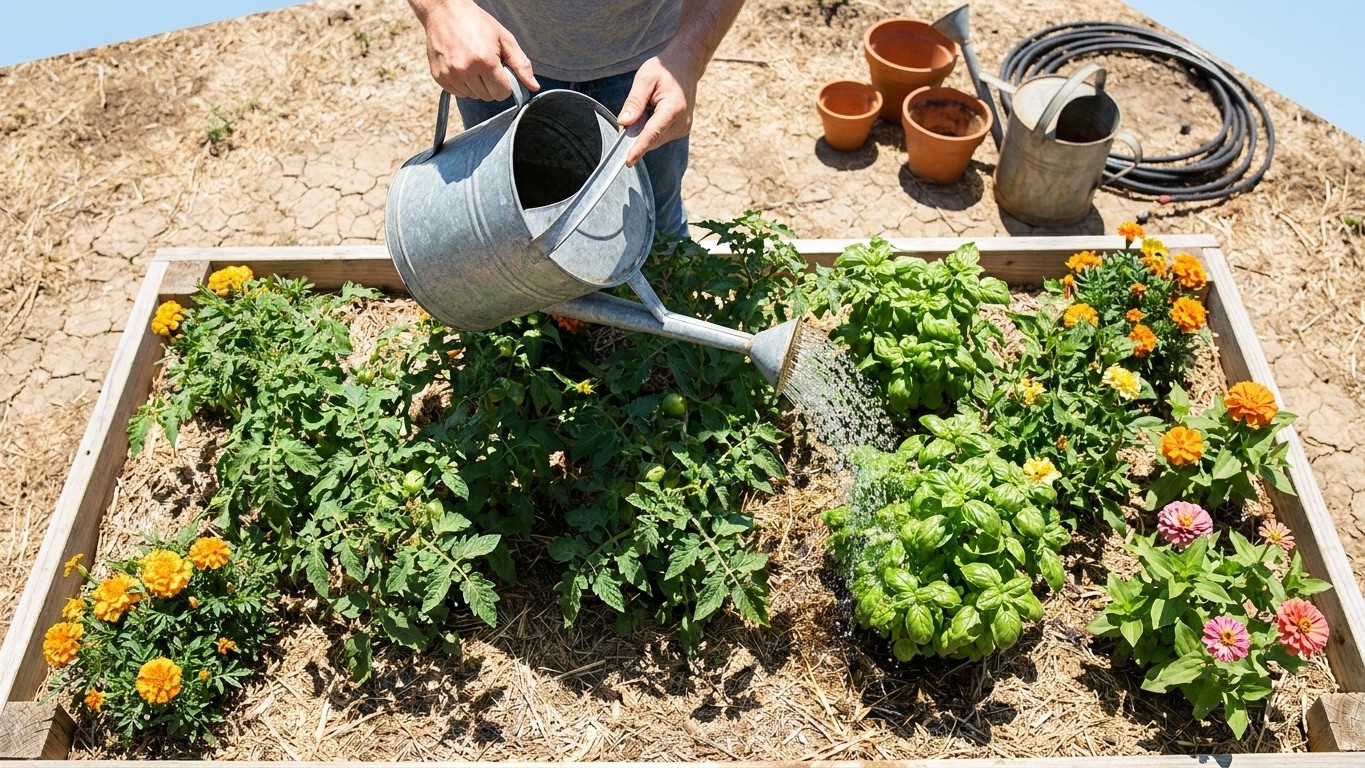

Row crops and raised beds across New Hampshire get by on rain more months than not, but July changes the math. That’s the month watering pots, cans and drip containers earn their keep, and knowing exactly how much the sky delivers versus how much you need to carry is what separates a thriving bed from a stressed one.
What changes here

Two numbers do the heavy lifting for New Hampshire gardeners. The driest summer month, July, brings 3.3 inches of rain on average. And the state sees 10.9 days a year that reach 90F or hotter. Put those together and you get a state that isn’t parched, but where the hottest stretches of summer land right when rainfall is at its thinnest for the season.
A vegetable bed or a bed of annuals wants roughly an inch of water a week to keep growing without stress. Do the arithmetic on that July figure: 3.3 inches over 31 days works out to about 0.75 inch in an average week. That leaves close to a quarter inch of the weekly inch that has to come from a watering can, a hose or a drip line rather than the clouds. It sounds small, but a quarter inch over a 4-by-8 raised bed is more than 13 gallons, water that doesn’t show up unless someone carries it there.
Compare July to the shoulder months, and the pattern gets clearer. June averages 4.04 inches and August comes in at 3.35, both ahead of July’s 3.3. That means the driest stretch of the growing season and the hottest stretch overlap almost exactly, and 10.9 days above 90F is enough evaporation pressure to pull moisture out of topsoil fast, especially loose or sandy ground that drains before roots can use it. On heavier, clay-rich soil that same inch of water sits longer and reaches deeper, but it also means a bed can look dry on the surface while still holding plenty a few inches down, or conversely stay soggy long after a downpour has passed. Either way, the number that matters isn’t the average rainfall on a chart. It’s what’s actually in the ground when you push a finger into it.
How to water when it matters
Deep, infrequent watering at the base of the plant, done in the morning, is the method that fits New Hampshire’s July gap best. Deep watering pushes moisture down where roots actually live, training them to grow downward instead of staying shallow and vulnerable. Watering at the base instead of overhead means the leaves stay dry, which matters more here than it sounds: a humid New England summer already gives fungal disease plenty of help, and wet foliage overnight is an invitation. Morning watering gives plants a full day to take up moisture before the heat of a 90-degree afternoon pulls it back out through evaporation, and it lets any leaves that do get splashed dry off in the sun rather than sitting damp until dusk.
The surface of the soil lies. It can look bone dry an hour after a hard rain, or look damp for days over ground that’s dry two inches down. The only honest test is a finger or a small trowel pushed down about two inches near the root zone. If it comes back dry at that depth, it’s time to water. If it’s still cool and moist, wait, even if the top layer looks parched.
Texture changes the rhythm. Sandy soil, common on New Hampshire’s coastal plain and river terraces, holds water for a short window and drains fast, so it typically needs shorter, more frequent soakings to keep up with a 90-degree stretch. Heavy clay, found through parts of the Merrimack Valley and inland hill country, holds a week’s worth of water but punishes impatience: water it again before it’s actually dried out and roots start to suffocate and rot. A reasonable starting point for most beds here is one deep soak of about an inch, delivered in one sitting, checked against the two-inch finger test every three to four days during July. Treat that as a baseline to adjust, not a fixed rule, since every yard’s drainage is a little different.
- Check soil moisture two inches down with a finger or trowel before deciding to water at all.
- Water at the base of the plant, using a watering can, soaker hose or drip line rather than an overhead sprinkler.
- Water in the morning, before the heat of the day, so moisture soaks in and any wet foliage dries quickly.
- Deliver about one inch in a single deep soak rather than splitting it into small daily doses.
- Recheck at the two-inch depth every three to four days through July, and adjust the interval to your own soil’s drainage.
What goes wrong
A little water every day
Daily sprinkles feel responsible, but they train roots to stay near the surface where the top inch of soil heats up and dries out fastest. Those shallow roots then have nothing to fall back on the moment a hot, dry stretch hits, which is exactly the pattern New Hampshire sees when its 10.9 days above 90F cluster together in July.
Watering leaves at night
An evening pass with the hose that soaks foliage instead of soil sets up a long, damp overnight window with no sun to dry it off. In a humid New England climate, that’s close to an open invitation for fungal disease to take hold on tomatoes, squash and roses alike.
Trusting a passing shower
A quick summer thunderstorm can look like a soaking and deliver almost nothing usable. It might wet only the top half-inch of soil before running off, especially on compacted or clay-heavy ground. The fix is the same two-inch finger check, not a guess based on how hard it rained.
Drowning a bed that never dried
Given how New Hampshire’s summer rainfall stays fairly steady outside of July, the costlier mistake here often runs the other way: watering on schedule regardless of what the ground already holds. On clay soil that’s still damp from the last rain, adding more water before it dries pushes air out of the root zone and invites rot, a slower but just as damaging failure as drought stress.
Skipping the mulch
Bare soil left exposed under a 90-degree sun gives back a good share of whatever water was just applied, straight into the air through evaporation. A two- to three-inch layer of mulch slows that loss and stretches the time between waterings.
Local help
The University of New Hampshire Cooperative Extension offers soil testing, planting guidance and local growing advice suited to the state’s specific conditions. Watering restrictions shift by town and by year depending on drought status, so check with your local water utility or municipal water department for the rules that apply to your address before setting up any automated watering schedule.
Common questions
How often should I water a New Hampshire garden in July?
Start by checking soil moisture two inches down every three to four days, and water deeply only when it’s dry at that depth. Sandy soil will likely need checking more often than clay.
Is New Hampshire’s summer rainfall enough on its own?
Not quite in July. The month averages 3.3 inches, which works out to roughly 0.75 inch in a typical week, short of the one inch most garden beds want.
Does New Hampshire get hot enough to stress plants?
Most summers bring about 10.9 days at or above 90F. That’s not extreme by national standards, but it’s enough heat concentrated in the driest month to accelerate evaporation and increase watering needs.
Should I water containers and raised beds differently than the ground?
Containers dry out faster than garden soil because they hold less volume and drain on all sides, so they typically need checking daily during hot stretches even when in-ground beds only need water every few days.