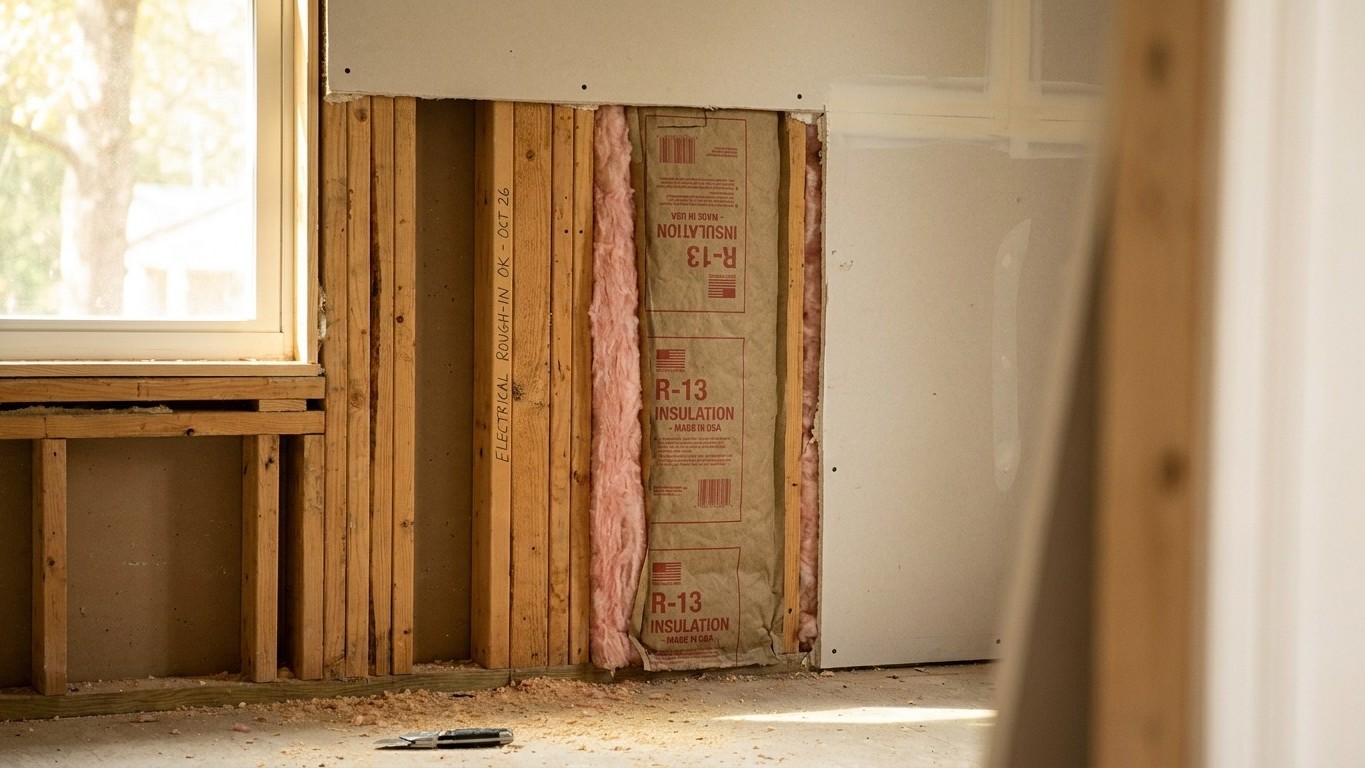

Short answer: in New Jersey, yes. The state’s 21 counties split between IECC climate zones 4A (14 counties) and 5A (7 counties), and neither zone falls under the exception that removes the requirement elsewhere in the country. That’s not true everywhere in the U.S., which is exactly why this question has a different answer depending on where the wall is.
What the code asks for in New Jersey

A wall in New Jersey needs an interior vapor retarder. The 2021 International Residential Code, Section R702.7, states it plainly: a vapor retarder of the class given by Table R702.7(2) “shall be provided on the interior side of frame walls.” That’s the baseline rule for the whole country, and it applies here without the carve-out that lets some warmer states skip it.
That carve-out matters because it’s the only thing that changes the answer state by state. The code lists four exceptions to the interior vapor retarder rule, and the one that gets the most attention nationally reads: “A vapor retarder shall not be required in Climate Zones 1, 2 and 3.” New Jersey has no counties in zones 1, 2, or 3. Fourteen counties sit in zone 4A, seven sit in zone 5A, and both of those zones fall outside the exception. So while a homeowner in Florida or coastal Texas might legitimately build a wall with no interior vapor retarder at all, that option isn’t on the table for a house in Trenton, Newark, or Cape May.
This is worth sitting with for a second, because the split between 4A and 5A counties looks like it should produce two different answers, and in some respects it does (the specific class of retarder assigned by Table R702.7(2) can vary by zone). But on the core question, whether a retarder is required at all, both of New Jersey’s zones land on the same side of the line. A reader in a 4A county and a reader in a 5A county are both under the same basic obligation. That’s genuinely different from a state that spans zone 3 and zone 4, where one part of the state is exempt and the other isn’t.
None of this means a specific reader should go buy a specific product for a specific wall. It means the model code, adopted in some form by New Jersey, defaults to requiring an interior vapor retarder for above-grade frame walls, with exceptions that are narrow and don’t include “I live in a 4A county” or “I live in a 5A county.” What it does include is covered further down. A wall assembled with the wrong vapor control doesn’t announce the mistake with a leak or a stain the next week. It shows up years later, as rot inside a stud cavity nobody’s opened yet.
Why the answer is the opposite in a warm climate
Here’s the part that makes the New Jersey rule make sense instead of feeling arbitrary. In a cold climate, the moisture problem starts inside the house. Heated indoor air holds water vapor, that vapor pushes outward through the wall assembly in winter, and if nothing stops it, it reaches the cold outer sheathing and condenses there. An interior vapor retarder, placed on the warm side of the insulation, intercepts that vapor before it gets to the cold surface. That’s the entire logic behind R702.7, and it’s why a 4A or 5A wall in New Jersey is built with the retarder facing the living space.
Flip the climate, and the vapor drive reverses. In a warm, humid region, the outdoor air is the moist air, and it’s pushing inward through the wall for much of the year, especially where air conditioning keeps interior surfaces cool. Put an impermeable vapor retarder on the interior side of that wall, and you’ve built a cold surface for that inbound moisture to hit, except now it’s trapped between the insulation and an interior finish instead of venting anywhere. The U.S. Department of Energy’s Building America program describes exactly what happens next: “If the wall contains a vapor retarder on the interior side of the insulation, the water vapor will condense on this cool, impermeable surface,” and the result is “ruined insulation, mold, and structural rot of framing members.”
That single sentence is the reason the code doesn’t apply one rule nationwide. It’s not a bureaucratic inconsistency or a state-by-state compromise. It’s a description of which direction the water is actually traveling. In New Jersey’s climate, with real heating seasons in both its zones, the vapor drive runs outward in winter often enough that an interior retarder does its job rather than causing the problem the DOE describes. That’s the mechanism behind the exception for zones 1, 2, and 3, and it’s the mechanism behind why New Jersey doesn’t get that exception.
The three classes, and why the word matters
The code doesn’t ask for “a vapor barrier.” It asks for a vapor retarder of a specific class, and the class is defined by how much moisture the material lets through, measured in perms. Three classes cover the range:
| Class | Example materials | Perm rating |
|---|---|---|
| Class I | Sheet polyethylene, nonperforated aluminum foil | 0.1 perm or less |
| Class II | Kraft-faced fiberglass batts, vapor retarder paint | Above 0.1 up to 1.0 perm |
| Class III | Latex or enamel paint | Above 1.0 up to 10.0 perm |
Polyethylene sheeting is a Class I material, not just “a vapor barrier” in some generic sense, and that distinction is the whole point of the code’s approach. A builder in one zone and a builder in another aren’t disagreeing about whether the wall needs vapor control. They’re working with different assigned classes, because a nearly impermeable Class I sheet does one thing in a heating-dominated climate and a very different thing in a cooling-dominated one.
Here’s a detail most homeowners never connect: ordinary latex paint on interior drywall is a Class III vapor retarder. If a wall has been painted with a standard latex finish, it already has some level of vapor control built in, whether or not anyone thought of it that way. That’s not enough to satisfy every requirement in every assembly, but it’s not nothing either.
One more distinction worth keeping straight: a vapor retarder and an air barrier are not the same thing. A vapor retarder slows the diffusion of water vapor through a material. An air barrier stops bulk air movement, which carries far more moisture than diffusion ever does. Some products do both jobs. Many don’t, and treating one as a substitute for the other is a common and costly mix-up.
Where the rule stops
Even in a zone where the interior vapor retarder is required, the code carves out situations where it isn’t. R702.7 lists these exceptions:
- Basement walls
- The below-grade portion of any wall
- Construction where accumulation, condensation, or freezing of moisture will not damage the materials
- Climate Zones 1, 2, and 3 (the one that doesn’t apply to New Jersey, as covered above)
The basement exception is the one most New Jersey homeowners actually run into, since basements are common across the state’s older and newer housing stock alike. A concrete or masonry foundation wall isn’t like a stud-framed wall drying to one side. It holds groundwater and releases it slowly, sometimes over years, and that moisture needs a path to escape. Seal the interior face with a low-permeance material and that moisture has nowhere to go but into the wood framing, insulation, or finishes built against it. The assembly needs to dry inward, at least to some degree, and an interior vapor retarder built like an above-grade wall’s would work against that. For the specifics of how a basement wall assembly should handle this differently, the basement wall guide on this site covers the detail this page doesn’t.
These exceptions remove an obligation. They don’t prohibit anything. A basement wall that happens to include some vapor control isn’t breaking a rule; it’s simply not required to have it by this section of the code.
Who actually decides, in New Jersey
The 2021 IRC is a model code. What actually governs a specific wall in a specific New Jersey municipality is whatever edition that municipality’s building department has adopted, sometimes amended, sometimes running years behind the national model. That’s true in every state, but it matters more here than in places with a simpler climate story, because New Jersey’s two zones both carry real winters. Newark averages roughly 4,701 heating degree days a year against a 65°F base, a figure that adds up how much and how long indoor heating has to work against the cold outside, plus about 1,270 cooling degree days on the other side of the ledger. That’s a heating demand load, not a temperature reading, and it’s a meaningful one: it points to a heating season that runs long enough for the interior vapor retarder rule to matter in practice, not just on paper.
None of this substitutes for a call to the local building department. The code in force for a given wall is the one that jurisdiction has adopted, and that’s the only source that can answer for a specific project. This page can explain what the rule depends on and why. It can’t tell an individual reader what to install in their own wall, because that decision belongs to the local code official who knows which edition applies, what amendments are in effect, and what exceptions might be relevant to that particular assembly. Getting it wrong doesn’t produce an immediate, visible failure. It produces a wall that looks fine for years while the framing behind the finish quietly rots.