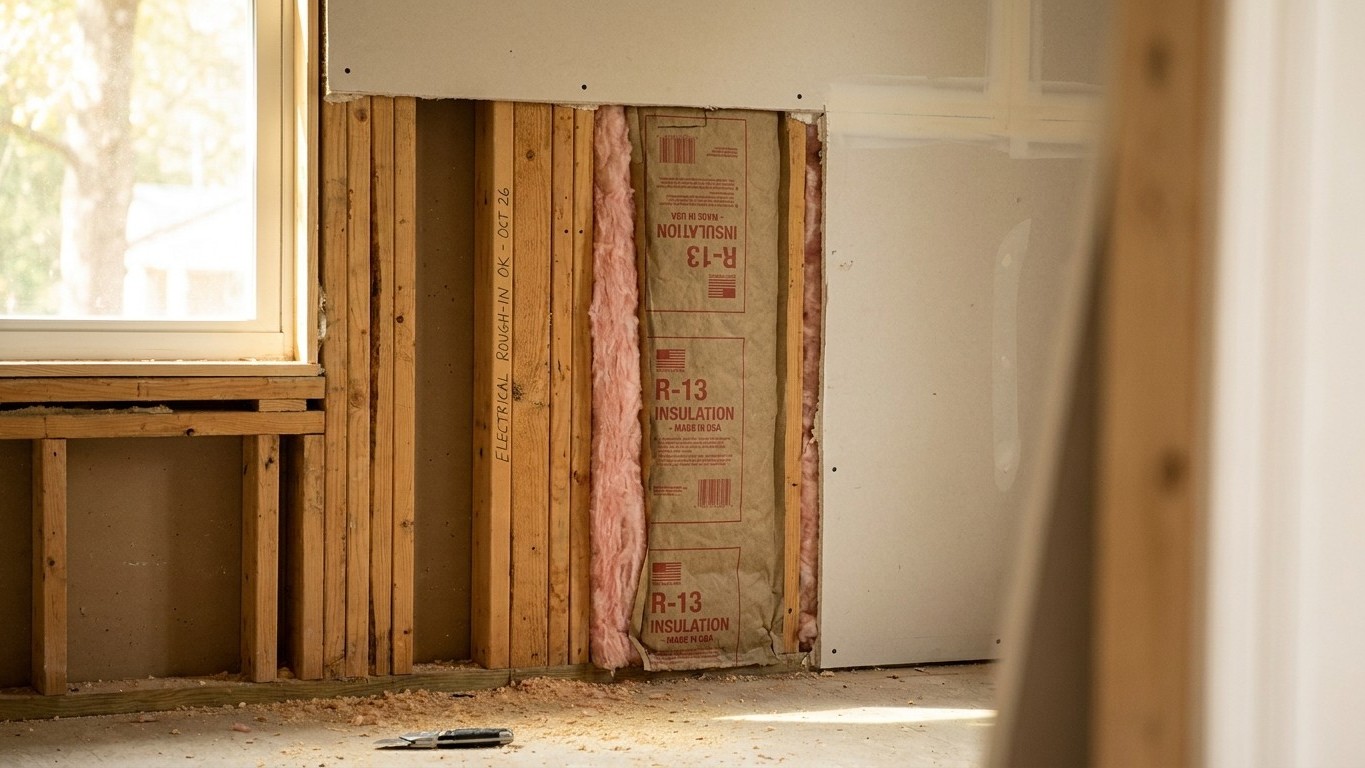

Yes. Under Alberta’s building code, a vapour barrier is required in insulated wall assemblies, and unlike the American model code, that requirement carries no climate-zone exception. The material must limit water vapour permeance to at most 60 ng/(Pa·s·m2), and it has to sit close enough to the side of the wall that’s warm in winter that condensation doesn’t form at design conditions. Calgary’s climate is exactly why this matters.
What the code asks for in Alberta

The rule comes from the National Building Code of Canada, Part 9, Article 9.25.4, which Alberta has adopted (with its own amendments) as the basis for its provincial code. It says a vapour barrier is required in insulated assemblies, and it limits that material’s permeance to no more than 60 ng/(Pa·s·m2). A companion clause, Sentence 9.25.4.3.(2), adds a positioning rule: the barrier has to be close enough to the warm side of the assembly, the interior side in winter, that condensation doesn’t occur at design conditions, no matter what other low-permeance materials the wall also contains and no matter where those sit.
That last part is the piece a lot of homeowners miss. It’s not enough to have a vapour barrier somewhere in the wall. Its position relative to every other layer, including rigid foam, house wrap, or even certain paints, determines whether the assembly actually works the way it’s supposed to.
What makes this different from the American conversation on the same topic is structural, not a matter of degree. The U.S. model code drops the vapour retarder requirement entirely in its three warmest climate zones. The National Building Code doesn’t do that. It applies the same requirement across the country, from the mildest coastal pockets to the coldest interior stretches. There’s no Canadian equivalent of the sentence “not required in Zones 1, 2 and 3” because the Canadian code was never written with that exception in mind.
For a station like Calgary Int’l A, the local climate racks up roughly 4,979 heating degree days below 18 C a year, which places that station in Natural Resources Canada’s climate zone 6. That’s a heating-dominated climate by any measure, and it’s the kind of climate the vapour barrier requirement was built to address in the first place. But a fact worth repeating: this figure describes one weather station, not the whole province. Alberta stretches from the foothills to the northern boreal forest, and a reader checking their own numbers should look up degree days for their own municipality rather than assume Calgary’s figure applies uniformly.
None of this means a vapour barrier is somehow optional to skip or, on the flip side, forbidden in certain assemblies. The requirement exists; what changes from one climate to another is whether an exception removes it for a specific part of the wall, not whether the whole idea is banned. That distinction matters more than it sounds, and it’s the subject of the next section.
Why the answer is the opposite in a warm climate
Alberta’s climate makes this question feel almost mechanical: cold outside, warm and humid inside, moisture wants to move from where it’s plentiful (indoors, in winter) toward where it’s scarce (outdoors, in the cold). A vapour barrier placed near the interior stops that moisture-laden air before it reaches a cold sheathing surface where it would otherwise condense. It’s a straightforward one-way defense against a moisture problem that only moves in one direction.
Flip the climate, though, and the physics flips with it. In a warm, humid region, the outside air carries more moisture than the inside air for much of the year, particularly when air conditioning keeps interior surfaces cool. Moisture there drives inward, not outward. An impermeable layer placed on the interior side of a wall in that kind of climate becomes the cold surface, the exact spot where incoming vapour condenses. Instead of blocking moisture, the barrier traps it inside the wall cavity, against insulation and framing that have nowhere to dry to.
The damage that follows isn’t cosmetic. Trapped moisture ruins insulation’s ability to perform, feeds mould growth, and rots the wood framing members that hold the wall together, all inside a cavity that looks perfectly fine from either side of the drywall or siding. That’s precisely why the U.S. model code removes the vapour retarder requirement in its warmest zones. It isn’t an oversight or a regional discount. It’s a direct response to which direction the water vapour is actually travelling for most of the year in that climate.
Alberta doesn’t have that problem, at least not at the scale that would justify dropping the requirement. The province’s heating season dominates its moisture dynamics for the overwhelming majority of the year, which is why the National Building Code writes one rule for the whole country rather than carving out zone-by-zone exceptions the way the American code does. The direction water travels here is settled enough, for long enough stretches of the year, that a single national rule makes sense in a way it wouldn’t in a climate that swings seasonally between two very different moisture patterns.
The three classes, and why the word matters
Vapour control materials aren’t a single category. They’re classified by how much moisture they let through, measured in perms, and the class matters more than the generic phrase “vapour barrier” suggests.
| Class | Example materials | Perm range |
|---|---|---|
| Class I | Polyethylene sheet, sheet metal, glass | 0.1 perm or less |
| Class II | Kraft-faced batt insulation, some plywoods | greater than 0.1, up to 1.0 perm |
| Class III | Latex paint, gypsum board | greater than 1.0, up to 10.0 perm |
That last row surprises a lot of people. Ordinary latex paint, the kind already on the walls of most Alberta homes, functions as a Class III vapour retarder. It’s not a strong one, but it’s not nothing either, and it’s already there, doing a modest version of the job, whether anyone planned for it or not.
The reason class matters so much is that the disagreement between a builder working in Calgary and a builder working somewhere with a very different climate isn’t about whether to include vapour control. It’s about which class belongs where. Calling a polyethylene sheet simply “a vapour barrier” skips the important detail: it’s a Class I material, at the impermeable end of the scale, and that’s a meaningfully different choice than a Class II or Class III product, even though all three technically qualify as retarders.
One more distinction worth keeping straight: a vapour retarder is not the same thing as an air barrier. They do different jobs, one slowing the diffusion of moisture through a material, the other stopping bulk air movement through gaps and seams, and it’s entirely possible for a single sheet of material to do both. But they’re evaluated separately, and a wall can meet one requirement without meeting the other.
Where the rule stops
The vapour barrier requirement isn’t universal within a building. The code carves out specific exceptions where the general rule doesn’t apply:
- Basement walls
- The below-grade portion of any wall
- Construction where moisture will not damage the materials involved
The basement exception is the one most homeowners actually run into. A poured concrete foundation wall holds moisture and slowly releases it, sometimes for years after the concrete was placed, and that moisture exchange doesn’t stop just because the house is finished and lived in. A basement wall assembly needs the ability to dry toward the interior when conditions call for it. Sealing that wall behind an impermeable interior sheet blocks that drying path entirely, and moisture that would otherwise migrate through and evaporate instead stays trapped against the concrete, the insulation, and any wood framing built against it.
That’s a different problem than the above-grade wall discussed earlier, and it comes with its own set of considerations around insulation placement, moisture management, and drying direction. Readers dealing specifically with a basement assembly should look at the basement wall guide elsewhere on this site rather than apply the above-grade rule to a foundation wall by default.
The third exception, construction where moisture won’t damage the materials, is broader and more situational. It covers assemblies built from materials that simply don’t degrade from moisture exposure the way wood framing or paper-faced insulation does, and it’s the kind of determination a local building official is best positioned to make for a specific project rather than something to assume applies broadly.
Who actually decides, in Alberta
The National Building Code is a model. Provinces adopt it, and some, Alberta included, amend it or run parallel provisions rather than applying the model text word for word. The code actually in force for a specific address is whatever Alberta and the local municipality have adopted, not necessarily the national version described here, and adoption timelines vary, sometimes running years behind the latest model code cycle.
That gap matters more in a province carrying Alberta’s kind of winter. Calgary’s roughly 4,979 heating degree days a year below 18 C is a measure of heating demand, not a temperature reading, and it places the region firmly in a climate zone where the vapour barrier question has real weight rather than being a technicality. A house built with the wrong vapour control assembly for its climate doesn’t announce the problem. There’s no visible sign of trouble on installation day. The wall looks finished, the paint goes on, and everything appears normal for years, sometimes for a decade or more, while moisture works quietly at the framing and insulation behind the drywall.
That delayed failure is exactly why this page stops short of telling any individual reader what to install in their own wall. The right answer depends on the specific assembly, the specific climate zone at that address, and the specific code edition the local building department is currently enforcing. The people equipped to answer that question definitively are the ones at the local building department, working from the code their jurisdiction has actually adopted, not from the model code a website can describe in general terms.