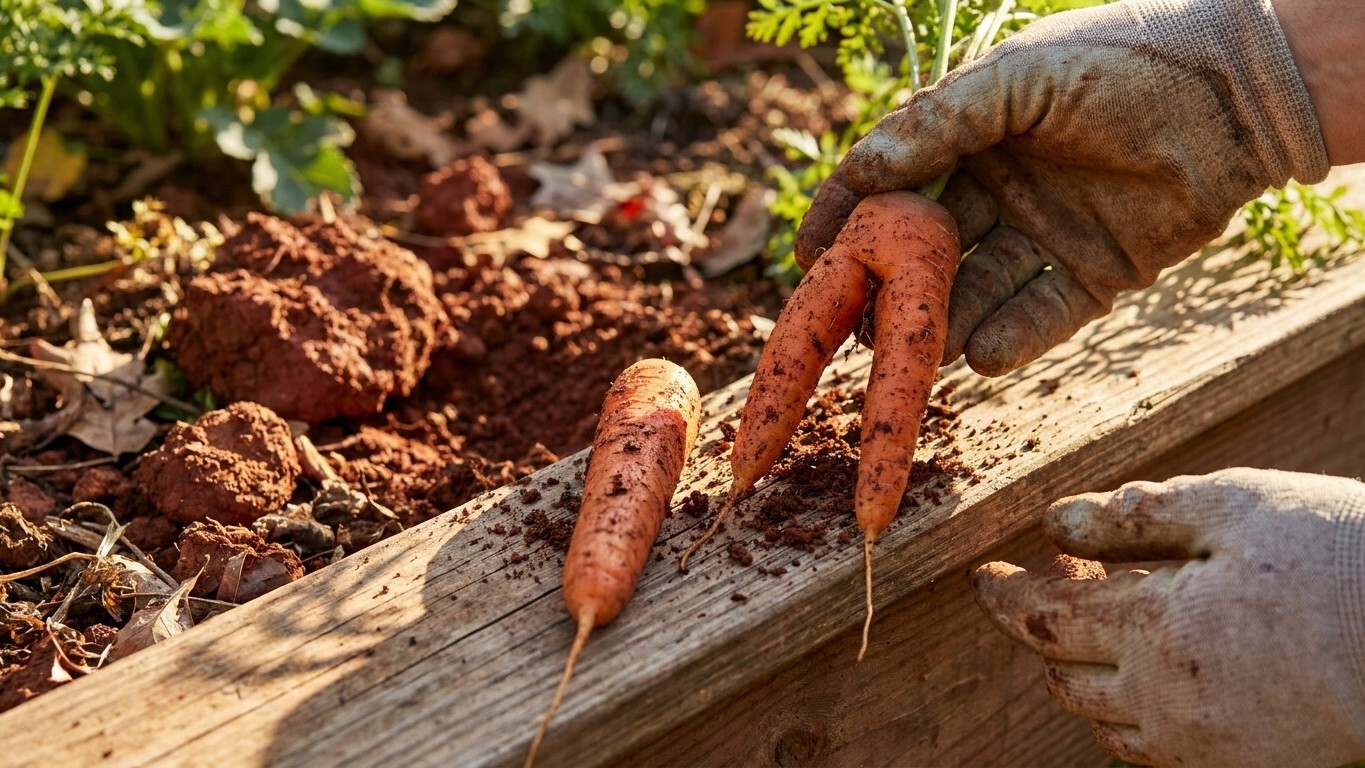

New Jersey’s representative soil, the Downer series, runs 79 percent sand and only 6 percent clay, with a well-drained profile that carrots generally like. Forking is far more a heavy-clay, rocky-ground problem than a sandy one, so on this specific soil type, forked roots are unlikely. The bigger issue in Downer-type ground is thin organic matter, not stones.
The short answer
The USDA lists the Downer series as representative of New Jersey. It’s an Ultisol, which means it’s old, heavily weathered, leached of nutrients over a long stretch of time, and naturally on the acid side. USDA NRCS Soil Data Access puts the surface horizon at 79 percent sand, 6 percent clay, and 15 percent silt, with a pH around 6.3 (slightly acid) and organic matter around 1.2 percent. Drainage class: well drained.
Run those numbers against what a carrot actually wants. Utah State University Extension is blunt about it: carrots need deep, sandy, well-drained soil rich in organic matter, and heavy or rocky ground is what makes the root fork. Downer series soil clears the sand and drainage bar easily, so a garden that genuinely matches this profile is not the kind of dense, clay-heavy ground that twists a taproot into two legs. That’s the good news.
The catch is organic matter. At 1.2 percent, Downer series surface soil is on the lean side, and Utah State’s guidance calls for soil rich in organic matter, not just soil that drains fast. Sand without organic matter dries out quickly and holds fewer nutrients, so even a fork-free carrot can end up stunted or woody if the bed isn’t built up first. The fix here isn’t a raised bed to escape clay, it’s compost worked in before seeding, plus attention to even watering since sandy ground drains fast enough to leave roots gasping between rains.
| Factor | Downer series (surface) | What carrots want |
|---|---|---|
| Sand | 79 percent | High |
| Clay | 6 percent | Low |
| Silt | 15 percent | Moderate to low |
| Drainage | Well drained | Well drained |
| Organic matter | About 1.2 percent | Rich in organic matter |
| pH | About 6.3, slightly acid | Not specified by this source |
None of that settles the question for any one backyard. A state spans hundreds of mapped soil series, and the Downer series describes what’s typical, not what’s under any particular garden. River bottoms tend to carry more silt and clay than upland sand plains. Hillsides erode differently than flat ground. And anywhere a house, driveway, or old foundation has been dug and refilled, the native profile is gone, replaced by whatever mix of subsoil and fill got pushed around during construction. Treat the Downer numbers as a regional tendency, sandy, acid, thin on organic matter, and then go check the dirt actually in front of you.
The test that settles it in your own garden
The only way to know if a carrot will fork in a specific bed is to look at that bed directly. State averages can’t tell you what a builder dumped behind a house forty years ago, or what’s been building up in a raised bed for a decade. A short walk through the plot answers more than any map.
- Dig a hole at least a foot deep in the spot where carrots will go. Carrots need depth to grow straight, so check whether the ground stays loose that far down or turns hard, compacted, or rocky partway through.
- Look at what came out of the hole. Stones, chunks of broken concrete, or dense clumps that don’t crumble are the forking culprits Utah State University Extension points to, rocky or heavy soil that splits a taproot around the obstruction.
- Grab a handful of moist soil and squeeze it. Sandy soil falls apart right away. Clay-heavy soil holds a slick, ribbon-like shape and doesn’t want to let go. Somewhere in between, a soil that holds together loosely but breaks apart with a light poke, is closer to the sandy loam carrots prefer.
- Pour a bucket of water into the hole and time how fast it disappears. Water that vanishes in a few minutes suggests fast drainage, closer to a sandy profile. Water that sits for a long stretch points to heavier, clay-rich ground that will need amending or a raised bed before carrots go in.
- Check for a hardpan or compacted layer by pushing a metal rod or long screwdriver straight down. If it stops hard well before it should, roots will hit that same wall and either stop growing down or push sideways and fork.
None of these steps requires a lab, and none of them replaces one either. A basic soil test through a local extension office adds the pH and nutrient numbers that texture and drainage checks alone can’t give. But for the forking question specifically, depth, stones, and drainage are the three things that matter most, and all three show up in that first hour of digging.
What goes wrong here
Sandy, well-drained ground like the Downer series avoids one classic carrot problem but opens the door to a few others, and a fast-draining bed with thin organic matter has its own list of ways to disappoint a gardener come harvest time.
- Forking in heavy pockets: even within a generally sandy region, low spots or old fill areas can carry more clay and stone than the surrounding ground. Utah State University Extension’s remedy for heavy or rocky soil is plenty of compost worked in, followed by double digging to break up the layer where the root would otherwise hit resistance and split.
- Poor germination during a hot spell: sandy soil heats up and dries out fast on the surface, and carrot seed sitting shallow in that top inch can crust over or dry before it sprouts. Keeping the seedbed consistently damp, not soggy, through germination matters more on sandy ground than on heavier soil that holds moisture longer on its own.
- Splitting from uneven water: a root that grows slowly through a dry stretch and then swells fast after a heavy rain or deep watering can crack along its length. Sandy soil swings between dry and wet faster than clay does, which makes steady, even watering a bigger part of preventing splits here than it would be in a heavier garden.
- Thin, weak growth from low organic matter: at roughly 1.2 percent organic matter in the representative surface soil, there isn’t much reserve of nutrients or moisture-holding material. Working compost into the bed before seeding addresses both the fertility gap and gives the sandy structure something to hold onto between waterings.
Common questions
Does sandy soil guarantee straight carrots?
No. Sandy, well-drained soil removes the main cause of forking that Utah State University Extension describes, heavy or rocky ground, but a bed can still fail for other reasons: buried debris, an old root system left in place, or a hardpan layer a few inches down that the roots hit and split around anyway. Sandy texture helps, it doesn’t guarantee anything.
What does the pH of state soil tell a gardener about their own plot?
Not much on its own. The 6.3 figure is a representative surface reading for the Downer series as mapped by USDA NRCS, not a measurement of any particular garden. A cultivated bed with years of compost, lime, or fertilizer added can sit well away from that number in either direction. A soil test is the only way to know a specific plot’s pH.
Do carrots need a transplant date to count their growing days from?
No. Carrots are sown directly in the ground where they’ll grow; they aren’t started elsewhere and moved. The 70 to 100 day range some growers reference runs from the seeding date, not from any kind of transplant, because there is no transplant step in growing this root.
Is a raised bed necessary in New Jersey because of the state soil?
Not based on the Downer series numbers alone. That representative soil is sandy and well drained, the opposite of the dense, waterlogged ground that usually pushes gardeners toward raised beds. A raised bed becomes the answer when a specific garden’s own dig-and-squeeze test turns up heavy clay, shallow soil over rock, or standing water, not because of a statewide average.