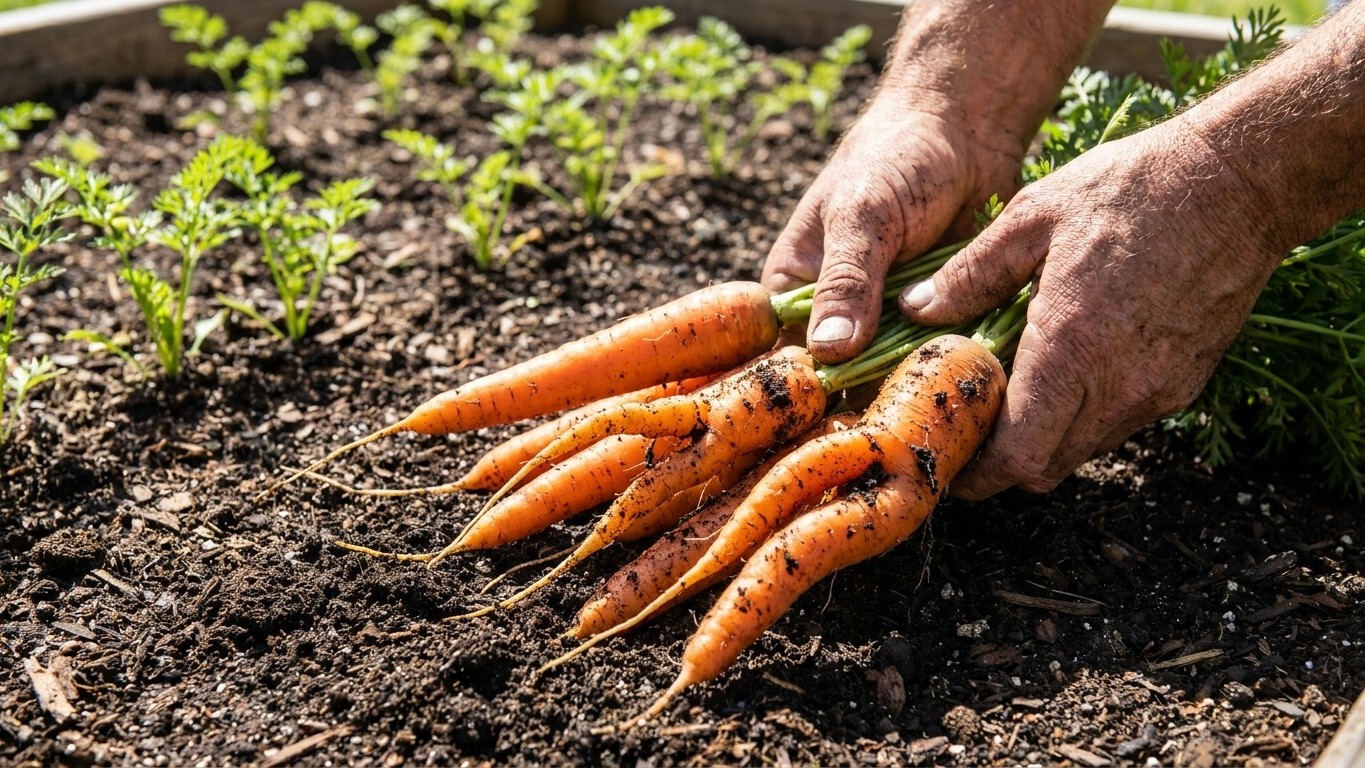

New Jersey gardeners put carrot seed straight into the ground while the soil is still cool, well ahead of the last frost, because this root crop handles cold far better than heat. There’s no transplanting involved; count on 70 to 100 days from seeding to harvest, depending on variety, according to Utah State University Extension. Timing only solves half the puzzle. The other half is what’s under your boots, and New Jersey’s representative soil happens to land close to what a carrot actually wants.
The short answer
The soil that USDA NRCS lists as representative of New Jersey is the Downer series, an Ultisol, one of those old, heavily weathered, leached soils that runs naturally acid and short on nutrients. Sampled at the surface horizon across 133 mapped components, Downer comes in at 79 percent sand, 6 percent clay, and 15 percent silt, with a pH around 6.3 (slightly acid) and organic matter around 1.2 percent. It drains well. Those numbers come from USDA NRCS Soil Data Access, part of the agency’s State Soils program.
Set that against what Utah State University Extension says a carrot needs: deep, sandy, well-drained soil rich in organic matter. Heavy or rocky ground makes the root fork instead of growing straight. On paper, Downer’s sand-heavy, well-drained profile is close to ideal, and forking from compacted clay shouldn’t be the first worry for a garden that resembles this soil. The organic matter figure, though, sits low at 1.2 percent, well under what a vegetable bed wants for feeding a hungry root crop through a 70-to-100-day season. That’s a fertility gap, not a forking problem, and it’s fixed the same way either way: work in compost before you sow.
Here’s the catch that matters more than any of those percentages. A state the size of New Jersey spans hundreds of mapped soil series, and Downer is simply the one USDA singles out as representative, not a description of any one backyard. A lot sitting near a river bottom, a plot on hill ground in the northwest counties, or a yard where a builder scraped and refilled the topsoil years back can all sit nowhere near these numbers. Treat this section as a starting point for what the region’s ground tends to do, hold water or shed it, run acid or stay closer to neutral, not as a diagnosis of your particular bed.
If your garden turns out heavier than Downer, with more clay than 6 percent and water that sits rather than drains, the fix Utah State University Extension points to is straightforward: work in plenty of compost and double dig the bed to loosen it a full spade’s depth, or skip the wrestling match entirely and build a raised bed filled with a lighter mix. Either route gets a carrot the loose, deep run it needs to grow straight instead of twisted around a rock or a clay lens.
The test that settles it in your own garden
Soil maps describe the county. They don’t describe your carrot bed. A short dig-and-feel check takes fifteen minutes and tells you more than any series name will.
- Dig a hole at least a foot deep where you plan to sow. Look at how far down the soil stays loose and workable before you hit a hardpan layer, a clay seam, or a shelf of rock and gravel.
- Pull out any stones you turn up as you dig. A bed full of pebbles is exactly the kind of obstruction that forks a carrot root, whatever the county soil map says.
- Grab a handful of moist soil from that hole and squeeze it. Sand falls apart and won’t hold a shape. Clay balls up tight and holds a ribbon when you press it between your fingers. Loam does a bit of both, crumbling into loose clumps.
- Refill the hole partway with water and watch what happens over the next hour. Water that vanishes within a few minutes points to fast, sandy drainage. Water that’s still sitting there after an hour points to a heavier, slower-draining soil that will need amending or raising before carrots go in.
- Repeat the dig in two or three spots around the bed. Soil in one yard, even one row, can shift from sandy to clay-heavy over a few feet, especially anywhere fill dirt was brought in.
What goes wrong here
New Jersey’s climate and ground create a specific set of carrot problems, and each one has a known fix.
- Forking in heavy ground. A carrot root splits or twists around anything it can’t push through, whether that’s compacted clay, a buried rock, or a chunk of undecomposed debris. Utah State University Extension’s answer is direct: work in generous compost and double dig the bed, or move the crop into a raised bed with a lighter fill so the root has a straight, open run down.
- Poor germination during a hot stretch. Carrot seed is slow to sprout under the best conditions, and a stretch of hot, drying weather on bare soil can leave a row spotty or empty. Keeping the top inch of soil consistently damp until seedlings show, and shading the row lightly with a board or light mulch during a heat spike, keeps the seedbed from crusting over and locking seedlings out.
- Splitting from uneven watering. A dry stretch followed by a heavy soaking swells the root faster than the skin can stretch, and it splits. A steady watering routine, backed by a couple inches of mulch to even out soil moisture between rains, keeps that swing from happening in the first place.
Common questions
Can I still grow straight carrots in New Jersey’s clay-heavy spots?
Yes, but not by picking a different variety. Utah State University Extension’s answer to heavy or rocky soil is to amend it with compost and double dig the bed, or build a raised bed with a lighter fill so the root isn’t fighting compacted ground on the way down.
Is the Downer series pH the pH of my garden?
No. That 6.3 figure is the surface horizon reading USDA NRCS recorded across the mapped components of the Downer series, the soil listed as representative of the state, not a measurement of any individual yard. A home soil test is the only way to know your bed’s actual pH.
Do carrots need deep soil even in a raised bed?
Yes. Whatever the growing method, carrots want loose, deep, obstruction-free soil to grow a straight root. A raised bed works precisely because you control the depth and texture of the fill instead of fighting whatever is native to the site.
How long from seeding to harvest should I plan for?
Utah State University Extension puts carrots at 70 to 100 days from seeding to harvest, depending on variety. Since carrots are sown directly and never transplanted, that clock starts the day seed goes into the ground, not from any later date.